Best cigarette smell remover for car: What works?
The best cigarette smell remover for a car depends on where the odor sits: use an ozone or chlorine dioxide treatment for lingering air and HVAC odor, an upholstery cleaner or enzyme spray for fabric, and an activated-carbon absorbent for light cabin smell. Pick the wrong type, and you waste money while the smoke odor keeps coming back. This guide ranks the options by what they actually fix, including air, fabric, vents, and old residue. In most cases, the practical order is deep-treatment fogger or ozone for severe embedded smoke, spray for localized fabric spots, and charcoal or gel for ongoing maintenance.
Cigarette odor comparison table

The trade-off is simple: sprays act fast on exposed surfaces, foggers reach deeper into the cabin, and absorbers work slowly as maintenance tools. None of them do the same job. A good purchase depends on whether the odor is in the air, soaked into fibers, or trapped in the HVAC path.
| Product type | What it can fix | Best use case | Repeat treatment | Main limit |
|---|---|---|---|---|
| Chlorine dioxide fogger | Air, upholstery, carpet, vents, crevices | Deep-penetration odor treatment after smoke has settled | A fogger treatment is often used more than once for heavy smoke. | Vehicle must be ventilated after use |
| Smoke odor eliminator spray | Fabrics and air, with direct contact | Fast spot treatment for visible surfaces and quick refreshes | May need multiple applications | Limited reach into padding and ductwork |
| Activated charcoal bag | General cabin odor in the air | Passive odor absorption for light smell and upkeep | Replace or recharge periodically | Does not clean embedded residue |
| Odor eliminating gel | General cabin odor in the air | Continuous cabin deodorizing for maintenance | A common rule of thumb is every 30-60 days. | Not enough for severe smoke |
| Ozone generator | Deep-set odor in air, fabrics, and vents | Severe lingering smoke when the car can sit empty | Sometimes repeated on stubborn cases | Requires strict vacancy and ventilation |
What each product type actually treats
Smoke odor spreads across several surfaces. It clings to upholstery and carpet fibers, sinks into the headliner, and hides in vents and the AC system. Surface-only products can reduce the smell you notice first, but they often leave the source untouched.
That is why a cabin can smell better for a day, then the odor returns with the first blast of the fan. The treatment may have touched the air. It did not fix the source in the fabric or ductwork.
Repeat-treatment frequency and use case
One pass is realistic for a light odor in a clean cabin. It is far less realistic for heavy smoke contamination, especially when the seats, carpet, and HVAC system all hold residue. Budget for a second round if the odor has been present for weeks or months.
For ongoing control, activated charcoal bags and odor gels fit the maintenance role. They are not the right first move for a strong smoke problem, but they can keep a cleaned cabin from drifting back toward stale odor.
Which product works best for your car?
The best choice changes with odor severity and where the smell shows up. Light cabin odor usually calls for absorption or a quick spray. Moderate smoke in fabric and vents usually needs a stronger neutralizer plus direct cleaning. Heavy, long-settled smoke often needs a fogger or ozone treatment after the interior is cleaned.
Light odor in the cabin
If the smell is faint and mostly in the air, start with an activated charcoal bag or a gel. Activated charcoal bags are a natural option for light odor control, and some are marketed as rechargeable in sunlight.
Baking soda is the budget pick for general odor absorption, and some baking soda deodorizers are marketed for extended freshness. That fits light cabin smell, not smoke baked into cloth or foam.
Moderate odor in fabrics and vents
When the smell is stronger, move to direct-contact treatment. Upholstery and carpet fibers are primary odor-absorbing surfaces, so they need direct cleaning before deodorizing will hold. If the headliner smells stale, apply only a gentle product there; it is delicate and can stain or sag if soaked.
Smoke odor eliminator spray fits this tier better than a passive absorbent. These sprays can help on fabrics and in the air, but they may need multiple applications.
Heavy, long-settled smoke odor
For heavy smoke, the problem is usually spread across several zones at once. That includes seats, carpet, the headliner, and the car vents and AC system, which are often missed by surface-only products. This is where foggers and ozone become relevant, provided the cabin is cleaned first.
Foggers are often used for smoke and deep odors. Chlorine dioxide fogger kits are marketed for stronger odor elimination rather than masking. Those claims fit deep odor treatment, not a quick refresh.
Suppose a sedan still smells like smoke two days after a quick wipe-down and spray. If the odor returns when the fan comes on, the vents are part of the problem. A fogger or ozone treatment makes more sense than another scented spray.
Chlorine dioxide fogger vs spray
Foggers and sprays are not interchangeable. A fogger is built for broader reach and deeper penetration, while a spray is a fast spot treatment for exposed surfaces. If the odor sits in upholstery, vents, and crevices, a fogger has the better chance of reaching it.
| Comparison point | Chlorine dioxide fogger | Smoke odor eliminator spray |
|---|---|---|
| Reach | Broad cabin coverage | Targeted, direct contact |
| Best for | Embedded odor in upholstery, carpet, vents | Quick refresh of air and fabrics |
| Repeat use | Sometimes needed for heavy smoke | May need multiple applications |
| Safety step | Requires ventilation after use | Still needs airflow, but less strict than fogging |
Deep-penetration treatment for upholstery and vents
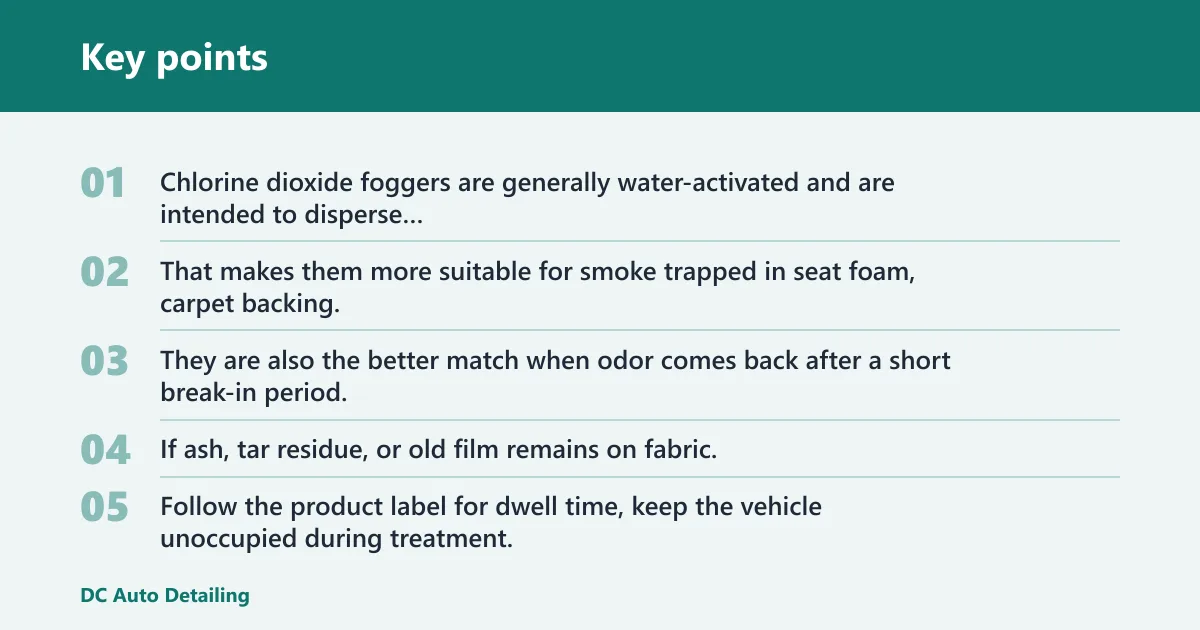
Chlorine dioxide foggers are generally water-activated and are intended to disperse through the cabin rather than remain on one spot. That makes them more suitable for smoke trapped in seat foam, carpet backing, and vent passages, although results depend on access, residue level, and how well the interior has already been cleaned. They are also the better match when odor comes back after a short break-in period.
They are not a substitute for cleaning. If ash, tar residue, or old film remains on fabric, the fogger has less to neutralize and the smell can return. Follow the product label for dwell time, keep the vehicle unoccupied during treatment, and ventilate the cabin fully afterward.
Fast spot treatment for fabrics and air
Sprays work best when you can identify the source and treat it directly. They are useful on seat bolsters, door inserts, and other exposed fabrics. They are also practical for a quick refresh before a drive, especially when the odor is light and localized.
The limit is coverage. A spray can miss the hidden path through the HVAC system, and it will not load the cabin with the same reach as a fogger.
Where each one falls short
A spray falls short when smoke has soaked into foam or ducting. A fogger falls short when the car still has residue on touch points and fabrics. If the goal is lasting odor control, a surface wipe, a deeper fabric clean, and a vent treatment often need to happen together.
Can charcoal or gel control smoke?
Yes, but only within limits. Charcoal bags and odor gels help control cabin odor over time, yet they do not remove the buildup inside upholstery, carpet, or vents. Think of them as maintenance tools after the source has been addressed, not as the first defense against heavy cigarette smell.
Activated charcoal bags for passive odor absorption
Activated charcoal bags are commonly used as a passive odor-absorbing option for light cabin smell. They are useful when you want the cabin to smell less stale without adding perfume. Some are marketed for long-term use and sunlight recharging.
That makes them a sensible low-maintenance choice for light smoke or for keeping a cleaned car from drifting back toward odor. They do not scrub fibers. They do not reach vents.
Odor eliminating gels for ongoing cabin control
Odor eliminating gel is the hands-off option for continuous cabin deodorizing. Some gels are marketed for continuous odor absorption over 30-60 days. That makes them useful for maintenance, rideshare use, or a daily driver with a mild smell problem.
They are not a deep reset. If the car still has embedded smoke in the seats or headliner, a gel may reduce the smell in the air while the source remains.
Why both are maintenance tools, not deep fixes
Charcoal bags and gels work best after the interior has been cleaned and treated. They help manage residual odor between cleanings. They are not the right answer when the cabin, vents, and fabrics all smell like stale smoke.
One common mistake is buying several passive products and expecting a heavy-smoke car to improve on its own. That usually leads to short-term improvement and then the same odor returns.
Ozone for cigarette odor
Ozone can make sense when smoke odor is deep-set across the cabin and other methods have not done enough. Ozone generators neutralize deep-set odors but need the car vacant. That rule matters. Ozone is not a drive-time product.
Use ozone carefully, because overuse can degrade rubber, adhesives, and some interior materials in a car.
When ozone makes sense
Ozone is usually reserved for severe lingering smoke. It is the option to consider when the odor persists after cleaning, after a spray, and after a fogger. It can help with air, upholstery, and vent contamination because it reaches areas that are hard to scrub by hand.
Even then, the car should be emptied first. Food, pets, people, and breathable exposure are not compatible with ozone treatment.
Safety, unoccupied vehicle rules, and ventilation
Ozone must be used in an unoccupied vehicle, then followed by post-treatment ventilation. That is not a minor caution. It is the central safety rule. The cabin should air out completely before anyone gets back inside. Follow the label for the exact treatment and ventilation times.
Chlorine dioxide foggers also require ventilation after use. Both products are stronger odor treatments, and both depend on proper airflow after treatment to clear the cabin.
Why ozone is usually reserved for severe cases
Ozone is a strong tool, but it is not the first tool to buy for a faint smell. It is more appropriate after the interior has been cleaned and the vent system has been addressed. If the odor is only light, charcoal or gel is cheaper and easier to live with.
Say a minivan carried a heavy smoker for months, and the smell still comes back through the vents after cleaning the seats. That is the kind of case where ozone becomes reasonable, not a basic air freshener.
Decision matrix for smoke odor
The right product depends on three things at once: severity, contamination zone, and what you want the car to do next. A quick refresh should not be treated like a deep reset. A maintenance product should not be expected to fix a full smoke buildup.
| Odor severity | Zone | User goal | Best product type | Repeat-treatment frequency |
|---|---|---|---|---|
| Light | Air | Fast refresh | Activated charcoal bag or odor gel | Replace or recharge monthly; gels every 30-60 days |
| Light | Upholstery or carpet | Fast refresh | Smoke odor eliminator spray | As needed; often more than one pass |
| Moderate | Upholstery, carpet, headliner | Deep reset | Spray plus direct cleaning | Usually 2 passes, sometimes more |
| Moderate | Vents | Deep reset | Fogger or ozone after cleaning | Often 1-2 treatments |
| Heavy | Air, upholstery, carpet, vents | Deep reset | Chlorine dioxide fogger or ozone | More than one treatment is common |
| Heavy | All zones | Maintenance after cleanup | Activated charcoal bag or odor gel | Ongoing replacement or recharge |
Choose fogger if… / Choose spray if…
Choose a fogger if the odor is embedded in multiple surfaces and the cabin still smells stale after a basic wipe-down. Choose a spray if you need a quick, targeted refresh on fabrics or in the air. Choose charcoal or gel if the car is already cleaned and you want low-effort upkeep.
Choose fogger if…
- The odor returns when the fan turns on.
- Smoke is present in upholstery, carpet, and vent paths.
- You can leave the vehicle empty for treatment and ventilation afterward.
- You need a deeper reset than a spray can reach.
Choose spray if…
- The smell is light or moderate.
- You need to treat a few seat areas or door panels quickly.
- You want a fragrance-free option or a lighter scented option for short-term use.
- You are willing to repeat the treatment if the odor persists.
Choose charcoal or gel if…
- The cabin has already been cleaned.
- You want a low-maintenance option for ongoing odor control.
- You are dealing with residual smell rather than heavy smoke.
- You need a passive product that does not add much fragrance.
A common first-timer mistake is to place a gel or charcoal bag in a dirty cabin and expect it to defeat stale smoke on its own. That usually fails because the source is still in the fabric, carpet, or vents.
Frequently asked questions
What is the best cigarette smell remover for a car that actually works?
The best choice depends on the source. For deep smoke in vents and fabrics, a chlorine dioxide fogger or ozone treatment is stronger. For light odor, activated charcoal or a gel works better as maintenance. For visible fabric spots, a smoke odor eliminator spray is the most direct option.
Do chlorine dioxide foggers work better than sprays for smoke odor?
Yes, when the odor is embedded in multiple areas. Foggers reach farther into upholstery, carpet, and vents, while sprays are better for quick spot treatment. Sprays are easier and faster, but they are less likely to solve smoke that keeps coming back from hidden areas.
Can activated charcoal remove cigarette smell from a car?
Activated charcoal can reduce cigarette smell in the cabin air, especially when the odor is light. It is a passive absorber, not a deep cleaner, so it will not remove smoke residue from fabric or vents. It works best after the car has already been cleaned.
Are ozone generators safe to use in a car?
They can be used safely only when the vehicle is unoccupied and then ventilated afterward. Ozone should never be used with people or pets inside. Because of that, it is usually reserved for severe odor cases where a stronger treatment is worth the extra caution.
How long does it take for an odor eliminator to work in a car?
Timing depends on the product. Sprays act quickly but may need repeats. Gels usually work over 30-60 days. Charcoal bags work gradually and may need periodic sunlight recharging. Foggers and ozone treatments are faster for deep odor, but they still need ventilation before the cabin is usable.
Will fragrance-free odor removers work better than scented ones?
For smoke odor, fragrance-free products can make more sense because they do not layer perfume over stale smoke. The best choice still depends on the formulation and the source of the odor. Scented products can help the cabin smell cleaner for a short time, but they are a poor substitute when the odor is embedded in fabric or vents.
Do I need more than one treatment for strong cigarette smell?
Often, yes. Strong cigarette odor usually lives in several places at once, so one pass rarely fixes every source. The common sequence is clean the upholstery and carpet, treat the vents, then use a fogger or ozone treatment if the smell still lingers. After that, use charcoal or gel for upkeep.