Cigarette smell: Is It home, car, or HVAC?
Start with a simple check: close the car, home, or HVAC source, then sniff after about 10 to 15 minutes; if the odor changes with the fan on, it is likely HVAC, if it stays local to seats or fabric, it is likely the vehicle interior, and if it seems to spread from vents or wall returns, it is likely the structure. Picking the wrong target wastes cleaner and time, and the smell often stays put. This guide shows how to trace cigarette odor to the right system before you clean.
Source map
Cigarette odor can come from three places at once: the source, the reservoir, and the path that moves it. Fresh smoke, stale thirdhand odor, and trapped nicotine or tar do not act the same way. That is why you should map where the smell is strongest before you clean anything.
A source is the place that produced or absorbed the smoke. A reservoir is a material that can hold odor after smoking stops, such as fabric, foam, carpet underlay, or dusty ductwork. The path is the air route that spreads the smell, often through supply vents, return vents, or a blower fan.
How do you tell whether the odor is from your home, car, or HVAC?
Start with where the odor concentrates and when it changes. If it follows the car cabin, seats, or one zone in the vehicle, the interior is the likely reservoir. If it is strongest in one room or near return grilles, the structure or HVAC path is more likely. If fan speed or mode changes the smell quickly, inspect HVAC first.
Clues that point to a car interior
Car odor usually stays strongest inside the cabin, especially around seats, carpet, the headliner, and door trim. It may change by zone: driver side, rear seat, or trunk. Smell that remains when the engine is off but intensifies after the car sits in sun points to trapped odor in soft materials, not only the vents.
Clues that point to a room or whole house
Room odor often follows airflow from one area to another. If the smell is stronger near a return vent, hallway, or a room shared with a neighboring unit, the structure or incoming air is a likely path. Yellow film on walls, blinds, or hard surfaces is a strong clue, but absence of staining does not rule out smoke.
Clues that point to the HVAC path
If the smell jumps when the fan starts, gets stronger in heat or AC, or changes when you switch between recirculate and fresh air, the HVAC system may be moving it. Supply vents can spread odor already in the system. Return vents can pull in smoke from a room, garage, crawlspace, or adjacent unit and distribute it.
| Clue | Likely source | Next test |
|---|---|---|
| Odor gets stronger with fan on | HVAC path | Run the system in fan-only mode for 10 minutes, then compare supply vents with the room or cabin |
| Smell is strongest near vents | Ducts, blower, or filter area | Inspect the cabin or home filter and sniff at return and supply grilles separately |
| One vehicle zone smells worse | Seat, carpet, or trim in that zone | Close the other doors and compare front seat, rear seat, and trunk one at a time |
| One room smells worse than the rest | Room materials or local air entry | Close interior doors and test each room after 10 to 15 minutes with the HVAC off |
| Yellow film on hard surfaces | Nicotine residue on the structure or interior | Wipe a white cloth on trim, window ledges, or dash edges and compare transfer |
| Odor is worse after sun exposure | Porous materials releasing trapped odor | Check seats, headliner, carpet, and soft furnishings while warm and again after cooling |
| Odor drops in recirculate mode | Outside air or return-air infiltration | Repeat the test with fresh air mode and compare whether the smell returns |
| Odor remains with recirculate on | Stored odor inside cabin or ductwork | Inspect the cabin air filter, blower intake, and fabric surfaces for residue |
| Smell appears after heat turns on | Warm ducts or warm porous materials | Test the system on cool fan-only first, then on heat, and note the change |
| Smell appears after AC turns on | Evaporator case, ducts, or wet debris | Check drain area, intake, and filter for damp odor and dust buildup |
| Odor is stronger near a garage wall | Garage air infiltration | Shut the garage door, run the indoor HVAC, and compare smell at adjacent returns |
| Odor appears only after clothes or luggage enter | Contamination from carried-in items | Remove the items for 24 hours and retest the room or vehicle with doors closed |
| Odor tracks wind or open windows | Outside air or neighboring source | Close openings, note wind direction, and retest at the same time of day |
| Smell lingers near return grilles | Return-air path or filter housing | Inspect the return side and replace the filter if it is loaded with dust or odor |
Cigarette odor checklist
Use the checklist below before you scrub anything. It separates a smell source from a smell reservoir, which keeps you from cleaning the vents when the real problem sits in carpet, foam, or a nearby air path.
- Close the space. Shut windows, doors, and trunk or cabin openings for 10 to 15 minutes. This lets the odor settle so you can tell whether it is local, airborne, or entering from another area.
- Test without the fan. Turn the HVAC off and sniff near vents, seats, carpets, headliner, or room returns. A smell that stays strongest at soft materials usually points to porous reservoirs.
- Switch the fan on. Run the system on low, then medium, and compare the odor. If the smell rises fast with airflow, inspect the HVAC path, filter, blower intake, and ducts before cleaning only fabric.
- Change air mode. Compare recirculate and fresh air. If fresh air makes the odor worse, outside or neighboring air may be entering. If recirculate intensifies a stale smell, the cabin or room may already hold the odor.
- Map the hot spot. Move from one zone to the next: front seat, rear seat, trunk, return grille, hallway, or adjacent room. The strongest point usually points to the best first inspection area.
Say your car smells smoky only after the AC starts, but the seats smell light when the system is off. That pattern points first to the HVAC path, not the upholstery. If the smell stays strongest on the rear seat even with the fan off, the rear fabric or underlay is the better first target.
How do you test vents, ducts, and filters?
Test the air path in the same order the air moves. In a vehicle or a house, the filter, blower area, returns, and supplies can hold or redistribute smoke odor. A filter swap can help, but it will not fix residue in duct walls, fan housings, or nearby porous materials.
Vehicle HVAC checks
On many vehicles, the cabin air filter sits behind the glove box or under the cowl near the windshield. Many manufacturers specify replacement by mileage or time, often around 12,000 to 15,000 miles or about once a year, though smoke odor can justify an earlier check. A carbon-activated filter can reduce odor better than a basic dust filter, but it will not remove tar from the evaporator case or seats.
- Inspect the cabin filter. Remove the filter and smell the dirty side. Heavy smoke odor, ash, or gray-brown dust means the filter has been loaded and may be recycling odor through the fan.
- Check both air modes. Run the system on recirculate, then fresh air, with the windows closed. If the smell changes sharply, note which mode is worse because that points to either cabin storage or outside infiltration.
- Compare vent locations. Sniff each supply vent separately. If one side is stronger, the duct branch or nearby material on that side may be holding odor.
Home HVAC checks
Home systems can move smoke through return vents, supply vents, and the blower compartment. If the smell appears when heat or AC turns on, the duct system may be stirring up residue, or it may be pulling smoke from a basement, garage, crawlspace, or neighboring unit. A filter change helps only if the filter is the main dirty point.
- Check returns first. Hold a hand or tissue near return grilles while the fan runs. If the odor is strongest there, the system may be drawing contaminated air into the equipment.
- Compare supply vents. Smell each supply grille after 10 minutes of fan operation. Strong odor at the supply side suggests the blower, coil area, or ductwork is re-odorizing the air.
- Inspect the filter path. Remove the home air filter and note the dust pattern and smell. A dirty filter with odor plus a clean room can mean the HVAC is distributing stored residue rather than creating it.
Can cigarette smell travel through ductwork or return vents? Yes. Return ducts can pull in smoke from an attached garage, a lower level, or another apartment, and supply ducts can also spread odor that is already in the system. That is why vent tests matter before any deep cleaning.
Which materials hold cigarette smell the longest?
Soft materials hold odor longer than hard, nonporous surfaces. Fabric, foam, carpet underlay, and dusty duct insulation can keep nicotine and tar particles in place long after the smoke source is gone. If the smell survives when vents are off, these materials are the next likely reservoirs.
Seats, upholstery, and headliners
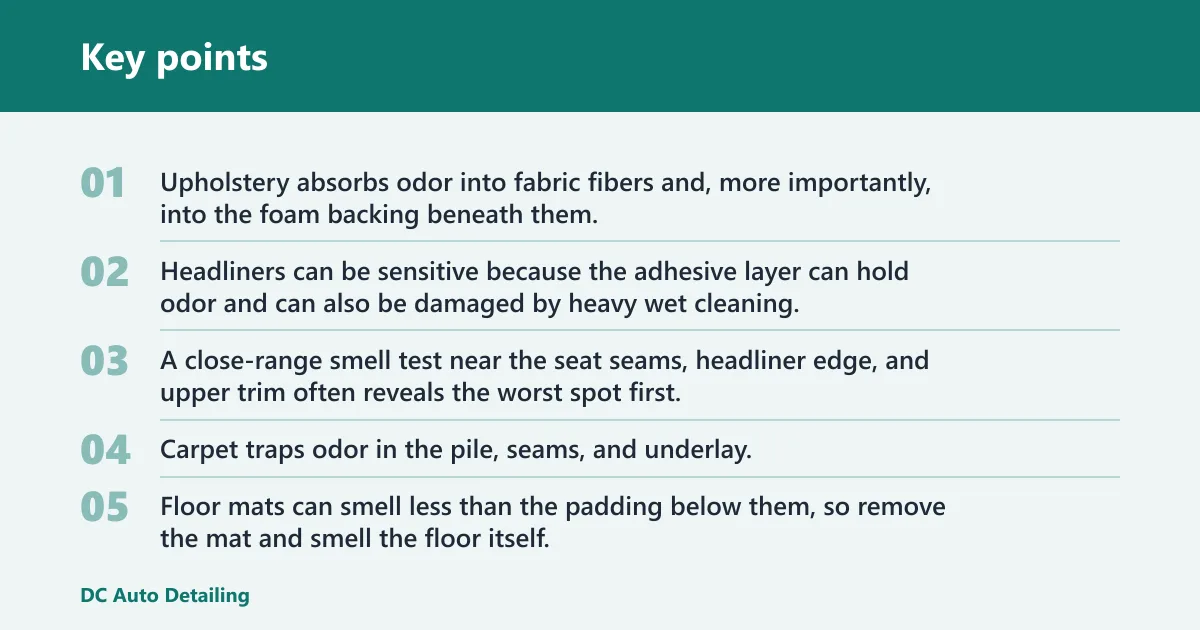
Upholstery absorbs odor into fabric fibers and, more importantly, into the foam backing beneath them. Headliners can be sensitive because the adhesive layer can hold odor and can also be damaged by heavy wet cleaning. A close-range smell test near the seat seams, headliner edge, and upper trim often reveals the worst spot first.
Carpet, floor mats, and underlay
Carpet traps odor in the pile, seams, and underlay. Floor mats can smell less than the padding below them, so remove the mat and smell the floor itself. Moisture makes the problem worse because damp fibers and underlay can hold smoke residue and release it again when warmed.
Walls, soft furnishings, and hidden cavities
In a home, painted walls, curtains, cushions, and closets can hold thirdhand smoke. Hidden cavities matter too: behind furniture, inside cabinet gaps, and around return openings where air moves slowly. If the odor is strongest near one wall or one closet, inspect the nearby material before treating the whole house.
Suppose a living room smells smoky only after an afternoon of sun hits the window. That clue often points to heat releasing odor from drapes, sofa foam, or dust in the return path. If the smell is absent at dawn and strong by 3 p.m., temperature is part of the diagnosis.
How do you tell fresh smoke from old residue?
Fresh smoke usually arrives with a sharp, obvious burst and fades faster when the source leaves. Stale thirdhand odor tends to linger, smell flatter, and cling to fabrics, filters, and painted surfaces. Yellow staining, sticky film, and touch-transfer residue point to repeated exposure, but lack of visible staining does not clear the space.
Odor versus staining
Fresh smoke can be strong without visible residue. Old residue can also remain noticeable when the stain is light. Use both smell and touch: if a white cloth picks up a yellow-brown film on a dash edge, door trim, wall ledge, or baseboard, nicotine residue is likely present.
Temperature and humidity clues
Heat usually makes trapped odor easier to detect because it releases compounds from fabric, foam, and dust. Humidity can do the same by helping odor move off porous surfaces and into the air. If the smell gets worse after warm sun, defrost, heat, or a humid afternoon, the odor reservoir is probably still in the space.
When should you call a professional?
Call a professional when the odor keeps returning after filter changes and targeted cleaning, when smoke exposure is spread across ductwork or hidden cavities, or when the smell is severe enough to saturate upholstery, carpet underlay, or wall materials. A pro is also the better next step after water damage, mold concern, or suspected contamination from an adjacent unit or garage.
For a car, professional help makes sense when the odor returns after a cabin filter replacement, when the headliner or foam is heavily contaminated, or when the vehicle has mixed smoke and moisture damage. For a home, it is worth escalating when the smell appears at returns, in multiple rooms, or only when the HVAC runs.
Frequently asked questions
How do I tell if cigarette smell is coming from my car or my house?
Compare where the odor is strongest after the space has been closed for 10 to 15 minutes. If it follows seats, carpet, and trim, the car interior is more likely. If it spreads through rooms or returns, the house or HVAC path is more likely. A simple zone-by-zone sniff test usually settles it.
How can I tell if the smell is coming from the HVAC system?
If the odor gets stronger when the fan starts, changes with recirculate versus fresh air, or is strongest near supply or return vents, the HVAC path is a strong suspect. Check the filter, blower intake, and duct openings. If the smell appears only when air moves, the system is probably carrying it.
Why does the smell get stronger when the heat or AC turns on?
Heat and AC move air across dusty parts, warm hidden residue, and release odor from porous materials. Warm ducts, foam, carpet underlay, and filter housings can all emit more smell once airflow starts. That does not mean the system caused the odor; it often means the system is carrying a stored smell.
What parts of a car hold cigarette smell the longest?
Seats, upholstery foam, carpet underlay, floor mats, and the headliner are the most common long-term reservoirs. The cabin air filter and ductwork can also hold odor, but fabric and padding usually keep it longer. If the smell remains with the fan off, start with those soft materials first.
How do I check if the smell is in upholstery or in the vents?
Turn the HVAC off and sniff close to the seat seams, headliner edge, and carpet. Then run the fan and compare the vent odor. If the smell stays local to fabric with the system off, it points to upholstery or carpet. If it surges at the vents, inspect the HVAC path next.
Can cigarette smell travel through ductwork or return vents?
Yes. Return vents can pull in smoke from a garage, hallway, crawlspace, or neighboring unit, and supply ducts can spread odor already inside the system. If the smell concentrates near returns or appears when the fan runs, ductwork is part of the investigation. That is why air-path tests matter before surface cleaning.
How do I know if the odor is from a previous smoker versus a neighbor or outside air?
Previous smoker odor tends to stay in soft materials and on hard surfaces with yellow film or sticky residue. Neighbor or outside-air odor usually changes with wind, open windows, bathroom or kitchen exhaust, or HVAC mode. If the smell follows outdoor conditions more than interior zones, inspect infiltration points first.