How to prevent water rings on cloth seats
Use the least moisture that still lifts soil: mist cleaner onto a towel or brush, work in small sections, and stop when the fabric feels damp, not wet. Too much water can leave tide lines, carry grime to the edges, soak foam, and create a musty odor. This guide explains how to control moisture, clean evenly, and dry cloth seats without rings.
Why do cloth seats ring when they get wet?
Answer: Cloth seats ring when moisture and dissolved soil dry at different rates across the panel. The weave and foam can pull liquid outward, so a centered spill or spot-clean can leave a darker border where wet and dry areas meet. Even coverage, light moisture, and full-panel drying are the main ways to reduce that edge.
Water rings form when a wet area dries unevenly. Cloth seat fabric is porous, so liquid can move into the weave and into the foam underneath. If one spot gets more cleaner or more water than the surrounding fabric, dissolved soil can travel outward and leave a darker edge where the wet and dry areas meet.
That is why a single damp patch can dry into a tide line. Cleaning only one spot can create a ring, especially if you stop mid-panel and let the area dry against dry fabric. The fix is even coverage, light moisture, and a controlled dry-down.
What you’ll need
- Vacuum with crevice tool
- Fabric or upholstery cleaner made for car interiors
- Clean, light-colored microfiber towels
- Soft-bristled upholstery brush
- Wet/dry vacuum or spot cleaner
- Small bowl or spray bottle for diluted cleaner
- Fan for drying airflow
- White towel for the test spot
How do I clean cloth car seats without water rings?
Answer: Clean one panel at a time and keep the fabric damp rather than wet. Vacuum first, test the cleaner on a hidden spot, then mist lightly, brush gently, blot or extract the soil, and dry with airflow before moving on. The goal is to keep the wet area broad and even so it does not dry into a visible edge.
Clean one panel at a time, keep the fabric damp rather than wet, and pull dirty moisture out before it spreads past the area you are treating. The best sequence is vacuum, test, pre-treat, agitate lightly, blot or extract, then dry with airflow before moving to the next panel.
- Vacuum first. Remove loose grit from the seat, seams, and crevices before any liquid touches the fabric. Dry debris turns muddy fast once cleaner hits it.
- Test a hidden spot. Use the lower back of the seat or another hidden area, then press a white towel on it after applying cleaner. Wait for it to dry before you proceed so you can check for color transfer or texture change.
- Work one panel. Treat a single seat panel from edge to edge instead of spot-cleaning the center alone. That keeps wet fabric from meeting dry fabric and cutting a hard line across the seat.
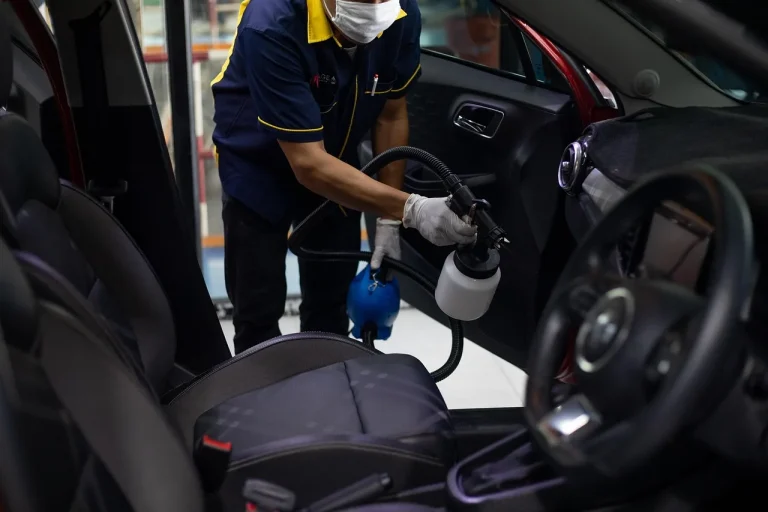
- Mist lightly and agitate. Start with 2 light mist passes on the towel or brush, not the seat foam. Brush in overlapping passes with a soft-bristled upholstery brush so the cleaner can spread more evenly without fuzzing the weave.
- Blot dirty moisture. Press a clean, light-colored microfiber towel into the damp area and lift straight up. Repeat with fresh towel folds until the towel picks up much less soil.
- Extract if needed. Switch to a wet/dry vacuum or spot cleaner once towel blotting leaves the fabric more than damp or once soil keeps returning. Extraction pulls out more dirt and water than towels alone and shortens dry time.
Cloth seat moisture checklist
| Before you move on | Stop point | What it means |
|---|---|---|
| Fabric feel | Damp, not wet | Surface should feel cool and slightly moist, but it should not squish or leave water on your fingers. |
| Cleaner passes | 2 light mist passes to start | Add only one more pass if the panel still needs glide; stop if the fabric darkens heavily or looks shiny with liquid. |
| Blotting | Move to extraction after 3 towel rounds | If the towel still pulls dark moisture after about three blot rounds, towels may no longer be enough. |
| Brush work | Two overlapping passes per zone | That is enough to loosen soil without overworking the fibers. |
| Panel check | Edge-to-edge, no wet core | Do not leave a wetter center surrounded by dry edges. |
Picture a front seat cushion with a coffee spill in the middle. If you wet only the stain, the center dries slower than the surrounding fabric and a pale ring can appear. Treat the whole cushion panel, from seam to seam, so the drying line does not form in one visible circle.
How much moisture should cloth seats get?
Answer: Use enough cleaner to loosen dirt, but stop before the fabric turns wet to the touch. A practical approach is to start with light misting, then reassess after each brush zone. If the surface beads, looks shiny, or feels saturated, the panel has crossed from damp to too wet.
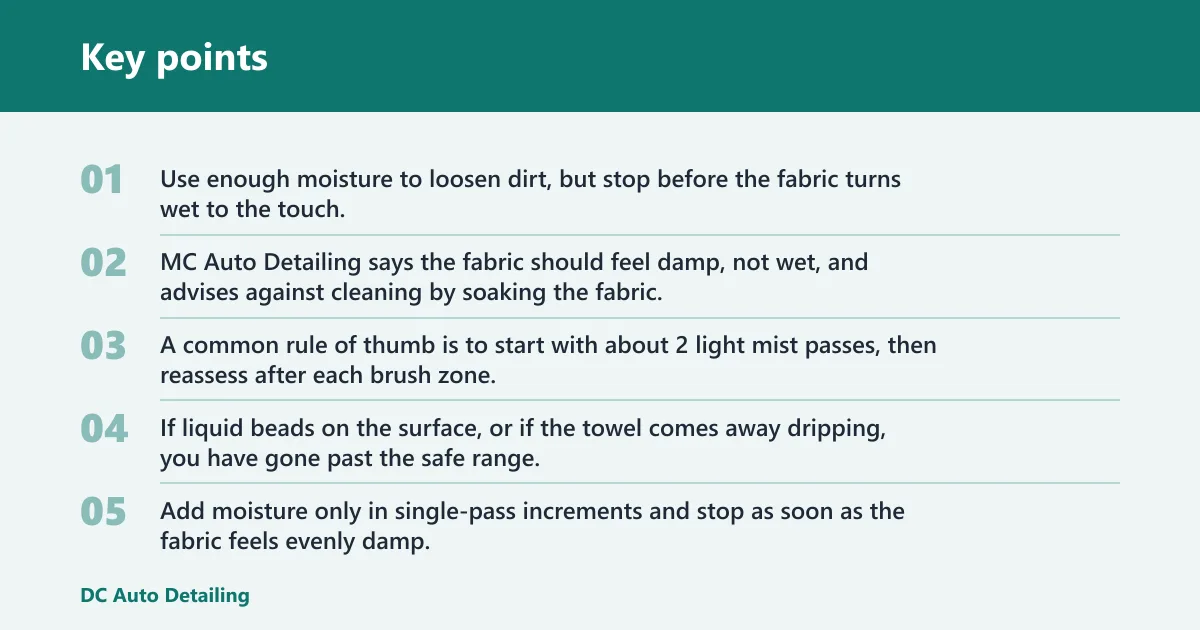
Use enough moisture to loosen dirt, but stop before the fabric turns wet to the touch. MC Auto Detailing says the fabric should feel damp, not wet, and advises against cleaning by soaking the fabric. That is the clearest rule to follow when you do not want rings or foam saturation.
A common rule of thumb is to start with about 2 light mist passes, then reassess after each brush zone. If liquid beads on the surface, or if the towel comes away dripping, you have gone past the safe range. Add moisture only in single-pass increments and stop as soon as the fabric feels evenly damp.
When to switch from towel blotting to extraction
Towels work well on light soil and fresh spills, but they have a ceiling. If the towel keeps coming up dark after repeated blotting, or if the seat still feels heavier and wetter after three rounds, move to a wet/dry vacuum or spot cleaner. That step matters because towels remove surface moisture, while extraction pulls liquid from deeper in the pile and foam.
Say your rear bench has a milk spill that was handled late. After two blot rounds, the towel still picks up odor and color. That is the point to extract, because more rubbing with towels only spreads the damp area wider.
How do you dry cloth seats faster without rings?
Answer: Drying starts as soon as cleaning ends. Use moving air, open the cabin path when weather allows, and keep the seats from sitting in a closed, humid space. The goal is steady evaporation across the full panel so the center and edges dry together instead of forming a line.
Drying starts right after cleaning. Point a fan at the seats, leave the doors or windows open, and run heat or A/C on fresh air, not recirculate. That airflow removes moisture before it can settle into the foam and leave tide lines or a musty smell.
Fan and airflow setup
- Point a fan at the seats. Aim moving air across the panel, not straight into one soaked spot. A broad sweep helps the whole seat dry at the same pace.
- Open the cabin path. Crack the doors or windows so damp air can leave the car. Closed-up interiors trap humidity and slow evaporation.
- Use fresh-air HVAC. Set heat or A/C to fresh air, not recirculate. Fresh air helps carry moisture out instead of cycling damp air back through the cabin.
When to leave the car open
Leave the car open while drying if weather and security allow. The goal is steady airflow, not heat alone. The same source says lightly cleaned seats can dry in about 2 to 4 hours, shampooed and extracted seats often dry in 3 to 6 hours, and soaked seats can take a day or more to dry. Wet upholstery should be dried within 24 to 48 hours.
Do not close the car for long periods while the seats are still damp. A closed cabin raises dampness risk, and a musty odor can follow if the foam stays wet too long.
What cleaner is safe for cloth car seats?
Answer: Use a fabric or upholstery cleaner made for car interiors and check the seat-material care guidance before applying heat, steam, or any stronger chemistry. Test the cleaner in a hidden area first and wait for it to dry before continuing. If you need a temporary mix, a few drops of mild soap in warm water can work in a pinch.
Use a fabric or upholstery cleaner made for car interiors. Test it in a hidden area first, then wait for the test spot to dry before you continue. If you need a temporary mix, a few drops of mild soap in warm water can work in a pinch, but only after a hidden-spot check.
Do not use a cleaner that leaves the fabric heavily wet, and do not flood the seat to “rinse” it. If the fabric still looks dark and saturated after application, stop and extract before the cleaner dries in place.
Common mistakes
Answer: Most ring problems come from too much liquid, uneven coverage, or skipping extraction. Heavy scrubbing can fuzz the fabric, and stiff brushes can damage it. Another common problem is using heat, steam, or moisture too aggressively near seat electronics or heated-seat elements instead of checking the seat-material care guidance first.
Most ring problems come from too much liquid, uneven coverage, or skipping extraction. Heavy scrubbing can fuzz the fabric, and stiff brushes can damage it. A soft-bristled upholstery brush should be used in overlapping passes, not pressed hard into the weave.
Another common error is cleaning a stain without treating the full panel. That leaves a visible border where the cleaned area meets dry fabric. The same thing happens when a wet seat is left in a closed car and dries slowly at the edges while the center stays damp.
- Do not soak the foam. Wet fabric should feel damp, not wet.
- Do not scrub hard. Use gentle, overlapping brush passes.
- Do not stop at the stain edge. Clean the whole panel.
- Do not rely on towels alone for soaked seats. Switch to extraction.
- Do not leave the car closed up wet. Dry it within 24 to 48 hours.
What if the seat already has a ring?
Answer: Rework the whole panel, not the ring alone, so the moisture and soil load are even again. Lightly re-dampen the broader area, blend outward with a soft brush, blot or extract, and dry both the marked area and the surrounding fabric together. That gives the edge a better chance to fade into the rest of the seat.
A dried ring usually means the edge dried faster than the center or the seat was cleaned in one spot only. Re-wet the full panel lightly, not the ring alone, then blend outward with a soft brush and remove the loosened soil with a microfiber towel or extractor. The goal is to even out the moisture field so the border softens.
If that did not work, clean the entire adjacent panel to the same dampness level, then dry both together with a fan. For a stubborn outline, a wet/dry vacuum or spot cleaner is the better next step because towels may only move the discoloration around.
Frequently asked questions
How much water should I use on cloth seats?
Start with 2 light mist passes, then recheck the fabric feel. Add only one more pass if needed, and stop when the seat feels damp rather than wet. If the towel starts coming away saturated or the panel looks shiny with liquid, you have gone too far.
How long do cloth car seats take to dry after cleaning?
The same source says lightly cleaned seats can dry in about 2 to 4 hours, shampooed and extracted seats often dry in 3 to 6 hours, and soaked seats can take a day or more to dry. Wet upholstery should be dried within 24 to 48 hours to limit odor and mildew risk.
What causes water rings on cloth car seats?
Rings usually come from uneven wetting and uneven drying. Cloth wicks liquid into the weave and foam, and dissolved soil can move outward as the spot dries. Cleaning only the center of a stain often leaves a visible edge where damp fabric meets dry fabric.
Can I use a steam cleaner on cloth car seats?
Only if the seat has no electrical components in the area being treated and the steam cleaner stays moving constantly. Check the seat-material care guidance before using heat or steam, and keep moisture and heat away from airbags, sensors, and heated-seat elements. For many seats, a cleaner plus extraction is the safer route.
Should I blot or rub cloth seat stains?
Blot. Press a clean microfiber towel into the damp area and lift straight up, then repeat with fresh folds. Rubbing pushes soil deeper into the fibers and can fuzz the fabric, especially if the brush or towel is rough.