
Best leather seats cleaner for cars: What to look for
Choose a pH-balanced, water-based leather cleaner that dries matte and matches your seat type; for most modern coated leather, that is the safest first pick. The wrong cleaner can leave seats sticky, glossy, stained, or dried out, and perforated leather is especially easy to damage. This guide explains how to compare cleaners by finish compatibility, residue risk, and fit for coated, genuine, synthetic, and perforated seats.
Coated, genuine, or synthetic leather
Start with the seat surface, not the bottle. Modern automotive leather is often coated, so the cleaner has to remove grime without stripping the top layer or leaving a shiny film. Genuine leather generally needs gentler care and less moisture. Synthetic leather can accept some 3-in-1 products, but compatibility should still be confirmed before adding conditioner.
Coated leather
Coated leather is the common modern seat finish. The top layer does most of the work against dirt and wear, so the safest cleaner is one that lifts residue without attacking that protective coat. A matte, low-residue result is the goal. If a product leaves a slick feel or obvious sheen, it is often a poor match for this finish.
Genuine leather
Genuine leather is more sensitive to harsh cleaners and over-wetting. It benefits from gentle pH-balanced cleaning, then a separate conditioner if the leather needs help staying supple. Do not treat it like coated leather. Heavy scrubbing and soaking can create more problems than the dirt you are trying to remove.
Synthetic leather
Synthetic leather, also called faux leather or leatherette, can work with some leather cleaner and conditioner combos. That does not mean every product is safe on it. Check that the formula is approved for synthetic surfaces before you assume the conditioner step belongs there. Some products clean well but change the final feel more than you want.
📊 Car and Driver names Weiman Leather 3-in-1 as best overall. Source: Best Car Leather Cleaners of 2026, Tested.
Leather cleaner comparison table
The main trade-off is simple: the safer the cleaner for a delicate finish, the less aggressive it usually is on heavy grime. That means you should match the formula to the seat type and the job. A maintenance clean on coated leather is a different task from cleaning older genuine leather or a perforated seat with trapped dust.
| Cleaner type | Best seat type | Finish compatibility | Residue risk | Perforation safety | Matte OEM look | Follow-up conditioning | Decision path |
|---|---|---|---|---|---|---|---|
| pH-balanced leather cleaner | Coated leather, older leather, delicate genuine leather | High for coated finishes; safer default for delicate leather | Low when wiped fully with microfiber | Good with light application | Yes, usually | Optional on coated leather; often useful on genuine leather | Choose when the seat is coated or genuine and you want the safest general-purpose starting point. |
| Leather cleaner and conditioner combo | Maintenance cleaning on coated leather or leatherette | Good if the formula matches the surface | Medium if over-applied or left on the surface | Fair with careful use; avoid flooding holes | Sometimes, depending on the formula | Usually built in | Choose when the seat is coated or synthetic and you want one-step upkeep more than deep cleaning. |
| Standalone leather conditioner | Genuine leather after cleaning | Not a cleaner; used after residue is removed | Low if applied lightly | Good, but avoid soaking perforations | Can leave a soft sheen if overused | Yes, this is the follow-up step | Choose when the seat is genuine leather and needs moisture support after a separate cleaning step. |
| Cleaner aimed at synthetic leather | Leatherette, faux leather | Good on synthetic surfaces; verify before use on genuine leather | Low to medium | Good if the application is light | Often yes | Usually no, unless the product is designed for both | Choose when the car uses synthetic upholstery and the label confirms compatibility. |
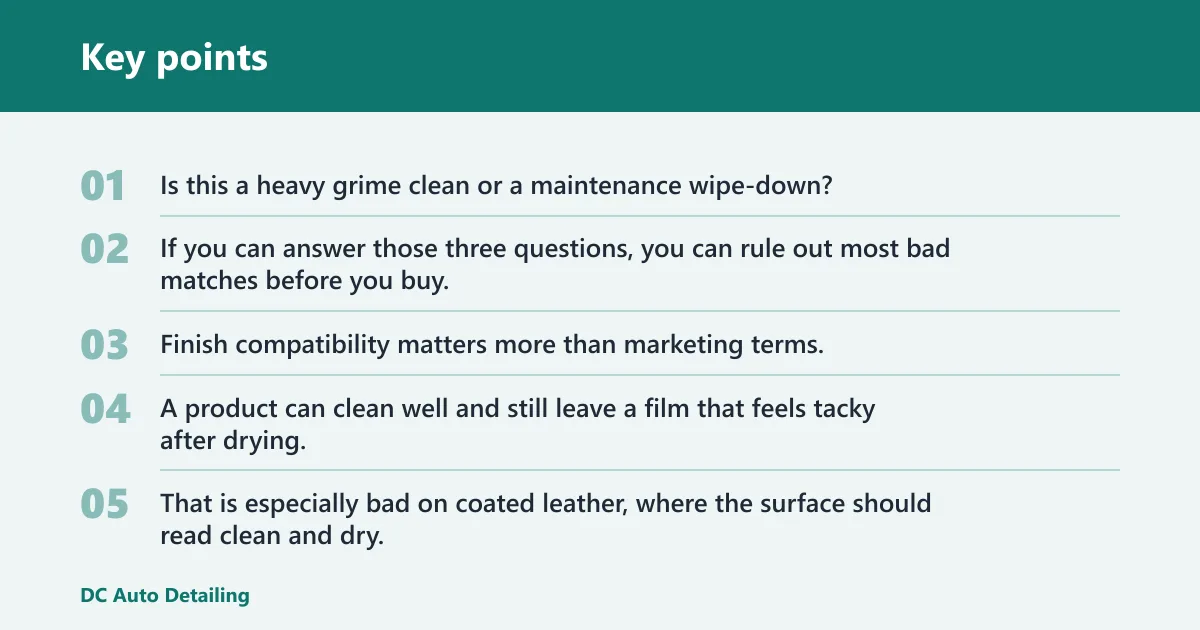
Three quick checks narrow the choice fast. Is the seat coated, genuine, or synthetic? Is this a heavy grime clean or a maintenance wipe-down? Are the seats perforated or solid? If you can answer those three questions, you can rule out most bad matches before you buy.
Finish compatibility and residue risk
Finish compatibility matters more than marketing terms. A product can clean well and still leave a film that feels tacky after drying. That is especially bad on coated leather, where the surface should read clean and dry, not slippery. A matte OEM look usually comes from a cleaner that wipes off cleanly, not from a heavier conditioner layer on top.
A common first-timer mistake is using too much product on the first pass. Suppose a sedan has light beige coated leather and dust in the bolsters. A light spray on the towel, then a wipe and a second dry microfiber pass, is usually safer than soaking the seat and trying to remove the excess later.
Perforation safety and follow-up conditioning
Perforated leather seats need restraint. Product that pools in the holes can clog perforations and leave residue where towels cannot reach well. Light application and careful wipe-off matter more here than on solid seats. If the cleaner leaves residue around the holes, the problem often gets worse after the cabin heats up.
Follow-up conditioning depends on the leather type and the cleaner used. Genuine leather is more likely to benefit from a separate conditioner after cleaning. Coated leather does not always need that step, especially after routine maintenance. A combo product may remove the need for a second bottle, but it can also leave a different finish than you expected.
What should you look for in a leather cleaner?
Look for a pH-balanced formula that cleans without stripping the finish, leaves little residue, and wipes off cleanly with microfiber. That combination lowers the risk of drying, discoloration, and glossy buildup. For older or delicate leather, gentler chemistry is usually the safer default than a stronger all-purpose cleaner.
pH-balanced formulas
A pH-balanced cleaner is the safest starting point for many leather interiors. It is often the better choice for older leather and for seats where the finish is already sensitive. Strong cleaners can remove grime, but they can also raise the odds of drying or finish changes. That is a bad trade on a seat you want to preserve.
Matte, low-residue results
Read the label for finish clues, but let the wipe-off behavior guide the final choice. If a cleaner leaves the seat feeling slick, it may be depositing more than it removes. The target is a clean, dry touch with no greasy residue. That matters even more on seats that are touched often, like the driver’s bolster.
Simple wipe-off with microfiber
A clean, soft microfiber towel is the main wipe-off tool. It lifts loosened soil and removes product before it settles into seams or perforations. Low-lint material is preferred so you do not leave fibers behind. A dirty towel can put residue right back onto the surface you just cleaned.
Is a cleaner and conditioner combo worth it?
A cleaner and conditioner combo is worth it when you want convenience and the seats only need maintenance cleaning. It is less ideal when you need deeper soil removal or when the seat type calls for a specific post-cleaning conditioner. Combos can also leave different finishes depending on the formula, so they are not a universal fix.
When a combo fits maintenance cleaning
Combo products suit routine upkeep on coated leather or leatherette when the seats are already in decent shape. They can reduce the number of steps and keep the surface from feeling overly dry after cleaning. That said, convenience should not override compatibility. If the label is vague about finish type, keep looking.
When standalone cleaner plus conditioner is better
Standalone products make more sense when the seat needs real cleaning first and conditioning second. That is especially true for genuine leather, which can benefit from a separate conditioner after the dirt is gone. If the cleaner has to work hard, the conditioner should not be forced to do both jobs at once.
How combos can change the final finish
Some combos leave a softer feel, while others leave a slight sheen. That finish shift may be welcome on a low-use interior and annoying on a factory-matte seat. If you want a true OEM look, a separate cleaner followed by a carefully chosen conditioner gives you more control.
Say your SUV has perforated beige seats and the driver bolster has dark hand oils. A combo product can be fine for a light maintenance pass, but the same bottle may not be the best answer if the perforations are clogged and the finish looks uneven. In that case, a cleaner with a microfiber wipe-off and a separate conditioner later is the safer route.
Is it safe on perforated leather seats?
Yes, if you use very little product and remove it carefully. Perforations raise the clogging risk because liquid can settle into the holes and stay there. The safe approach is light application, limited saturation, and a dry wipe afterward. Do not flood the seat and do not scrub hard across the perforations.
Why perforations raise the clogging risk
Perforated seats have more places for product and loosened soil to hide. If the cleaner pools, it can leave residue inside the holes and around the edges. That is harder to remove than dirt on a solid panel. The problem is not the perforation itself; it is over-application.
How to apply less product
Apply the cleaner to the towel, not directly to the seat, when you are working near perforations or stitching. That gives you more control over the amount reaching the surface. Use only enough to dampen the towel, then work in small sections. If the seat starts to look wet, stop and wipe dry.
How to remove residue without soaking the surface
Wipe across the surface, then follow with a dry microfiber towel to pick up the leftover film. On seams and perforations, use gentle passes instead of pressure. If you need more cleaning power, use a soft-bristled detailing brush lightly, then dry the area again. Do not chase residue by adding more liquid.
How do you avoid sticky or shiny results?
Use less product, wipe it fully, and do not leave conditioner sitting on the surface. Sticky or shiny seats usually come from too much product, poor wipe-off, or the wrong finish for the seat type. A matte result comes from control at each step, not from a heavy coat of cleaner or conditioner.
Use a clean microfiber towel
The towel matters as much as the cleaner. Microfiber picks up residue without grinding it back into the leather. Keep one towel for application and another for dry buffing if the seat needs a second pass. If the towel is dirty or damp from another job, it can leave streaks behind.
Use a soft-bristled brush only where needed
A soft-bristled detailing brush helps with seams, stitching, and grain where a towel cannot reach well. Family Handyman recommends a boar hair brush for the job, which points to the need for soft bristles rather than stiff nylon. The brush should lift grime, not abrade the finish. Use it sparingly on coated leather and even more carefully on genuine leather.
Keep product off seams and perforations
Seams, bolsters, and perforations trap residue. A small amount of product around those areas is fine if you wipe it immediately, but wet buildup is where problems start. Family Handyman also recommends vacuuming before cleaning, and an air compressor can help with perforations and seams when debris is packed into tight spaces.
The same source lists the project cost at $15 to $80 and the project takes 1 to 2 hours. It also labels the job beginner-friendly, which is useful context: leather care does not need to be complicated, but it does reward careful technique. Use microfiber, light product, and patience.
Choose a leather cleaner if… / Choose a cleaner and conditioner combo if…
The best choice depends on the seat, the soil level, and the finish you want to keep. A dedicated cleaner gives you more control over the final look. A combo gives you speed. Neither is automatically better.
Choose a leather cleaner if…
- You want a matte OEM look on coated leather.
- The seat is genuine leather and needs a separate conditioner afterward.
- You are dealing with heavy grime, seams, or older leather that needs careful cleaning first.
- You want to minimize residue risk on perforated seats.
Choose a cleaner and conditioner combo if…
- You are doing routine maintenance on coated leather or leatherette.
- You want one bottle for a quick upkeep pass.
- The label clearly says the product is safe for your seat type.
- You are comfortable with a finish that may be slightly different from a dedicated cleaner.
What is the best leather cleaner for car seats?
The best leather cleaner for car seats is the one that matches the seat finish and leaves the least residue. For most modern coated leather, a pH-balanced cleaner with a matte finish is the safest first pick. For genuine leather, gentler cleaning matters more than shine. For synthetic leather, compatibility on the label matters more than brand hype.
Frequently asked questions
What should I look for in a leather cleaner for cars?
Look for a pH-balanced formula, low residue, and compatibility with your seat type. Coated leather should dry matte without a greasy film. Genuine leather usually needs gentler cleaning. If the product is meant to clean and condition, make sure the finish still matches what you want after it dries.
Are leather cleaner and conditioner combos worth it?
They are worth it for routine maintenance when you want one step and the seats are in decent shape. They are less ideal for deep cleaning or for genuine leather that needs a separate conditioner. The trade-off is convenience versus control over the final feel and finish.
Is a leather cleaner safe for perforated car seats?
Yes, if you use a light amount and wipe it off promptly. Perforations can trap product and soil, so over-application is the main risk. Apply to the towel, not the seat, work in small sections, and finish with a dry microfiber pass to reduce residue.
What cleaner works best on coated leather seats?
A pH-balanced cleaner that leaves a matte finish is usually the best starting point for coated leather. It should clean without stripping the protective top layer or leaving shine. If the bottle reads slick or glossy after drying, it is probably not the right fit.
How do I avoid greasy or sticky leather seats after cleaning?
Use less product, wipe fully with a clean microfiber towel, and do not leave conditioner sitting on the seat. Sticky results usually come from residue, not from leather itself. A soft brush can help release grime, but the final wipe is what controls the finish.
Can I use the same product on synthetic and genuine leather?
Sometimes, but do not assume it is safe. Synthetic leather can work with some 3-in-1 products, while genuine leather often benefits from gentler cleaning and a separate conditioner. Check the label for both surface compatibility and whether the conditioner step is meant for your material.