How Can You Tell When Ceramic Coating Maintenance Fails?
If water no longer beads evenly after a proper wash and decontamination, or slickness, gloss, and panel-to-panel behavior keep dropping, maintenance is no longer enough. Ignoring that pattern can leave bonded contamination, water spotting, and coating failure that simple toppers will not fix. This guide shows how to sort normal maintenance issues from contamination, spot damage, and the point where reapplication makes more sense.
What a healthy coating should do
A healthy ceramic coating should shed water consistently, feel slick after washing, and behave the same across most panels. Tight beading, fast sheeting, and uniform gloss are the core signs. If one door acts differently from the hood or roof, that difference matters more than a single weak wash result.
Tight beading and fast sheeting
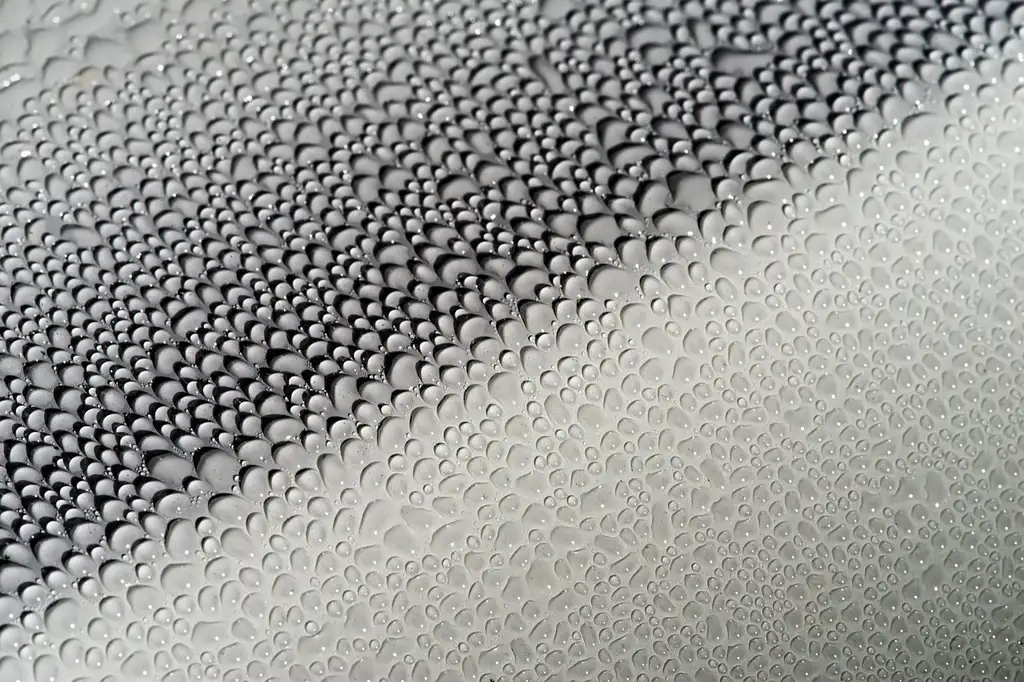
The day-to-day signal is simpler: water should bead or sheet consistently across panels. A hydrophobic test can be performed by pouring clean water over the surface. Flat pooling suggests the hydrophobic properties are fading.
Uniform behavior is the key. Even water behavior across panels tells you the coating is still performing as expected. If beading remains tight on the hood but weak on lower doors, that points to exposure, residue, or wear patterns rather than a whole-car failure.
Slick paint after a proper wash
A properly coated surface should feel extremely smooth and slick. After a correct wash and dry, your hand should glide without a gritty drag. A rough feel after washing can mean particles are bonded to the surface, even if the coating layer itself is still present.
Consistent behavior from panel to panel
Healthy coatings should show consistent water beading or shedding across panels. That includes the roof, hood, upper doors, and lower panels. Small differences can happen from exposure, but a clear split between upper and lower areas usually means the surface is carrying different amounts of contamination or wear.
Why coating performance can look worse than it
Loss of water repellency does not always mean the coating has worn out. Road film, mineral deposits, dust, insects, bird droppings, and tree sap can sit on top of the coating and change how it looks and feels. Those layers can also make gloss appear muted and water behavior look inconsistent.
Road film and dust on top of the coating
Road film and dust can reduce slickness without fully removing the coating’s function. This is common on daily-driven cars, especially on lower panels and rear surfaces. A car may still be coated, yet feel sticky after a wash because the top layer is not clean enough to behave normally.
Mineral deposits and hard-water spots
Water spotting is usually mineral residue, not automatic coating failure. It returns most often on warm panels. If spotting becomes harder to remove over time, that can mean the residue is bonding more firmly or the coating surface is no longer shedding water as well.
Insects, bird droppings, and tree sap
Bird droppings, tree sap, and road film are common contamination concerns. These contaminants can dull gloss, leave sticky patches, and change water beading in the affected area. If the roof or hood looks hazy while the sides still bead well, that pattern often points to localized contamination or damage from exposure.
Maintenance vs decontamination vs reapplication
Use the symptom pattern, the severity, and the panel location to decide the next step. Mild issues usually need maintenance or a booster spray. Moderate issues often need decontamination. Severe, repeated, or panel-specific failures may call for professional inspection, spot repair, or full reapplication.
| symptom | likely cause | simplest next step | when to book professional service |
|---|---|---|---|
| Uneven beading on lower panels | Road film, dust, salt, or heavier exposure on rockers and doors | Wash, dry, then inspect after a clean water test | If lower panels still bead weakly after decontamination |
| Rough feel after washing | Bonded contamination on the surface | Decontamination step, such as chemical or professional removal | If the roughness stays after decon or spreads across panels |
| Recurring hard-water spots | Mineral residue, often on warm panels | Remove spots promptly and change drying habits | If spots etch, repeat quickly, or resist normal removal |
| Dull gloss after washing | Residue on top of the coating or surface wear | Decontaminate and recheck in direct light | If gloss stays hazy after cleaning and decon |
| Slickness loss on one side of the vehicle | Exposure imbalance, traffic film, or uneven topper depletion | Clean thoroughly and apply a booster spray | If one side still feels rough after topper use |
| Beading that is still present but weaker | Topper depletion or light surface contamination | Use a ceramic booster spray | If beading keeps fading within days or weeks |
| Gloss that is uniform but water behavior is not | Coating may still look fine while hydrophobic ability is weakening | Perform a clean water test and inspect for residue | If flat pooling continues after cleaning and drying |
| Gritty feel after a proper rinse and dry | Bonded contamination or heavier surface residue | Decontamination, then reassess | If the surface remains gritty or the coating looks patchy |
Here is the simple cost-and-effort comparison. A booster spray is a light step and is often used about every few months or around every 6 months. Decontamination takes more time and effort, but it can restore slickness and gloss when washing alone fails. Spot repair or full reapplication costs more and makes sense when wear is real, not just hidden by grime.
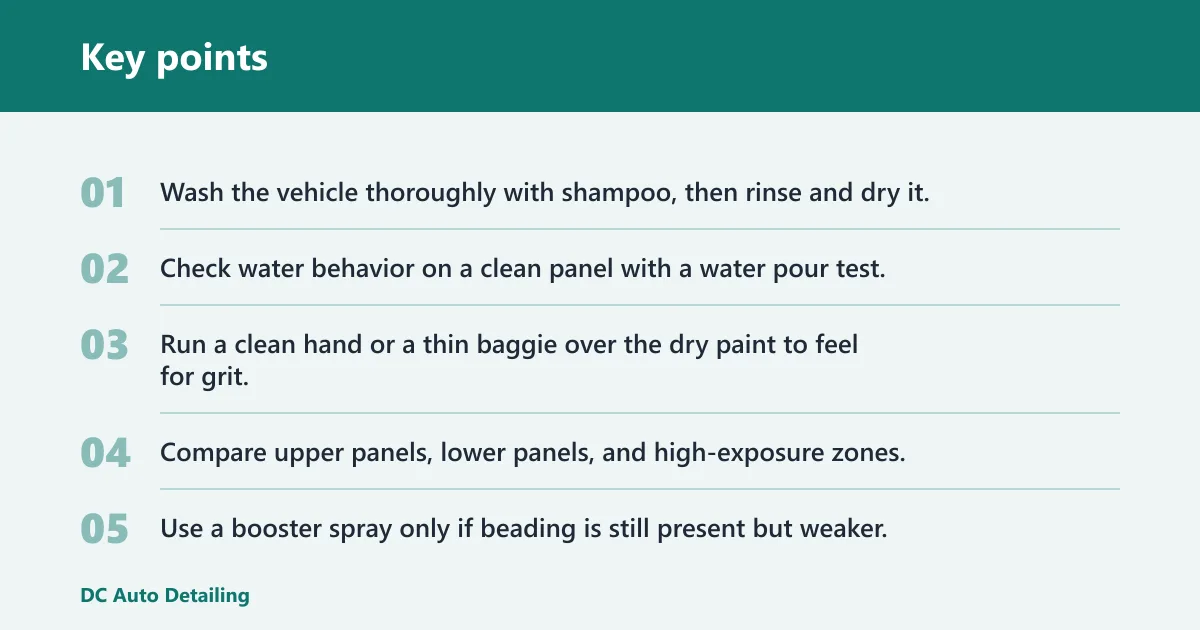
- Wash the vehicle thoroughly with shampoo, then rinse and dry it.
- Check water behavior on a clean panel with a water pour test.
- Run a clean hand or a thin baggie over the dry paint to feel for grit.
- Compare upper panels, lower panels, and high-exposure zones.
- Use a booster spray only if beading is still present but weaker, and note that some toppers can temporarily mask failure and confuse diagnosis.
- Move to decontamination if the paint feels rough or looks hazy.
- Book inspection if symptoms overlap or only some panels fail.
Can contamination make a coating look worn out?
Yes. Contamination can make a ceramic coating look weak even when the coating layer is still there. Bonded film, minerals, and residue can change how water moves, how the paint feels, and how light reflects off the surface. That is why touch and gloss matter as much as beading.
How bonded contamination changes touch and gloss
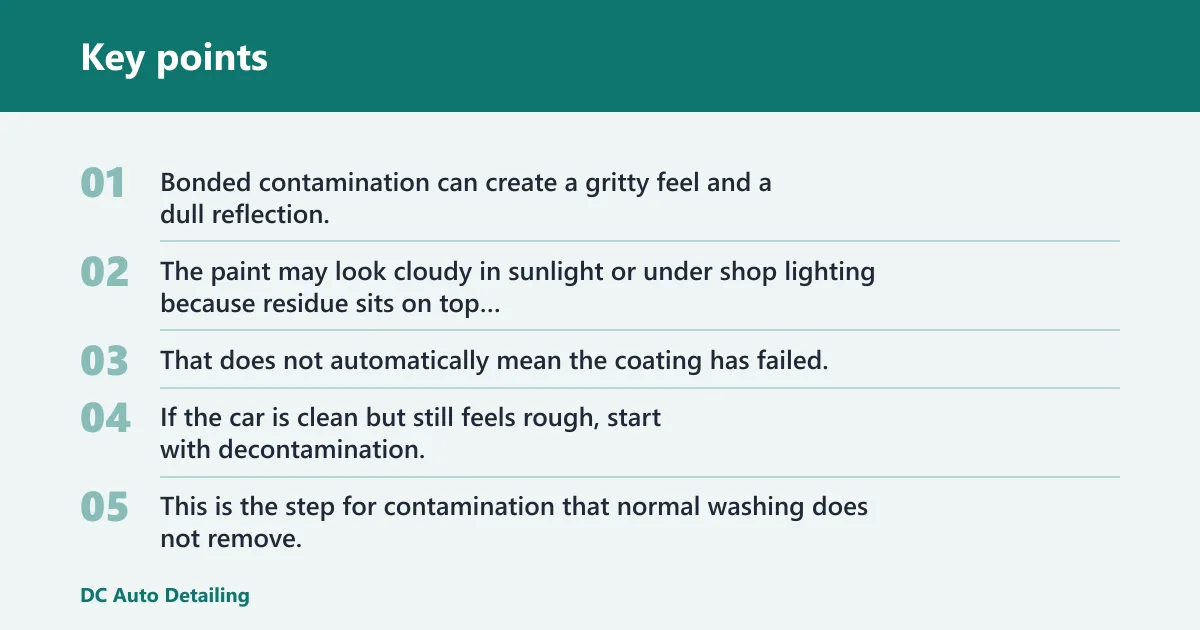
Bonded contamination can create a gritty feel and a dull reflection. The paint may look cloudy in sunlight or under shop lighting because residue sits on top of the coating. That does not automatically mean the coating has failed, but it does mean washing alone may no longer be enough.
When decontamination is the right first step
If the car is clean but still feels rough, start with decontamination. This is the step for contamination that normal washing does not remove. It can restore slickness and gloss when the coating is still intact underneath. If the car improves sharply after decon, reapplication may not be needed yet.
When polishing or spot correction may be needed
If decontamination does not restore consistent beading, and one panel still looks hazy or behaves differently, the problem may be deeper than surface contamination. At that point, polishing or spot correction may be needed before any coating repair. A professional inspection helps separate residue from wear.
Say your white sedan beads well on the hood but the lower doors flatten water after every wash. That pattern often points to exposure-driven buildup, not total coating failure. The quickest fix is usually decontamination, not another round of normal washing.
When is a booster spray enough?
A booster spray is enough when the coating still has some hydrophobic behavior, the paint is clean, and the problem is mainly reduced slickness or weaker beading. Maintenance sprays are used to top up the surface layer. They are not a fix for true coating wear.
What top-up maintenance can restore
A ceramic booster spray can improve water behavior after normal wear or light residue buildup. It can help restore a cleaner feel and more even beading if the coating is still structurally sound.
How often boosters are typically used?
Booster sprays are often used every few months or every 6 months, depending on product and exposure. That kind of schedule is maintenance, not repair.
When topper use stops being the right fix
Stop relying on a booster alone when beading stays weak after decontamination, or when one panel keeps failing while the rest still looks normal. If flat pooling, roughness, and dull gloss all show up together, the problem is no longer just topper depletion. That is the point for inspection.
Do water spots mean the coating is gone?
No. Water spots usually mean mineral residue, especially if they show up on warm panels. They can sit on top of an otherwise healthy coating. If spots return often, become harder to remove, or leave the surface dull after cleaning, then deeper damage or coating wear becomes more likely.
Mineral residue versus coating failure
Mineral residue can be removed if addressed early. Coating failure is different: water behavior weakens across the panel, slickness drops, and gloss no longer recovers after cleaning or decontamination. The spot itself does not tell the whole story. The pattern around it does.
Why warm panels spot faster
Warm paint dries water quickly, which leaves minerals behind sooner. Roofs, hoods, and panels in direct sun often spot first. That is why water spotting often appears in the same places over and over, even when the coating is still present.
When spotting points to deeper damage
If water spots etch into the surface, keep returning after proper drying, or line up with weak beading and roughness, the issue may have moved beyond maintenance. At that point, decontamination may still help, but inspection is smarter than guessing. The goal is to separate residue from true wear.
Suppose a black SUV sits outside in summer and the hood spots within an hour after a wash. If the sides still bead normally and the paint feels slick, the coating may be fine. The likely problem is heat, drying time, and mineral residue, not a failed coating layer.
When should you book a professional inspection?
Book an inspection when symptoms overlap and the cause is unclear. If water behavior, gloss, and touch all disagree, a professional can judge wear versus contamination and decide between spot reapplication and full reapplication. That is the best move when one or more panels behave differently.
When symptoms overlap and the cause is unclear
Overlap is the warning sign. For example, weak beading plus roughness plus dull gloss may point to both contamination and wear. A professional inspection matters because each issue gets different treatment. Booster spray will not fix true coating loss, and polishing alone will not solve every mineral issue.
When one or more panels behave differently
Panel-by-panel differences matter. Lower panels often fail first because they take more road film, grime, and splash. If the roof still sheds water well but the lower doors do not, that is a clue. It may mean spot treatment is enough, or it may show that the coating is wearing unevenly.
When to choose spot reapplication or full reapplication
Spot reapplication can make sense when only one area seems to have failed and the rest of the coating still behaves normally. Full reapplication is more likely when water behavior seems weak across the vehicle, gloss stays dull after cleaning, and roughness returns soon after decontamination. That is the point where maintenance has reached its limit.
Frequently asked questions
How do I know if ceramic coating maintenance is no longer enough?
Maintenance may no longer be enough when a proper wash, dry, and decontamination still leave weak beading, poor slickness, or dull gloss. If those symptoms keep returning, or if only certain panels keep failing, the issue is beyond routine upkeep and may need inspection or reapplication.
What are the signs my ceramic coating is failing?
Common signs include flat water pooling, uneven beading across panels, rough paint after washing, and a dull or hazy finish that does not improve after cleaning. One sign alone may point to contamination, but several together suggest real coating wear.
Can contamination make a ceramic coating look bad without being worn out?
Yes. Road film, dust, minerals, insects, bird droppings, and tree sap can sit on top of the coating and change both touch and gloss. If the surface feels rough or looks dull but improves after decontamination, the coating may still be intact underneath.
When is a booster spray enough for ceramic coating?
A booster spray is enough when the coating still beads, but less strongly than before, and the surface is otherwise clean. It can refresh the hydrophobic layer. It is not the right fix for heavy contamination or worn coating sections.
Do water spots mean my ceramic coating is gone?
No. Water spots usually mean mineral residue, especially on warm panels that dry quickly in sun or heat. If the spots remove cleanly and the coating still beads well elsewhere, the coating may be fine. Repeated spotting plus roughness or flat pooling is more concerning.
How often should a coated car be inspected?
A coated car should be inspected whenever performance changes, not only on a fixed calendar. A quick check every few months is sensible for daily-driven vehicles, and any time you see uneven beading, roughness, or dull gloss on one section, inspection becomes useful.