Dual action polisher vs rotary: Which should you use?
Use a Dual action polisher for most correction jobs; choose a Rotary only when you need controlled heavy defect removal on harder paint and you can manage heat, pad angle, and edge risk. In practical terms, the DA is the safer default for light swirls, wash marring, one-step work, and finishing, while the Rotary is the better tool for severe oxidation, deeper clear-coat defects, and hybrid cut-then-refine workflows. That distinction aligns with manufacturer guidance on machine motion, correction aggressiveness, and finish risk, including Meguiar’s, 3M, and Rupes guidance on dual-action versus rotary behavior and the need to keep correction conservative on delicate surfaces.
| Decision factor | Dual action polisher | rotary | Winner |
|---|---|---|---|
| Cut speed | Slower on severe defects, strong enough for light-to-medium correction | Maximum cut with direct speed control | rotary |
| Finish risk | Lower risk of haze and holograms when used correctly | Higher heat and hologram risk if technique slips | Dual action polisher |
| Learning curve | More forgiving for beginners | Requires experienced control | Dual action polisher |
| Thin clear coat and edges | Less aggressive, but still needs caution on corners | Higher burn-through risk near edges and body lines | Dual action polisher |
| Heavy oxidation or deep defects | Can work them down in some cases, often with more time or a multi-step plan | Best suited when controlled heavy correction is needed | rotary |
| Maintenance and finishing use | Well suited to finishing, maintenance polishing, and one-step work | Useful for correction, then usually followed by refinement | Dual action polisher |
Dual action polisher vs rotary polisher
Core trade-off: correction speed versus control
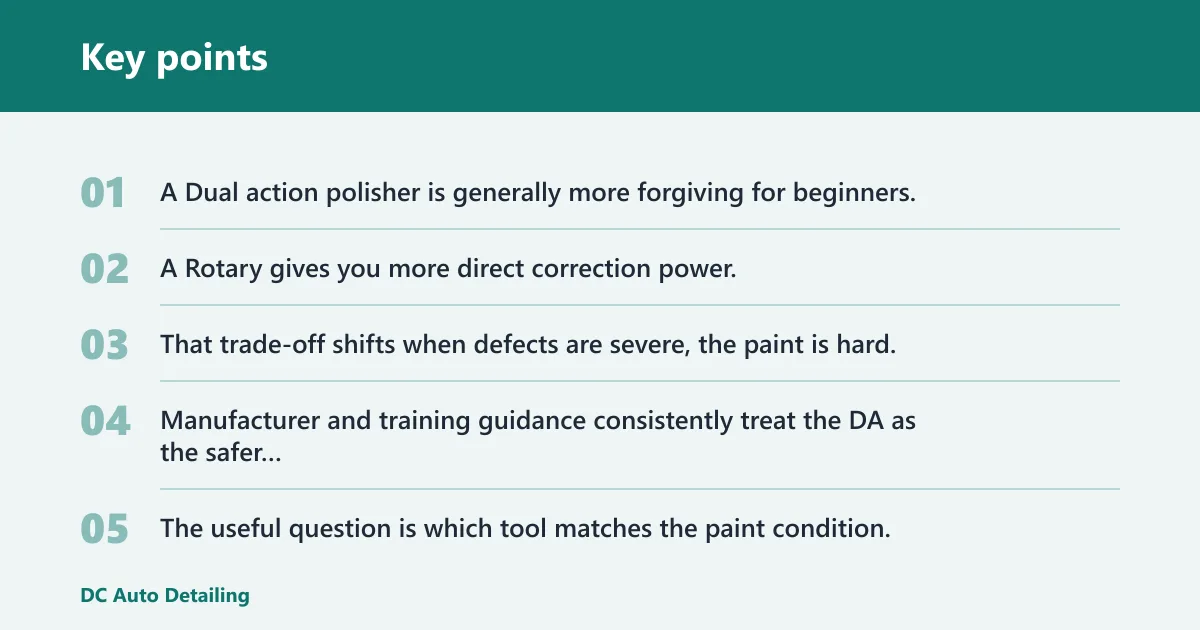
A Dual action polisher is generally more forgiving for beginners. A Rotary gives you more direct correction power. That trade-off shifts when defects are severe, the paint is hard, or you need faster removal than a DA can reasonably deliver. Manufacturer and training guidance consistently treat the DA as the safer general-purpose machine and the Rotary as the more aggressive, skill-dependent tool.
The useful question is which tool matches the paint condition, the pad and product you can safely pair with it, and how much risk you can control near edges, fresh repaints, or thin clear coat.
What each machine does
A dual action polisher moves in two ways at the same time: it oscillates and it spins. That motion reduces the chance of concentrated heat in one spot, which is why it is commonly chosen for light-to-medium correction, finishing, and maintenance polishing. In practice, DA machines are usually discussed in OPM, and many user manuals place common working behavior in the mid-range of that motion rather than at maximum output.
A rotary polisher uses a single circular motion on one axis. That direct action is why it cuts faster, but it also raises the chance of heat buildup, edge damage, and holograms if pad angle, pressure, or speed are not controlled. Rotary machines are commonly discussed in RPM, and the higher the speed and pressure, the more the risk rises on vulnerable paint.
Why motion affects heat and haze
Because a rotary keeps the pad moving in one continuous path, it can build friction quickly on a tight area. That is useful when you need maximum cut, but it also means the finish can haze or trail if the abrasive, pad, or technique is too aggressive for the paint. This is why reputable detailing guidance treats rotary holograms as a technique-related risk, not an automatic outcome.
A DA spreads that action across a more forgiving motion pattern. It can still stall on edges and corners, so you still need to keep the pad flat and avoid forcing the machine into tight body lines.
When should you use each machine?
Light swirls and maintenance polishing
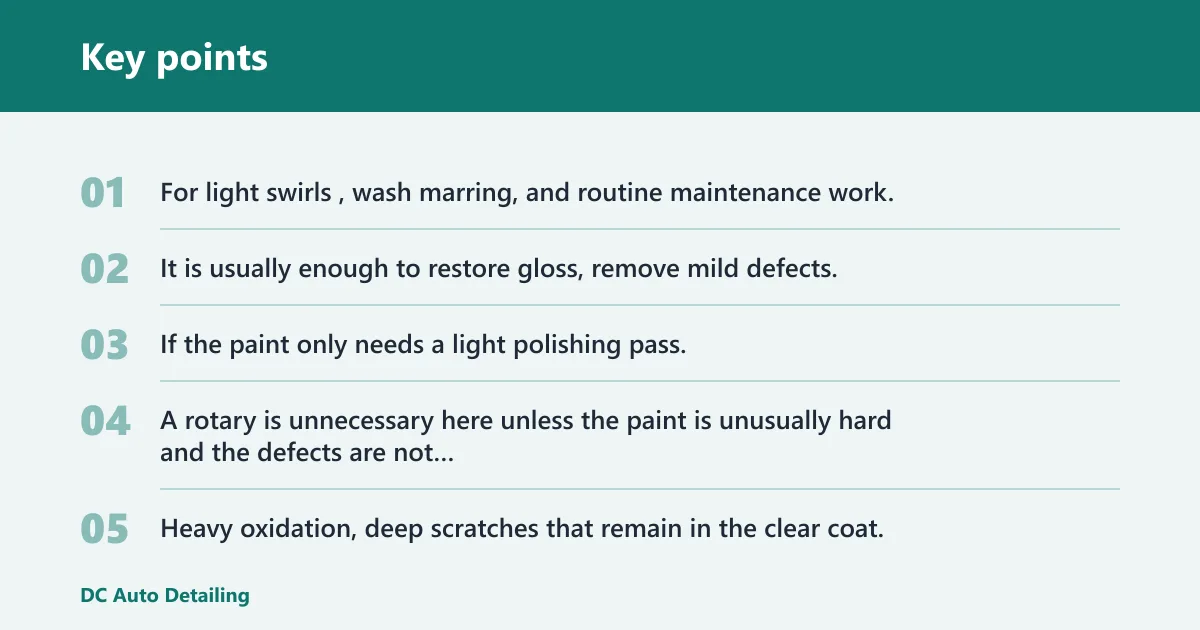
For light swirls, wash marring, and routine maintenance work, a dual action polisher is the cleaner first choice. It is usually enough to restore gloss, remove mild defects, and refine the finish without adding much risk.
If the paint only needs a light polishing pass, a medium pad with a finishing or light-cut polish is usually enough. A rotary is unnecessary here unless the paint is unusually hard and the defects are not responding.
Heavy oxidation and severe defects
Heavy oxidation, deep scratches that remain in the clear coat, and stubborn buffer trails are the situations where a rotary can be justified. The machine’s direct cut helps when a DA would need several slow passes or a more aggressive pad-product combo to make progress.
That does not mean every severe defect needs a rotary. If the damage is mostly oxidation or haze in the upper damaged layer, a DA with a microfiber or firmer foam pad may still be the cleaner option. In paint correction terms, reducing the defect safely is often better than chasing complete removal and risking excessive clear-coat removal.
Fresh repaints and thin clear coat
Fresh repaints and thin clear coat demand caution regardless of tool, but a DA usually gives you a wider margin for error. Rotary heat can move from working area to problem area quickly on edges, repainted panels, and body lines.
If the panel feels delicate, treat the rotary as a specialty tool, not the default. Start with the least aggressive pad and product that can do the job, then step up only if the defect remains and the paint responds predictably. Clear-coat safety guidance from coating and polishing manufacturers consistently emphasizes restraint near edges and high spots because film build is not uniform there.
Polisher decision matrix
| Paint condition | User skill | Machine choice | Recommended pad/product pairing | Risk level | Likely finish quality after one step |
|---|---|---|---|---|---|
| Light swirls on soft paint | Beginner | Dual action polisher | Soft foam finishing pad with a light polish | Low | High gloss with mild defect removal |
| Heavy oxidation on hard paint | Experienced | rotary | Wool or microfiber cutting pad with a compound | High | Good correction, but haze likely without a refinement step |
| Thin clear coat on an edge | Any level | Dual action polisher | Thin foam pad with a finishing polish, light pressure | Low to moderate | Safe cleanup, but full removal may be the wrong goal |
| Deep scratches on sound clear | Advanced | rotary | Cutting pad with compound, then a finishing step on a DA | High | Strong initial leveling, finish usually needs refinement |
| Finish refinement after rotary work | Intermediate to advanced | Dual action polisher | Soft foam pad with finishing polish | Low | Very good clarity after rotary cut |
| One-step correction on medium defects | Beginner to intermediate | Dual action polisher | Medium foam or microfiber pad with a one-step polish | Low to moderate | Balanced correction and finish on most daily drivers |
Say your hood has light swirls, but the paint feels soft and the car is a daily driver. A dual action polisher with a finishing pad and a mild polish is the safer first pass, because the goal is to clear the haze without creating new marks.
Suppose a black coupe has heavy oxidation on the roof, but the clear coat is otherwise sound. A rotary with a cutting pad and compound can remove the damaged top layer faster, then a DA can finish the panel and clean up any trail marks.
Light swirls on soft paint
Soft paint usually responds quickly, so the machine with the gentler motion makes more sense. A DA can clear the defect without forcing you into a harsher pad or a more aggressive compound than the panel needs.
Heavy oxidation on hard paint
Hard paint can resist a mild setup and tempt users to overwork a DA. In that situation, a rotary can save time, provided you keep the pad flat and stop as soon as the oxidation is removed enough to refine safely.
Thin clear coat on an edge
This is a warning zone. A rotary can concentrate heat on an edge fast, and that is where burn-through risk climbs first. A DA is the more controlled choice, but even then you should avoid leaning on the machine or lingering on the corner. If the defect is too close to the edge, defect reduction is safer than trying to erase it completely.
Deep scratches on sound clear
If the scratch is truly in the clear coat and the panel has enough material left, a rotary may be the right tool for the initial cut. The safer workflow is to do the heavy correction in controlled passes, then switch to a DA for refinement. Some scratches are simply too deep to remove safely without removing too much clear coat, so the correct goal is often improvement rather than full disappearance.
Finish refinement after rotary work
Rotary work can leave haze or holograms depending on pad, product, and skill. A DA is usually the better finishing tool because its motion is less likely to leave visible rotary trails once the heavy correction is done. This is one reason finishing compounds and polishes are commonly used as a second step after aggressive cut.
One-step correction on medium defects
For medium defects where you want a single pass without building a whole multi-step process, a DA often gives the best balance. Pairing the right pad and one-step product can remove enough defect while still leaving a finish that is acceptable on most daily drivers.
Can a beginner safely use a rotary polisher?
A beginner can physically hold a rotary, but that does not make it the right first machine. Rotary control demands steady pad flatness, careful trigger use, and close attention to heat, especially near edges, emblems, and panel transitions. Training from machine manufacturers and detailing education sources consistently treats rotary work as more technique-sensitive than DA polishing.
If you are still learning how different pads and products behave, start with a DA. Use the rotary only after you can keep a pad flat, read paint response, and stop before the surface starts heating too quickly or leaving a trail.
Skill level and control demands
The rotary’s single-axis motion amplifies small mistakes. A slight tilt, too much pressure, or one slow pass too many can leave holograms or create a hot spot that a beginner may not notice until after the panel cools.
Heat management and pad flatness
Heat is the main reason rotary learning takes time. Keep the pad moving, keep it flat, and reduce speed before you reach edges or sharp body lines; if the panel feels hot enough that you would not rest a hand on it comfortably, stop and inspect. Since heat buildup is related to friction, technique matters more than simply choosing a lower or higher number on the dial.
Practice areas before paint
Start on a scrap panel, an old fender, or another non-critical surface. Practice keeping the machine stable at low and mid speed before touching a customer panel or a fresh repaint, because the cost of one mistake can be a repolish or repair.
Pad and backing plate fit
Pad and backing plate fit matters because size mismatch affects balance, cut, and control. The backing plate should match the pad diameter closely enough that the pad stays stable, the machine runs without obvious runout, and the hook-and-loop or adhesive attachment stays secure.
If the plate is too large for the pad, the edge can flex too much. If it is too small, the pad may not support itself evenly, which can change how the face contacts the paint and how the machine vibrates in your hands.
Pad diameter and backing plate size
Check that the backing plate size is intended for the pad diameter you plan to use. Most systems are built around a specific fit, and forcing a mismatch can create poor balance or poor access in tight areas.
Balance, runout, and attachment style
Hook-and-loop is the most common attachment style for polishing pads, but the plate must still run true. Excess runout can make the machine harder to guide and can leave the pad bouncing instead of working evenly across the surface.
Foam, microfiber, and wool choices
Foam pads are the most common choice for finishing and lighter correction. Microfiber and wool usually cut faster, but they also raise the aggressiveness of the setup, so they are more often paired with compound on defects that need stronger removal.
Speed, compound, and pad pairing
DA speed is usually measured in OPM, while rotary speed is measured in RPM. Common manufacturer specifications place many DA machines in roughly the 2,500–6,800 OPM range and many Rotaries in roughly the 600–3,000 RPM range, but exact numbers vary by model. In practice, the better rule is to choose the lowest speed that accomplishes the correction safely, then increase only as needed.
DA speed in OPM
Lower OPM is useful for spreading product, priming a pad, or doing gentle finishing work. Mid-range settings are the practical working zone for correction on most panels, while higher settings are used when the pad and product need more motion for defect removal.
Rotary speed in RPM
Low RPM is useful for spreading product and warming up the section without immediate aggression. Mid RPM is where many correction passes happen, while high RPM should be reserved for controlled situations where the paint and the operator can tolerate the extra cut and heat.
Aggressive versus finishing abrasives
Compound uses more aggressive abrasives and is meant for heavier defect removal. Polish is lighter, and finishing polish is the final step when you want to reduce haze, improve clarity, and clean up the surface after a stronger pass.
One-step products sit between those extremes. They can be useful on medium defects, especially with a medium foam or microfiber pad, but they are not a replacement for a stronger cutting setup when oxidation or deep scratches are severe.
Priming and pressure basics
Many pads need light priming so the face works evenly from the start. Apply enough product to cover the working surface, then keep pressure modest; too much pressure reduces pad rotation on a DA and can amplify heat on a rotary.
Choose Dual action polisher if… / Choose rotary if…
Choose Dual action polisher if you want safer correction, easier finishing, and a better fit for maintenance work, light swirls, one-step correction, or fresh panels with thin clear coat. It is the stronger default for most DIY users because it is more forgiving and easier to control.
Choose rotary if the job calls for faster defect removal, especially on hard paint with heavy oxidation or deeper defects, and you can control heat, pad angle, and edge work. It also makes sense when you plan a hybrid workflow: rotary for cut, DA for refinement.
Choose Dual action polisher if the vehicle has soft paint, visible edges, or areas where burn-through risk is a concern. Choose rotary if the panel is sound, the defects are severe, and the operator can stop early instead of chasing perfection with more heat.
A common first-timer mistake is reaching for a rotary because the defect looks dramatic, then trying to fix the finish with extra passes after the panel starts to haze. A better path is to use the least aggressive tool that can still remove the defect, then step up only when the paint condition justifies it.
Frequently asked questions
Which is better for removing scratches, a dual action polisher or a rotary?
For most scratches, a rotary removes defects faster, but that does not make it the right first choice. If the scratch is light to moderate, a dual action polisher often removes it with less risk. Deep scratches may need rotary cut first, then DA refinement.
Will a dual action polisher damage clear coat?
A DA can still damage clear coat if you overwork an edge, use the wrong pad and product, or stay on one area too long. The motion is more forgiving, but it is not risk-free. Inspect thin areas and reduce pressure near body lines.
When should I use a rotary instead of a DA polisher?
Use a rotary when you need maximum cut on heavy oxidation, deep defects, or stubborn rotary trails that a DA is removing too slowly. It is the better choice when you can control heat and plan a finishing step afterward, usually with a DA.
Does a DA polisher finish better than a rotary?
In many cases, yes. A DA usually leaves less chance of visible holograms and is easier to finish cleanly on most paints. A rotary can finish well too, but only when technique, pad choice, and product choice are matched tightly to the surface.
What causes holograms when polishing with a rotary?
Holograms usually come from pad movement, pressure, speed, or abrasive choice that leaves directional trails in the paint. A rotary’s single-axis motion can create those marks if the pad is not kept flat or if the finish step is too aggressive for the paint.
Can a DA polisher handle heavy oxidation or deep defects?
Sometimes, but not always efficiently. A DA can remove heavy oxidation on some paints with the right compound and pad, yet deep defects may need more time or a stronger setup. If the panel is hard and the defect is severe, rotary cut may be justified.
Do I need both a rotary and a dual action polisher?
Not for most DIY work. A DA covers the majority of correction and finishing jobs. Owning both only makes sense if you correct often, work on varied paint systems, or want rotary cut followed by DA finishing for a more controlled hybrid process.