Car wash soap vs dish soap: What happens to your paint?
Dish soap can strip wax or spray sealant, but it is usually the wrong wash soap for paint because it gives less lubrication. Use it only when you want to remove temporary protection before reapplying it. pH alone does not determine safety; lubrication, residue, rinse behavior, and how often you wash matter too. Used too often, or with too much pressure, it raises the risk of dry washing, haze, and repaint-protection costs. This guide explains when dish soap is acceptable, when it is the wrong choice, and when re-protecting costs less than saving time.
| Decision factor | wash soap | dish soap | Winner |
|---|---|---|---|
| Paint safety for regular washing | Designed for automotive paint and clear coat | Built to cut grease and food residue | wash soap |
| Lubrication during mitt contact | Higher lubricity for better slip | Lower lubricity on painted surfaces | wash soap |
| Protection removal | Usually leaves wax and sealant in place longer | More likely to strip wax and sealant | dish soap |
| Best use case | Weekly maintenance, coated vehicles, routine care | Emergency wash or strip wash before re-protection | tie |
Why the trade-off matters
The main difference is simple: wash soap is made to clean paint with more slip, while dish soap is made to remove grease from dishes and can also strip temporary protection from paint. One careful wash usually changes protection first, not the clear coat itself. Repeat the habit, and friction, trim drying, and swirl marks become the real cost.
pH is part of the story, not the whole story
Reputable product labels and detailing guidance show that pH alone does not tell you whether a soap is safe for paint. Car wash soaps are often formulated near neutral or mildly pH-adjusted, while dish soaps are designed for kitchen degreasing; the practical difference is that paint-safe washes prioritize lubrication and residue control, not just cleaning strength.
Lubricity and rinse behavior decide the wash quality
Lubricity is the slipperiness between the mitt and the paint. Reputable detailing guidance consistently treats lubrication as the key safety factor because it helps the mitt glide rather than drag contamination across clear coat. Foam volume alone does not stop grit from moving on the surface, and a soap that rinses poorly can leave residue behind even if it looks clean in the moment.
Car wash soap also tends to rinse cleaner with less residue. Dish soap can leave a cleaner-looking panel in the moment, yet still leave less protection behind and less slip for the next wash. Reputable sources also distinguish between cleaning power and paint-safe lubrication, which is why a soap designed for dishes is not the same thing as a soap designed for automotive finishes.
Clear coat takes the friction load
Clear coat is the layer that usually sees the wash mitt first. If protection is gone and lubrication drops, the risk of fine wash-induced scratches rises. Those swirl marks often show up most clearly in direct sun, on dark paint, or after a few harsh washes in a row. The concern is usually friction-induced marring first, with direct chemical damage to the clear coat being a much less common issue from one normal wash.
Say your sedan has a dark hood with light road film and you wash it with dish soap once before a weekend event. The paint may look clean and the water may stop beading, but that result points first to lost wax or sealant, not immediate paint failure. If that same routine becomes weekly, the friction risk becomes the real problem. In other words, protection loss and texture damage are the immediate issues; clear-coat chemical harm is not the usual first outcome.
Can you use dish soap on a car?
Yes, but only in narrow situations. Dish soap can work as an emergency wash when you need to remove grime and have nothing better, or as a strip wash before fresh protection goes on. It is the wrong choice for regular maintenance because it gives less lubrication and can shorten the life of wax, sealant, or coating maintenance.
Emergency wash: acceptable with limits
If the car is covered in salt, bird residue, or sticky film and dish soap is the only option, one careful wash is usually less harmful than leaving contamination in place. Use plenty of rinse water, a clean mitt, and a gentle touch. The goal is to get the paint clean without turning a shortcut into a habit. Reputable wash guidance favors the least aggressive cleaner that still gets the job done.
Pre-wax strip wash: one legitimate use
Dish soap can serve as a strip wash before applying fresh protection because one of its jobs is to remove oily residue and weaken temporary wax or sealant behavior. That makes sense when the surface is about to be re-protected. After the strip wash, plan to apply wax, sealant, or coating maintenance right away instead of treating the wash as a normal routine.
Weekly maintenance wash: the wrong use case
Weekly washing is where dish soap causes the most avoidable compromise. Regular use can strip protection faster than you expect and leave the paint with less slip for the mitt. That combination raises the chance of haze, streaks, and fine wash marks, especially if the car is not fully lubricated and rinsed well. For routine care, reputable wash-soap guidance consistently favors automotive shampoo over kitchen soap.
What happens to wax, sealant, and ceramic coating?
Dish soap can strip wax and sealant, which changes how water behaves on the surface and shortens protection life. Ceramic coating is more durable than wax, but repeated harsh washing or aggressive degreasers can still reduce hydrophobic performance. The coating may not fail outright, yet it can stop behaving the way it should.
Wax and sealant lose their temporary layer first
Reputable detailing sources commonly note that dish soap can remove wax and sealant, which is why the immediate change after using it is often weaker beading or faster sheeting rather than visible paint damage. Protection is the first thing to go, and that is exactly why a strip wash can be useful before you reapply wax or sealant.
Ceramic coating is tougher, not immune
A coated vehicle does not need the same routine as bare paint with wax, but it still benefits from a soap that is kinder to protection. Repeated dish soap use can reduce hydrophobic behavior and make the coating look tired sooner. It can also leave the surface feeling less slick, which matters during drying and maintenance washing. For coated paint, use a coating-safe wash and reserve harsher cleaners for specific prep steps.
For a deeper look at maintenance habits for protected paint, see Ceramic coating. The important point is that a coating still depends on careful cleaning; it is durable, not invincible.
What to inspect after washing
After a dish soap wash, check three things: water beading, trim appearance, and the paint surface under good light. If beading drops sharply, protection likely needs to be renewed. If black trim looks dry or gray, the soap may have pulled oils from porous plastic or rubber. These are maintenance signals, not proof that the clear coat was chemically ruined.
- Rinse the vehicle fully and dry it with a clean microfiber towel.
- Check for streaking, white residue, or patchy water behavior.
- Apply wax, sealant, or coating maintenance if the surface has lost its protection behavior.
- Inspect trim and rubber seals for dryness, then dress them if needed.
Soap decision matrix
| Scenario | Recommended soap type | Acceptable pH range | Lubrication priority | Is dish soap acceptable? | Next protective step if dish soap was used |
|---|---|---|---|---|---|
| Emergency wash | dish soap if nothing else is available; otherwise wash soap | Use a reputable product label and avoid assuming pH alone tells the whole story | High | Yes, with restraint | Dry fully, inspect beading, reapply wax or sealant if protection was stripped |
| Weekly maintenance wash | wash soap | Near neutral or mildly pH-adjusted, depending on the product | Very high | No | Use wash soap next time; refresh protection if beading has dropped |
| Pre-wax strip wash | dish soap or wash soap formulated for strip prep | Use the product label; focus on strip behavior rather than a fixed number | Moderate to high | Yes | Apply wax, sealant, or coating maintenance after the panel is dry and clean |
| Coated-vehicle wash | wash soap | Near neutral or coating-safe as directed by the product | Very high | Usually no | If dish soap was used, inspect hydrophobic behavior and restore coating maintenance as needed |
Emergency wash
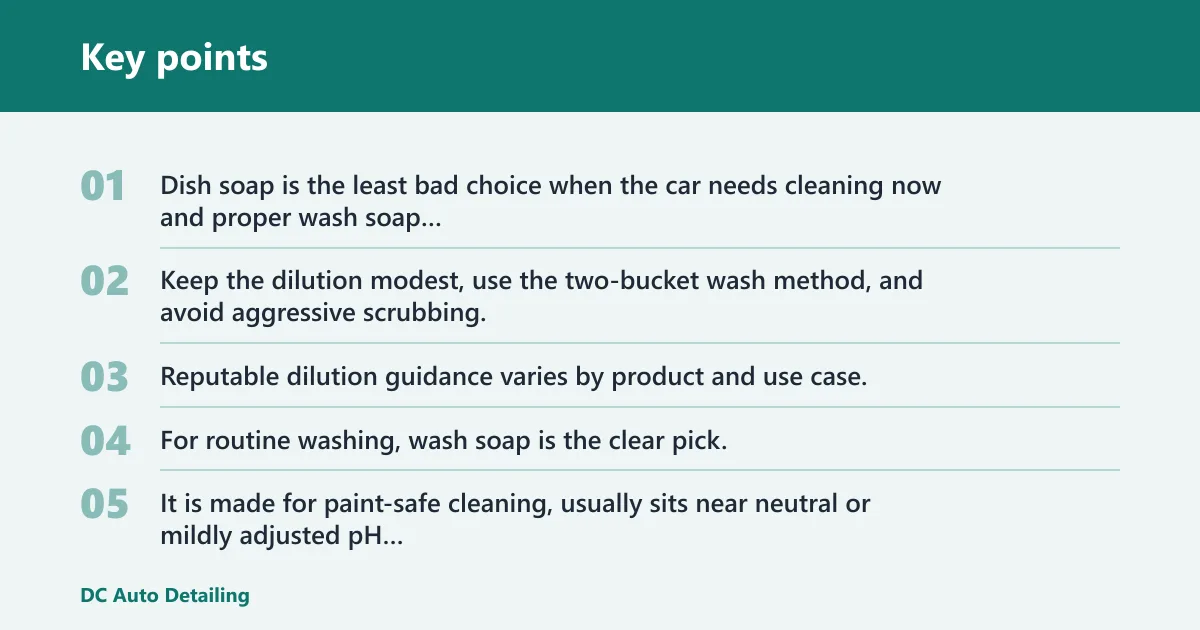
Dish soap is the least bad choice when the car needs cleaning now and proper wash soap is unavailable. Keep the dilution modest, use the two-bucket wash method, and avoid aggressive scrubbing. Reputable dilution guidance varies by product and use case, so follow the bottle rather than treating a single universal ratio as a rule. Stronger is not safer.
Weekly maintenance wash
For routine washing, wash soap is the clear pick. It is made for paint-safe cleaning, usually sits near neutral or mildly adjusted pH depending on the formula, and carries more lubrication for the mitt. That combination matters more than cleaning power alone because the goal is to remove dirt without moving grit across the clear coat.
Pre-wax strip wash
This is the use case where dish soap has a real purpose. If you want old wax, sealant, or coating maintenance out of the way before new protection goes on, a strip wash can help. The key is not to let “strip wash” become the default for every wash. Once the surface is clean, re-protect it promptly.
Coated-vehicle wash
On ceramic-coated paint, wash soap is still the safer standard because the coating’s hydrophobic behavior depends on keeping the surface clean without unnecessary harshness. Dish soap may not destroy the coating in one pass, but repeated use can reduce the water behavior that owners expect from a coated car. That is a maintenance problem, not a myth.
For a broader buying and care context, see Ceramic coating. The coating discussion matters here because the wash choice can either preserve the finish behavior you want or make maintenance feel less effective over time.
Choose wash soap if… / Choose dish soap if…
Wash soap wins for routine paint care. Dish soap wins only when the goal is to remove temporary protection on purpose or when an emergency wash is the only realistic option. The right pick depends on whether you want to keep protection in place or strip it now.
Choose wash soap if…
- You wash the car weekly or on a normal maintenance schedule.
- The car has wax, sealant, or ceramic coating you want to keep in place.
- You care about higher lubricity, cleaner rinsing, and lower swirl risk.
- You want the easiest path to preserving beading and trim finish.
Choose dish soap if…
- You need an emergency wash and have no proper wash soap on hand.
- You are doing a strip wash before applying fresh wax or sealant.
- You are cleaning non-painted surfaces such as engine bays or wheel wells when diluted.
- You are willing to re-protect the paint right after the wash.
What to use instead if you have nothing on hand
If the choice is between dish soap and no wash at all, dish soap can be the fallback. But for regular care, a dedicated wash soap is the better answer because it is built for painted panels, not grease on plates. If the vehicle is already protected, the safer habit is to keep that layer in place rather than strip it away again and again.
How to wash without adding swirl marks
Swirl marks come from dragging dirt across clear coat with too little lubrication. The two-bucket method helps because one bucket holds soap and the other holds rinse water for the mitt. That reduces grit transfer, which matters even more if the soap itself is less slippery. When swirls do build up, the fix is often paint correction, not just another wash.
Two-bucket wash method
Use one bucket for the wash solution and one for rinsing the mitt after each pass. Load the mitt with clean solution, wash a small section, then rinse out debris before reloading. This is a basic control step, but it matters more when the soap is weaker on lubrication.
Mitt control and rinse discipline
Keep pressure light and let the soap do the work. If the mitt starts to grab, stop and reload it rather than pushing through resistance. That simple pause can prevent the kind of fine scratching that later looks like dull paint under sunlight.
Drying and spot-minimizing steps
Dry the car fully so water spots do not set in, especially after a dish soap wash that may rinse less cleanly. Pay extra attention to mirrors, emblems, trim edges, and lower door panels where residue collects. If you see streaking or hard-water marks, a quick rinse and re-dry is better than letting them bake on. If the wash left visible haze or repeated micro-marring, the next step may be paint correction.
Picture a white SUV that was washed with dish soap after a muddy road trip. If the owner dries it well and re-waxes the hood and roof the same day, the main issue is protection loss. If the same wash repeats for several weeks, the more likely result is dull trim, weaker beading, and a higher chance of visible wash marks.
Cost comparison: shortcut now, cost later
Dish soap looks cheaper at the register, but the real cost is what happens after the wash. If it strips wax or sealant, you spend time reapplying protection. If repeated use adds swirl marks, the next bill can include paint correction, not just another bottle of product.
A proper wash soap is usually the lower-risk purchase because it supports the protection already on the car. The small soap savings from dish soap can vanish if you need to re-wax more often, refresh sealant sooner, or correct paint haze after repeated harsh washing.
Frequently asked questions
Can you use dish soap to wash a car?
Yes, but only in limited situations. Dish soap can clean the surface and strip temporary protection, which makes it useful for an emergency wash or a strip wash before new wax or sealant. It is not the right soap for regular maintenance because it gives less lubrication than wash soap. For most owners, that makes it a backup product rather than a routine one.
Will dish soap ruin car paint?
One wash usually does not ruin paint by itself. The more immediate effect is lost wax or sealant, followed by less slip during washing. Repeated use raises the risk of swirl marks, haze, and dried trim because the paint is being washed without the level of lubrication it was designed to get. Direct chemical damage to the clear coat is not the usual first concern.
Does dish soap strip wax off a car?
Yes. That is one of the main reasons people use it before re-protecting a vehicle. Reputable detailing sources commonly note that dish soap can weaken or remove wax and sealant because it is designed to cut grease, not preserve paint protection. After that, protection should be reapplied.
Is dish soap bad for clear coat?
It can be, if you use it often or wash with too little lubrication. Clear coat is the layer that takes the friction load, so once protection is stripped, the mitt has less slip against the surface. That raises the chance of fine scratches and dull-looking paint over time. The bigger danger is usually wash marring, not immediate chemical failure.
What happens if I wash my car with Dawn?
Dawn behaves like other dish soaps in this context: it can remove grease and also strip wax or sealant from paint. A one-time wash is usually more of a protection-loss issue than a paint-damage issue. The next step is to dry the vehicle and restore wax, sealant, or coating maintenance if needed. If the surface looks hazy later, the issue is often friction or residue rather than paint destruction.
Can you use dish soap on a ceramic coated car?
It is not the first choice. Ceramic coating is more durable than wax, but repeated dish soap use can reduce hydrophobic performance and leave the surface less slick. For coated paint, wash soap is the safer maintenance choice because it cleans without pushing the coating toward faster fade. If the coating’s water behavior changes, the issue is usually maintenance loss before any coating failure.
When is dish soap okay to use on a car?
Dish soap is okay as an emergency wash or as a strip wash before new protection goes on. It can also be used, when diluted, on non-painted surfaces such as engine bays or wheel wells. Outside those cases, wash soap is the better choice for paint, trim, and long-term finish care. The safest answer is to use it sparingly and only when its stripping behavior is the point.
What should I use instead of dish soap to wash my car?
Use a dedicated wash soap made for automotive paint. The better products are designed for lubricity and rinse cleanly without stripping protection as aggressively. If the car has wax, sealant, or a coating, that is the safer route for regular washing. For coating maintenance, a coating-safe wash is the best fit because it supports both cleaning and finish behavior.