Wheel cleaner vs iron remover: Which should you use?
Use Wheel cleaner for routine brake dust and dirt; use iron remover when you need to dissolve bonded iron fallout embedded in the wheel finish. Using the wrong chemical can waste time, leave residue, or let contamination keep etching the surface. This guide explains what each product does, when to choose one over the other, and how to use them safely on different wheel finishes.
| Decision factor | Wheel cleaner | iron remover | Winner |
|---|---|---|---|
| Main job | Maintenance cleaning for road film, grease, tire residue, mud, and loose brake dust | Decontamination for bonded ferrous particles embedded in the finish | tie |
| Best timing | First-pass wash product before agitation and rinsing | Used after washing when roughness or iron spots remain | tie |
| Contamination type | Loose soil and surface grime | Metal fallout, orange-brown specks, and embedded particles | tie |
| Surface compatibility | Depends on formula and label; can be pH-neutral, alkaline, or acidic | Depends on label chemistry and finish compatibility | tie |
| Routine wheel care | Usually the better default | Only when contamination remains after washing | Wheel cleaner |
When each product is the better choice
Wheel cleaner is a maintenance cleaner for loose dirt, road film, and brake dust sitting on the surface. Iron remover is for bonded ferrous contamination that clings to the finish after washing. Brake dust can include iron from pad and rotor wear, so one wheel may need both products in sequence.
Main job
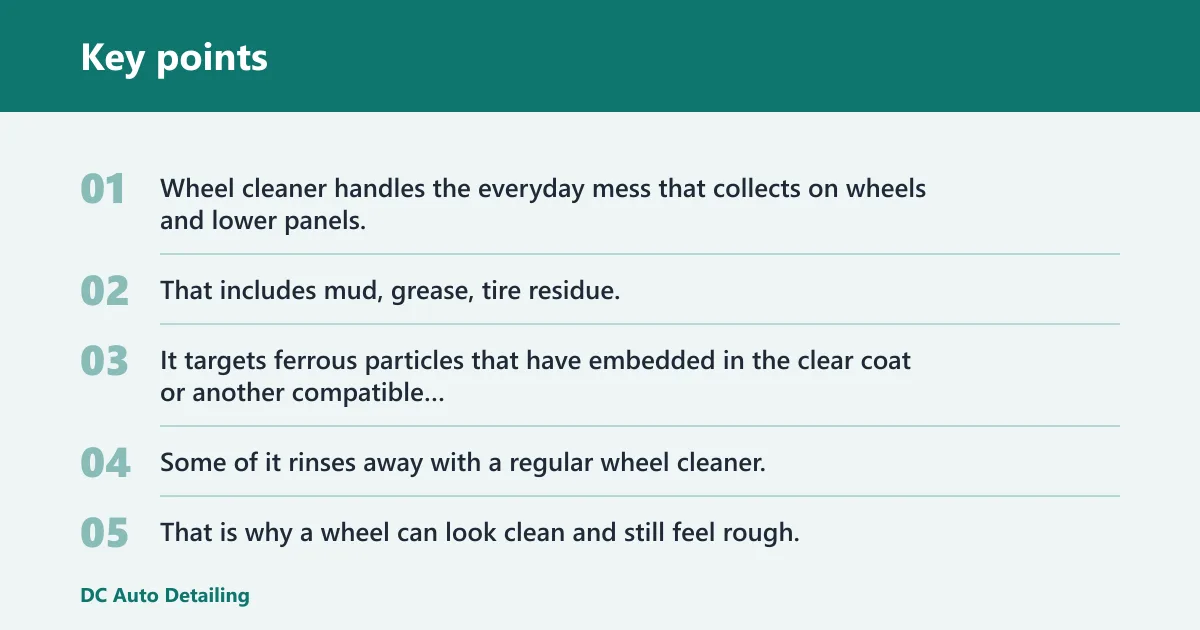
Wheel cleaner handles the everyday mess that collects on wheels and lower panels. That includes mud, grease, tire residue, and loose brake dust that has not fully bonded to the finish.
Iron remover is different. It targets ferrous particles that have embedded in the clear coat or another compatible finish, where normal washing leaves roughness and orange-brown specks behind.
Why brake dust can need two steps
Brake dust is not one single contaminant. Some of it rinses away with a regular wheel cleaner, but some particles oxidize and stick to the surface. That is why a wheel can look clean and still feel rough.
Say your front wheels turn dark after a week of commuting, and a normal wash removes the gray film but leaves tiny orange dots around the spokes. Wheel cleaner has handled the loose grime; iron remover is the better next step for the bonded spots.
Should I use wheel cleaner or iron remover first?
Start with wheel cleaner, then use iron remover only if washing leaves behind bonded contamination. A common cleaning order is pre-rinse, wash, chemical dwell, light agitation if needed, and then a thorough rinse. That order cuts down the amount of soil both products have to attack.
Pre-rinse and wash before chemical use
Rinse the wheel first to knock off loose grit. Then wash away the bulk of the dirt before applying either chemical, because both products work better on a cleaner surface and should not be asked to sit on heavy mud or sludge.
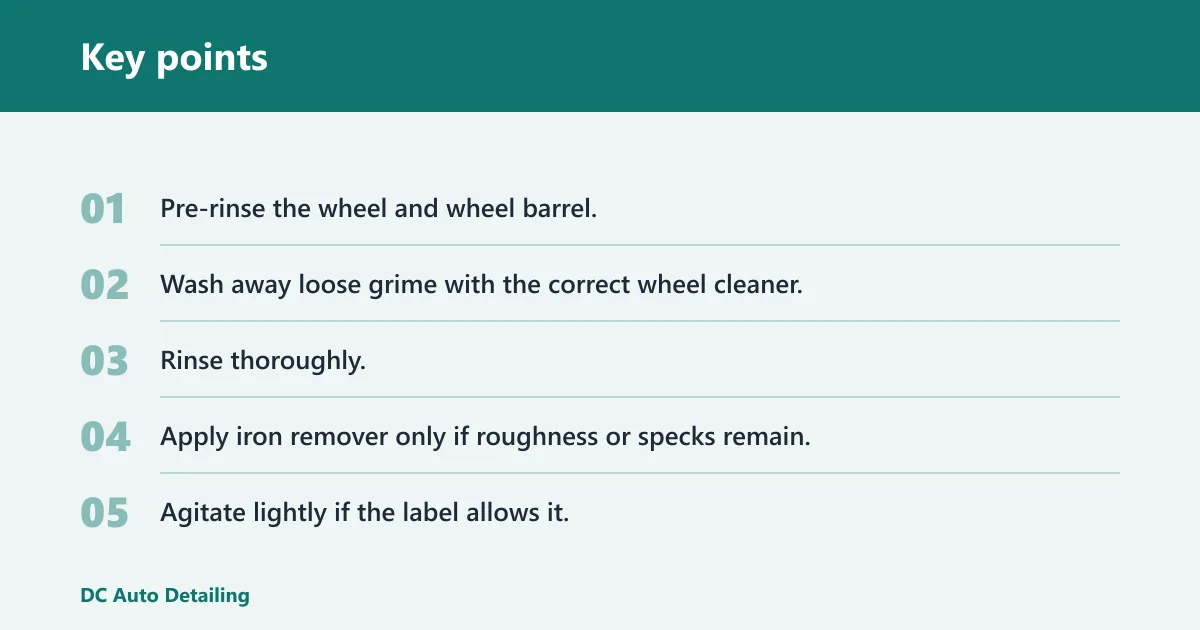
- Pre-rinse the wheel and wheel barrel.
- Wash away loose grime with the correct wheel cleaner.
- Rinse thoroughly.
- Apply iron remover only if roughness or specks remain.
- Agitate lightly if the label allows it.
- Rinse again until no residue remains.
When to follow wheel cleaner with iron remover
Use iron remover after wheel cleaner when the wheel still shows orange-brown specks, feels gritty, or has a bonded fallout layer that survives a normal wash. That sequence is common on wheels exposed to heavy braking or constant highway dust.
A common first-timer mistake is assuming a purple reaction means the wheel is fully clean. The color change only shows that the product reacted with iron contamination; it does not prove every contaminant is gone.
When wheel cleaner is enough
Wheel cleaner is enough when the contamination is mostly surface dirt. If the wheel has road film, grease, tire residue, mud, or loose brake dust after a regular wash, a proper wheel cleaner can handle the job without a second chemical step.
Road film, grease, and tire residue
These soils sit on top of the finish and are the kind of contamination wheel cleaner is designed to remove. A pH-neutral, alkaline, or acidic formula may be appropriate depending on the wheel type and the label directions.
Choose the product that matches the finish and the soil load. Stronger chemistry is not the goal; the goal is matching the cleaner to the residue you actually have.
Loose brake dust after a regular wash
If the brake dust wipes or rinses away easily, wheel cleaner is usually the right first and often only step. That keeps the process simple and reduces the risk of overusing a decontamination product when the contamination has not bonded yet.
What iron remover does differently
iron remover targets bonded ferrous contamination that wheel cleaner may leave behind. It is commonly thioglycolate-based, and the familiar purple, red, or orange bleeding reaction comes from the chemical reacting with iron contamination, not from a stain indicator.
Bonded ferrous contamination
Ferrous contamination can embed in clear coat and leave a rough feel or orange-brown specks. Once the particles oxidize and anchor themselves in the surface, normal wash chemistry has limited effect.
That is where iron remover earns its place. It is a decontamination step, not a routine maintenance cleaner, and it works best after the wheel has already been washed.
What the color change can and cannot tell you
The bleeding color means the product is reacting with iron contamination. It does not tell you how much contamination was present, and it does not guarantee the wheel is free of all dirt, tar, or mineral deposits.
Use the reaction as a clue, then inspect the surface. If the wheel still feels rough after rinsing, the finish may need another controlled decontamination pass or a different treatment for non-ferrous residue.
Wheel contamination guide
Iron remover is most useful when the wheel still shows contamination after washing. Look for rough texture, specks that do not rinse away, and fallout that seems bonded into the finish rather than sitting on top of it.
Signs your wheels need iron remover
Visual clues matter, but touch matters too. Orange-brown dots, stubborn specks near spoke edges, and a gritty feel after washing all point toward ferrous contamination instead of simple surface dirt.
If the wheel looks clean but feels sandpapery in a few areas, that is a strong signal that bonded metal particles remain. Wheel cleaner alone may not remove them.
Surface feel and visible fallout
Run a clean hand over the rinsed wheel only when it is cool and free of loose grit. A rough finish or tiny embedded specks usually means the contamination is below the surface level that wheel cleaner reaches.
Picture a silver clear-coated wheel with light road film gone but small orange flecks still sitting behind the spokes. That is the kind of wheel that often benefits from iron remover after the wash step.
Will it damage wheel finishes?
Both products can be safe on the right wheel, but finish type, temperature, and label directions matter. Check compatibility for clear-coated alloy, powder-coated, chrome-plated, and polished bare aluminum wheels before you spray anything.
Clear-coated alloy and powder coat
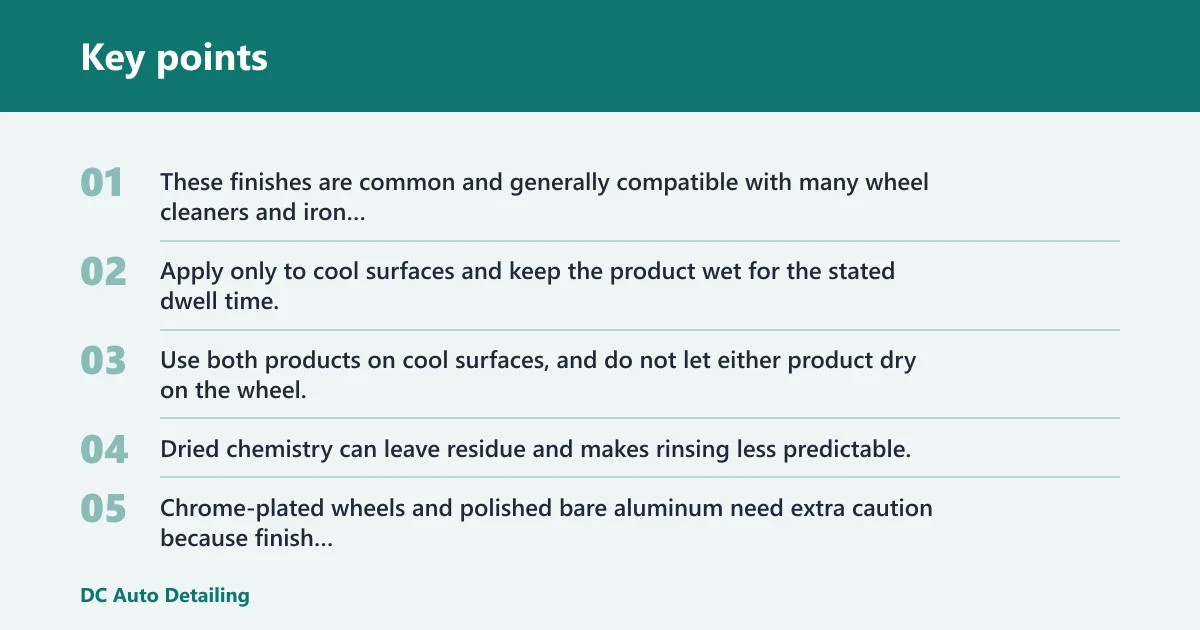
These finishes are common and generally compatible with many wheel cleaners and iron removers, as long as the label says so. Apply only to cool surfaces and keep the product wet for the stated dwell time.
Use both products on cool surfaces, and do not let either product dry on the wheel. Dried chemistry can leave residue and makes rinsing less predictable.
Chrome-plated and polished bare aluminum
Chrome-plated wheels and polished bare aluminum need extra caution because finish sensitivity varies. Compatibility on the label matters more here, especially with acidic wheel cleaners and with any product not explicitly approved for bare metal.
Use the mildest approved option first. If the wheel finish is unclear or delicate, test a small hidden area and rinse promptly.
Heat, dwell time, and label checks
Surface temperature changes how fast chemicals dry and how long they remain safe to use. A common rule of thumb is to work on cool wheels and follow the label’s dwell time rather than stretching it.
Most manufacturers list a short dwell window for wheel cleaner, often about 1 to 3 minutes, while iron remover is commonly left for about 3 to 7 minutes. Those products must stay wet for the full dwell period and should not dry on the surface.
Choose Wheel cleaner if…
Wheel cleaner is the right pick if the wheel mainly has road film, grease, tire residue, mud, or loose brake dust. It is also the better first-pass product when you are doing regular maintenance and the finish does not show signs of embedded fallout.
Routine maintenance use
Use wheel cleaner when you want a fast, finish-aware wash step that lifts surface grime before you agitate and rinse. That keeps the process focused on ordinary contamination instead of decontamination.
If the wheel is clean enough after that step, stop there. There is no need to add iron remover unless the surface still shows bonded contamination.
Best-fit use case
Choose wheel cleaner for clear-coated alloy wheels after a normal commute, for powder-coated wheels with grime buildup, and for any wheel where the main issue is visible dirt rather than embedded specks. It is the everyday choice.
Choose iron remover if…
iron remover is the right pick if the wheel still feels rough after washing or shows orange-brown specks that do not rinse away. It is designed for bonded ferrous contamination, especially when brake dust has embedded into the finish.
After-wash decontamination
Use iron remover after the wheel has been rinsed and washed, not as a replacement for the wash step. That order gives the chemical a cleaner surface to work on and reduces wasted product.
If the wheel still feels gritty after the rinse, iron remover is the better tool. If the surface is smooth and the contamination is only loose soil, wheel cleaner is enough.
Best-fit use case: choose iron remover
Choose iron remover for wheels with stubborn fallout, for finishes that keep showing orange specks after cleaning, and for decontamination on compatible clear-coated, powder-coated, chrome-plated, or polished bare aluminum wheels when the label allows it. It is a targeted step, not a routine one.
Frequently asked questions
What does iron remover do that wheel cleaner can’t?
Iron remover dissolves or loosens bonded ferrous contamination that wheel cleaner usually cannot reach. That includes embedded brake dust particles and fallout that leave a rough feel or orange-brown specks after washing. It is a decontamination product, not a general wash cleaner.
Can iron remover replace wheel cleaner?
No. Iron remover is not a full replacement for wheel cleaner because it is aimed at bonded iron, not everyday grime like road film, grease, mud, and tire residue. You still need a wheel cleaner for routine washing and surface soil removal.
Do I need both products for brake dust?
Not every time. Loose brake dust often comes off with wheel cleaner alone, while bonded brake dust may need iron remover after washing. Use both only when the wheel still shows roughness, specks, or embedded fallout after the first cleaning step.
Will iron remover damage painted or coated wheels?
It can be safe on painted or coated wheels if the label says the product is compatible and you use it on a cool surface for the stated dwell time. Problems usually come from using the wrong formula, letting it dry, or leaving it on a finish it was not meant for.
How do I know if my wheels need iron remover?
After washing, feel for roughness and look for tiny orange-brown specks or stubborn fallout spots. If the wheel still feels gritty or looks contaminated in the spoke edges, iron remover is a good next step. If the wheel feels smooth, wheel cleaner was probably enough.