Do car washes cause swirl marks?
Yes—car washes can cause swirl marks, but the risk comes from trapped grit, poor pre-rinse, dirty wash media, and careless drying, not the wash label alone. Automotive paint-care guidance from manufacturers and detailing standards consistently points to contamination control and drying technique as the key factors in preventing clear-coat marring.
Do car washes cause swirl marks?
Yes, they can. The biggest risk is abrasive contamination: dirt caught in brushes, cloth, mitts, or towels can drag across the clear coat. OEM wash guidance and detailing standards emphasize that safe washing is mostly about keeping grime off the paint, then drying without reintroducing it.
Why a wash can reveal old marring instead of creating it
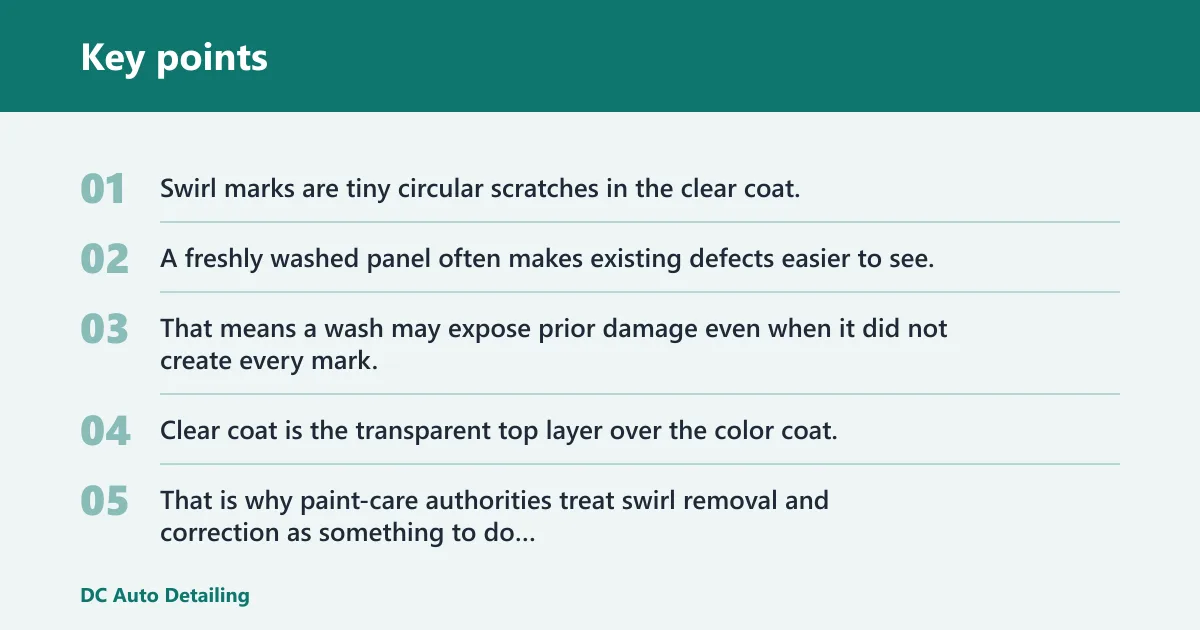
Swirl marks are tiny circular scratches in the clear coat, and they show most clearly in direct sun or strong artificial light. A freshly washed panel often makes existing defects easier to see, especially on dark paint. That means a wash may expose prior damage even when it did not create every mark.
Clear coat is the transparent top layer over the color coat, and it is thin enough that repeated polishing must be approached carefully. That is why paint-care authorities treat swirl removal and correction as something to do sparingly, only when the finish actually needs it.
What swirl marks are on car paint
Swirl marks are fine circular scratches in the clear coat. They are not the same as water spots, which are mineral deposits, or deep random scratches vs swirl marks, which usually cut more sharply through the finish. Swirls often look like haze, spiderwebbing, or a ring pattern under bright light.
Dark paint tends to show those defects first because the contrast is stronger. That is why black and deep blue vehicles often look perfect in shade, then suddenly show gray haze or webbing under sunlight, LEDs, or fluorescent bay lighting.
Why dark paint shows them first
On black or deep blue paint, even light marring reflects overhead LEDs, sun angle, and garage lighting. The defect is still there on lighter colors, but the eye catches it sooner on dark panels. That is why owners of black cars often notice wash-related marring first.
If a black sedan looks fine in the driveway but suddenly shows a faint gray haze under bright white lights, the wash did not necessarily create a new defect in that moment. More often, it made an existing clear-coat problem easier to see.
How wash type changes the risk
Wash type changes risk because each method handles contact, grit, and drying differently. Touchless washes reduce direct abrasion, while contact washes can be safe only when the system is well maintained and the vehicle is pre-rinsed thoroughly. The tradeoff is that less contact can also mean more leftover traffic film.
Automatic car wash
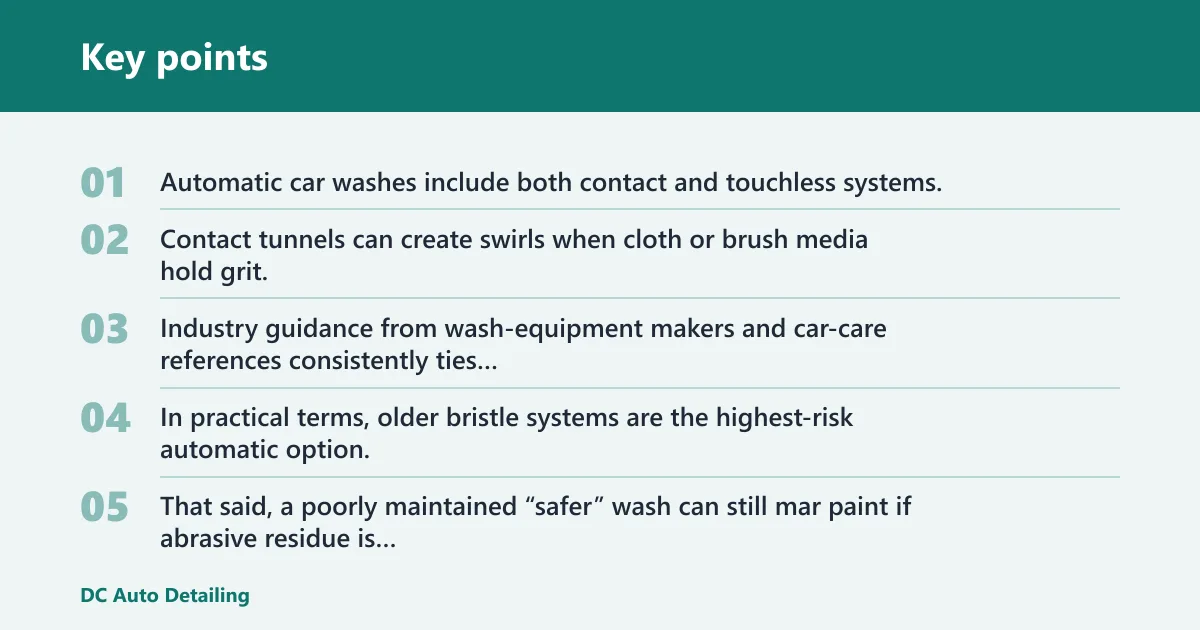
Automatic car washes include both contact and touchless systems. Contact tunnels can create swirls when cloth or brush media hold grit, when the pre-rinse is weak, or when the vehicle arrives heavily soiled. Industry guidance from wash-equipment makers and car-care references consistently ties scratch risk to maintenance quality and contamination control.
In practical terms, older bristle systems are the highest-risk automatic option, soft-cloth tunnels are usually a middle ground, and touchless systems are the lowest-contact option. That said, a poorly maintained “safer” wash can still mar paint if abrasive residue is being carried across the surface.
Touchless wash
Touchless washes use high-pressure water and detergents instead of physical contact, so they reduce brush-related scratch risk. That makes them a strong choice for keeping new marring to a minimum. The tradeoff is cleaning power: stubborn road film, winter salt, bug residue, and bonded grime can remain if the cycle is too mild.
That matters because owners sometimes create a second problem by dry-wiping leftover film after the wash. If contamination is still stuck to the panel, a towel dragged across it can still leave micro-marring even without brushes.
Hand wash
A hand wash is usually the safest option when the mitt, rinse water, and drying towel stay clean. The two-bucket wash method helps by keeping one bucket for shampoo water and one for rinsing the mitt, which reduces the chance of reintroducing grit. Microfiber wash mitts are preferred because they hold contaminants away from the paint better than hard sponges.
Drying is part of the wash, not a separate cleanup step. A clean microfiber drying towel reduces drying-induced marring, while dirty towels, spot wiping, and dragged debris can leave visible marks even after a careful wash.
Wash-risk decision table
This table uses a 1 to 5 scale. Lower contact risk is better. Lower pre-rinse dependence means the wash is less likely to fail if the car is not perfectly prepped. Lower drying risk is better. Higher scores for cost and time mean more cost or time.
| Wash type | Contact risk | Pre-rinse quality dependence | Drying risk | Cost/time | Best use by dark paint | Best use by neglected paint | Best use by winter salt | Best use by existing swirl severity |
|---|---|---|---|---|---|---|---|---|
| Touchless automatic | 1 | 4 | 2 | 2 | Good when you want the lowest contact risk | Poor if heavy film remains | Strong for routine salt removal, weaker on bonded grime | Best for light-to-moderate swirl prevention |
| Modern soft-cloth tunnel | 3 | 3 | 2 | 2 | Acceptable if the tunnel is well maintained | Okay only when the pre-rinse is strong | Useful when salt needs faster removal | Can be fine on already marred paint, but not ideal for preserving a flawless finish |
| Older nylon-bristle automatic | 5 | 3 | 2 | 1 | Not recommended | Only if no better option exists | Works for removal, but highest scratch concern | Worst choice for swirl prevention and likely to add more marring |
| Self-serve brush bay | 4 | 3 | 3 | 2 | Only if you avoid the bay brush and control the contact yourself | Useful for a quick rinse of very dirty panels | Helpful for heavy salt rinse, but drying still matters | Risky if the equipment brush touches paint |
| Two-bucket hand wash | 2 | 2 | 1 | 4 | Best choice for black or dark paint | Best if the paint already has swirl marks and you want to avoid adding more | Very good after winter driving if you can manage the time | Best all-around choice for preserving or improving finish condition |
| Water-only rinse with no drying care | 3 | 5 | 5 | 1 | Not recommended | Not recommended | Not enough for winter salt buildup | High chance of spotting, residue, and wipe-induced marring |
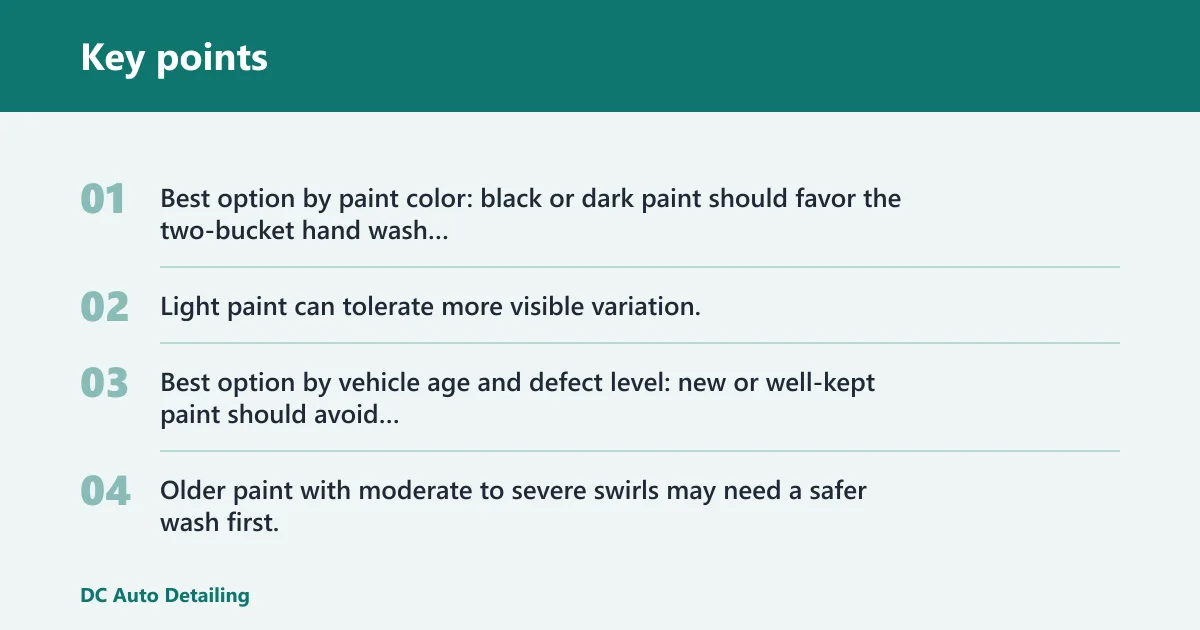
Best option by paint color: black or dark paint should favor the two-bucket hand wash first, then a touchless automatic wash if contact control is uncertain. Light paint can tolerate more visible variation, but the same wash discipline still protects the finish.
Best option by vehicle age and defect level: new or well-kept paint should avoid higher-risk contact systems. Older paint with moderate to severe swirls may need a safer wash first, then paint correction later if the finish still bothers you.
What causes swirl marks on car paint?
Grit trapped in brushes, mitts, or towels is the most common cause. Dry wiping or dragging dirt across the clear coat can add fine circular scratches, especially when the panel is only partly rinsed. Repeated maintenance washes on already damaged paint can also make swirls more obvious over time.
Brushes, mitts, and towels that hold grit
Any wash media that keeps abrasive dirt against the paint can leave a pattern of fine marring. That includes dirty automatic wash cloths, a neglected wash mitt, or a drying towel that picked up grit from the floor or trim. Microfiber helps, but only when it is clean and dedicated to automotive use.
Drying and final wipe-down mistakes
The drying step is a common failure point. Spot wiping a door, trunk lid, or mirror cap can drag trapped particles in short circles. Door jamb drips can also tempt owners to wipe quickly, but a gritty towel used there can spread marks onto adjacent panels.
Many detailing references note that drying can do more damage than the wash itself when the towel is dirty or the panel is not fully rinsed. If residue remains, the towel is effectively sanding the paint rather than drying it.
Start by removing loose grit before any contact. Then keep the contact step controlled, and finish with clean drying. That sequence matters more than chasing a “safe” wash label, because each step can either reduce or add marring.
- Pre-rinse the car thoroughly before touching paint.
- If washing by hand, use the two-bucket method with clean shampoo water and a separate rinse bucket.
- Use a microfiber wash mitt, not a household brush or hard sponge.
- Rinse the mitt often so grit does not build up.
- Dry with a clean microfiber drying towel.
- Do not spot wipe dusty panels or drag a towel over dry grime.
- Watch door jambs, mirror bases, and panel edges for trapped runoff before final wipe-down.
Wash in shade or indoors when possible. Car-care guidance from wash systems and detailing standards points to cooler, shaded conditions because they make residue easier to see and reduce rushed drying. That matters most when you are checking for leftover film before touching the paint again.
How to inspect for swirls under sunlight or LED light
Inspect the paint in direct sunlight, under overhead LEDs, or with a strong handheld light aimed across the panel at an angle. Swirls usually show as circular haze, spiderwebbing, or faint arcs rather than straight lines. If the defect appears only in strong light, you are likely seeing clear-coat marring rather than staining.
Dark paint makes inspection easier, but the same check works on any color. Move around the car and change the viewing angle, because swirls often disappear head-on and reappear when the light hits the panel from the side.
Do swirl marks go away with wax or correction?
Wax and glaze can hide swirl marks temporarily, but they do not remove them. They may improve gloss and soften the look of the defects in normal lighting, but the scratches remain in the clear coat. For true removal, paint correction is the right fix.
When paint correction is the right fix
Paint correction is the proper way to remove swirl marks when the defect level is moderate or more noticeable. Machine polishing levels the clear coat around the scratch until the marring becomes much less visible. The goal is to remove as little material as needed while restoring clarity and gloss.
Because clear coat is finite, aggressive polishing should be reserved for situations where the finish really needs it. That is why many OEM and detailing sources treat correction as a repair step, not a routine maintenance step.
Wax, glaze, and their limits
Wax and glaze are useful when you want a temporary improvement before a full correction. They can reduce the appearance of swirls, but they do not solve the underlying scratch pattern. If the defect returns in direct light, the finish still needs correction or a better wash routine.
Frequently asked questions
How do I know if my car has swirl marks after a wash?
Look at the paint in direct sunlight or under bright artificial light. Swirl marks show as fine circular scratches or a hazy spiderweb pattern, especially on dark panels. If the surface looks dull in strong light but fine in shade, you are likely seeing swirls rather than stains.
Are touchless car washes safer for paint?
Usually yes, because they avoid brush or mitt contact. That lowers scratch risk, which is why touchless automatic often ranks lowest among automatic systems. They can still leave road film behind, so you may need a careful follow-up if the paint is still grimy.
Can automatic brush washes create swirl marks?
Yes, especially when the brushes or cloth media hold grit or the system is poorly maintained. Modern soft-cloth tunnels are generally safer than older nylon-bristle systems, but neither is defect-free. The pre-rinse and maintenance standard matter as much as the wash label.
Do swirl marks go away with wax or glaze?
No. Wax and glaze can hide the marks for a while by improving gloss and filling the look of the defect, but they do not remove the scratches. If you want the finish corrected, paint correction with machine polishing is the proper fix.
How do I prevent swirl marks when washing my car?
Pre-rinse first, then use a clean microfiber wash mitt with the two-bucket method. Keep the mitt and drying towel clean, and avoid spot wiping dusty panels. Finish with a clean microfiber drying towel so grit does not get dragged back across the clear coat.
Sources
- Automotive OEM owner’s manuals and paint-care instructions: wash with approved materials, avoid abrasive tools, and dry carefully to protect clear coat.
- Meguiar’s detailing guidance: safe wash technique, microfiber use, and minimizing wash-induced marring.
- 3M automotive care and refinishing references: clear-coat protection, polishing limits, and defect removal basics.
- International Carwash Association and equipment-maintenance guidance: tunnel maintenance, pre-rinse quality, and contamination control in automated washes.
- Detailing training standards and industry references: two-bucket washing, microfiber handling, and drying as a high-risk step for marring.