Why do car carpet stains keep coming back after cleaning?
Car carpet stains come back when cleaner, moisture, or contamination stays below the visible surface. As the carpet dries, that material moves back up. Leave it alone and you keep treating the same spot, using more product while odor and mildew risk climb. This guide shows how to tell wicking from residue and deeper leak-driven contamination, then what to do next.
Why do car carpet stains come back?
A returning stain usually means the stain was never removed from the hidden layers. The visible fibers may look clean right after scrubbing, then dissolved soil, dye, or cleaner residue moves back to the top as the carpet dries. In vehicle interiors, that hidden reservoir often sits in backing, padding, jute, foam underlayment, or wet floor insulation.
Phantom stain versus true stain return
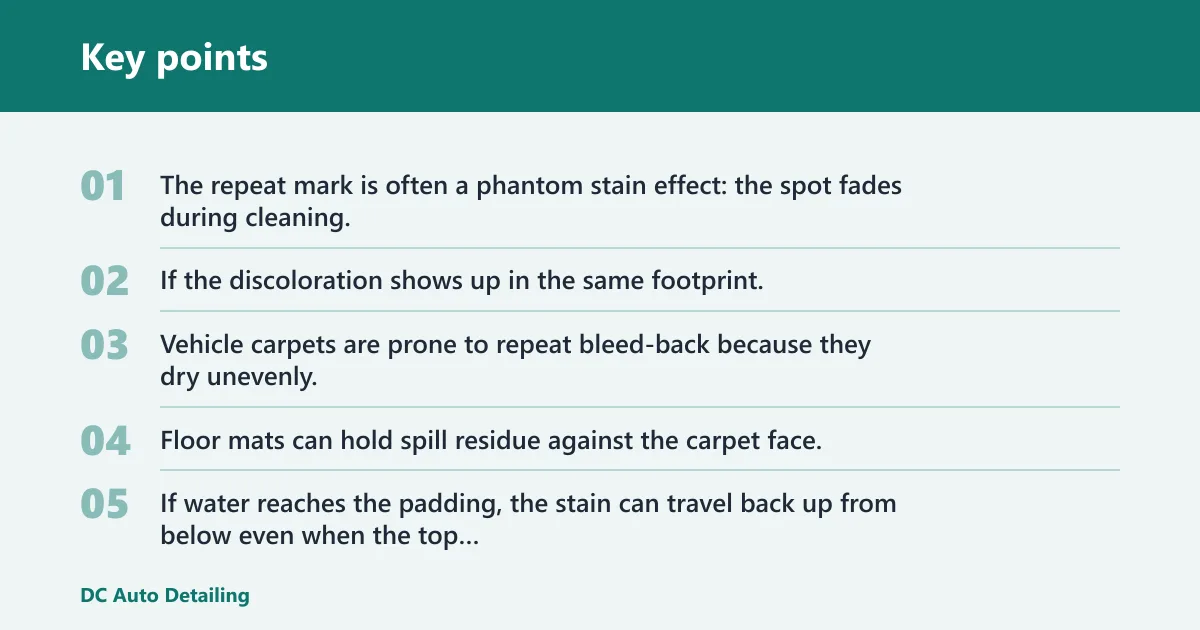
The repeat mark is often a phantom stain effect: the spot fades during cleaning, then reappears after drying. That is different from a true new spill. If the discoloration shows up in the same footprint, the source is usually still inside the carpet structure rather than on the surface.
Vehicle carpets are prone to repeat bleed-back because they dry unevenly. Seat rails block airflow. Footwells trap moisture. Floor mats can hold spill residue against the carpet face. If water reaches the padding, the stain can travel back up from below even when the top layer looked clean.
Why vehicle carpets are prone to repeat bleed-back
Carpet stains can be larger in the backing than they appear on the surface. That matters because a small visible spot can hide a much wider contaminated area below it. Once that lower layer stays damp, the stain can rise again during drying.
For example, a small coffee spot in the passenger footwell may look gone after a quick scrub, then a tan ring may reappear around the same area a couple of hours later. That pattern points to dissolved residue or coffee solids still sitting below the visible fibers, not a fresh spill.
Wicking: the main reason stains reappear
Wicking is the upward flow of water and dissolved material as carpet dries. The carpet acts like a straw. Moisture moves up through the fibers, and it carries stain material with it. That is why a spot can look better right after cleaning and worse once the area dries.
How capillary action pulls soil upward
As the surface dries, the remaining dampness in the backing or padding draws liquid toward the face fibers. Any dissolved soil moves with it. That process is more likely when moisture remains trapped below the surface, especially in thick carpet, under-seat zones, or areas with poor airflow.
Humid interiors slow drying, so the window for wick-back gets longer. If the carpet stays wet for hours, the stain has more time to travel upward. That is also why a spot can look fine in the morning and show a darker edge later in the day.
Why drying exposes the stain again
Drying does not create the stain. It reveals the contamination that was already there. The visible spot often reappears as a ring or halo because the outer edge dries first and pulls residue outward. If the surface was over-wet, the return stain can be larger than the original mark.
Why humid interiors make wick-back worse
Vehicle cabins dry more slowly than open room carpet. Limited air movement, closed doors, under-seat dead zones, and damp sound insulation can all slow evaporation. In that environment, even a small amount of leftover moisture can be enough to bring the stain back.
What is hiding under the carpet?
Carpet face fibers are only the top layer. Below them may be carpet backing, padding, jute, foam underlayment, floor insulation, and metal floor pan surfaces that can hold moisture. A stain that returns after cleaning often lives in one of those hidden layers, not in the visible pile.
Carpet backing and hidden residue
Carpet backing is where residue can sit after cleaning. If cleaner, coffee, sunscreen, or urine was pushed through the fibers, it can remain in the backing and release back upward while drying. That is why repeated scrubbing of the top layer often gives only short-lived improvement.
Padding, jute, and floor insulation as reservoirs
Carpet padding can hold spilled liquid and feed the stain back into the face fibers. Once padding is heavily contaminated, it can be impossible to fully clean. Jute and floor insulation can do the same job, especially if the spill reached beyond the carpet itself or if a leak has soaked the floor pan.
Seat rails, footwells, and trapped moisture zones
Seat rails can create pockets where water may pool and air movement can drop. Footwells collect splash, melted snow, and cleaning runoff. Those areas often stay damp longer than the visible carpet suggests, so the stain can return from a hidden wet zone even after the top looks dry.
A common first-timer mistake is soaking a seat-footwell stain three times in a row because the first two passes seem to help. Each round can push contamination deeper into the padding. The spot may look lighter for a few minutes, then come back darker because the lower layers were never dried out.
Car carpet stain rebound checklist
Use this checklist to help separate wick-back from deeper contamination. The symptom tells you where the moisture is likely hiding and what to do next.
| Symptom | Likely cause | Where moisture is hiding | The correct next step |
|---|---|---|---|
| Ring returns after drying | Wicking from residue below the face fibers | Carpet backing or upper padding | Stop adding water, extract again, then dry fast |
| Darker outline appears later | Soil migrates outward as the edges dry first | Backing and nearby damp fibers | Use less liquid and shorten drying time |
| Sour odor after cleanup | Organic contamination or trapped moisture | Padding, jute, or underlayment | Check with a moisture meter and inspect for deeper soak-through |
| Stain returns after extraction | Incomplete water recovery | Backing or padding | Use stronger extraction and do not rewet blindly |
| Repeat staining near seat rails | Water trapped under rails or wiring channels | Under-seat carpet and floor insulation | Lift mats, open airflow paths, and dry the hidden area |
| Repeat staining in footwells | Runoff, splash, or leak-driven saturation | Floor pan, padding, and insulation | Inspect for leaks before cleaning again |
| Stain feels bigger than the visible spot | Deep stain spread in the backing | Backing and lower fibers | Treat the full affected area, not just the center |
| Carpet stays damp far longer than expected | Too much water or poor air movement | Padding and subfloor layers | Switch to faster drying with fans or a lower-moisture method |
| New discoloration shows after the area is dry | True dye transfer or residue bleed, not surface dirt | Backing, padding, or stain source above the carpet | Identify the contaminant before more cleaning |
How do you stop car carpet stains from wicking back up?
Stop adding moisture, pull out as much liquid as possible, and dry the area fast. Wicking gets worse when the carpet stays wet in the backing or padding. The best fix is to control how much water enters the spot, recover more of it than you add, and shorten the drying window.
Use less water on problem spots
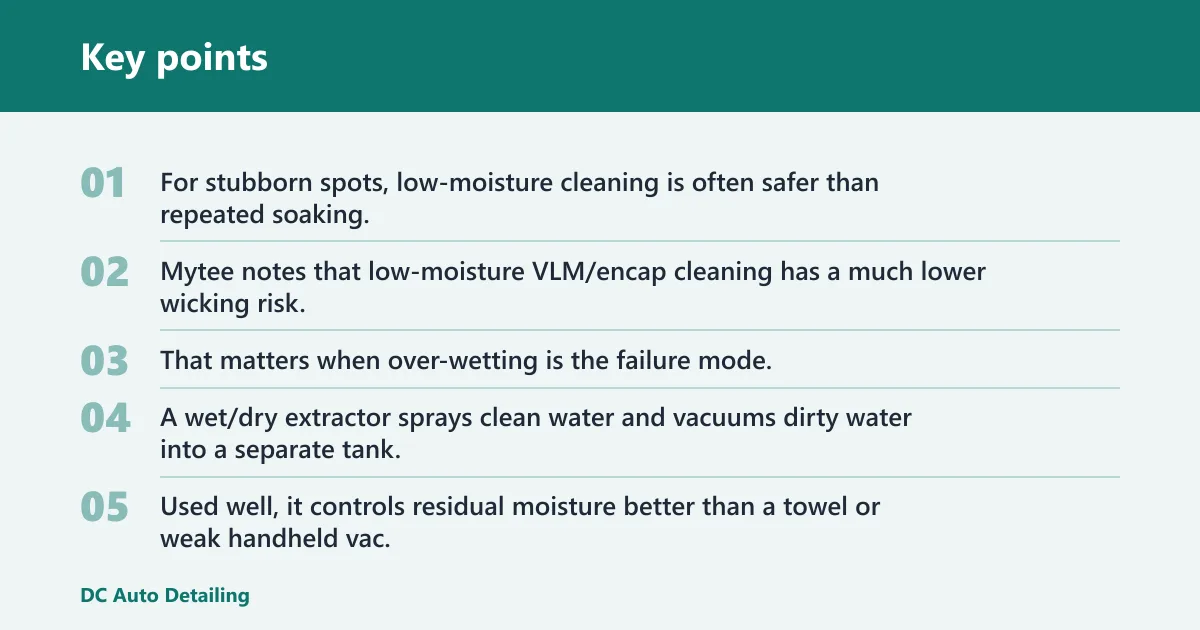
For stubborn spots, low-moisture cleaning is often safer than repeated soaking. Mytee notes that low-moisture VLM/encap cleaning has a much lower wicking risk. That matters when over-wetting is the failure mode, because less liquid means less chance of pulling soil up from below.
Extract more moisture than you add
A wet/dry extractor sprays clean water and vacuums dirty water into a separate tank. Used well, it controls residual moisture better than a towel or weak handheld vac. Baza says professional hot water extraction is the most effective way to break the cycle, and powerful extraction should remove 90%+ of dirty water.
Dry the area fast with fans or air movers
The same source recommends taking extra steps to dry carpet quickly when wicking is possible. Air movers or fans reduce the time available for wick-back. That matters most in humid weather, near seat tracks, or after cleaning a spot that had already soaked into padding or sub-floor layers.
Suppose a driver-side footwell still feels damp after a cleaning pass. If airflow is weak, the spot may keep climbing back for hours. Move a fan so air crosses the carpet surface and under-seat area, then check whether the moisture level drops before doing anything else.
Use a moisture meter before and after cleaning
A moisture meter helps identify hidden wet spots before cleaning and can reveal liquid intrusion beyond the visible stain. Use it to compare the treated spot with dry carpet nearby. If the meter still reads damp in the padding zone, another heavy wetting pass is usually the wrong move.
Should you use hot water extraction?
Hot water extraction can be the right choice when the stain is in the carpet face or backing and the recovery step is strong. It is less helpful if the issue is deep padding contamination and the carpet cannot dry fast enough. Heat alone does not fix a stain if the water recovery is weak.
When hot water extraction helps
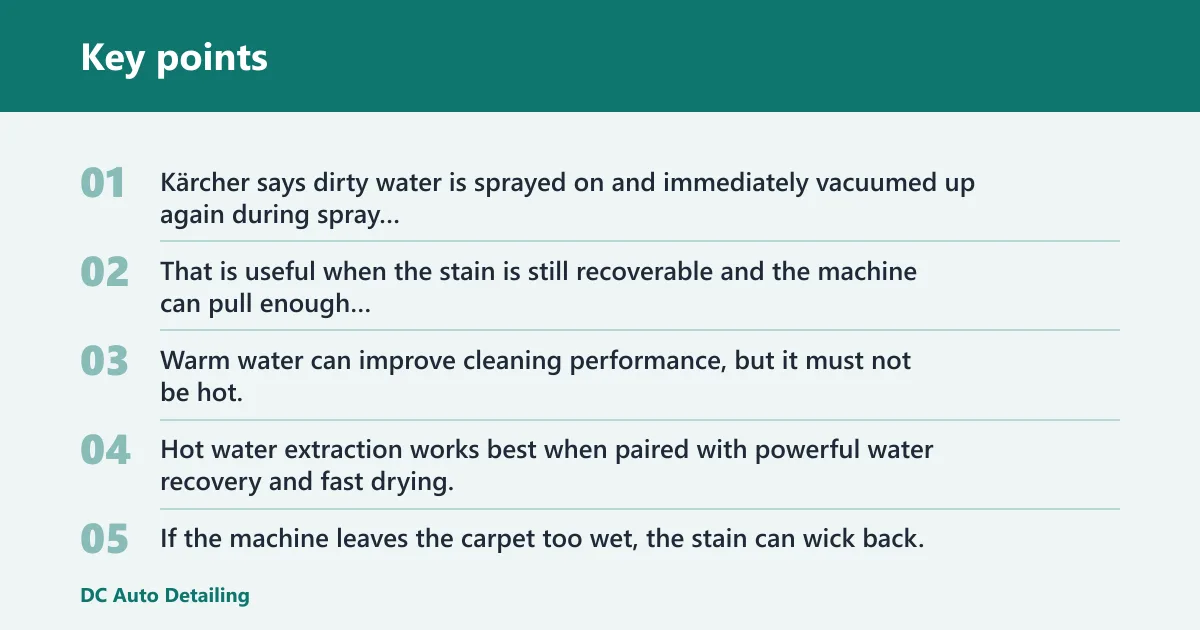
Kärcher says dirty water is sprayed on and immediately vacuumed up again during spray extraction. That is useful when the stain is still recoverable and the machine can pull enough moisture back out. Warm water can improve cleaning performance, but it must not be hot.
Why strong recovery matters as much as heat
Hot water extraction works best when paired with powerful water recovery and fast drying. If the machine leaves the carpet too wet, the stain can wick back. That is why a professional-grade extractor usually does better than a weak DIY setup on repeat-return stains.
When low-moisture cleaning is the better choice
Low-moisture cleaning makes sense when repeated soaking is causing the problem. It is also useful for trouble spots near electronics, seat rails, or damp insulation. If the stain is only in the top fibers, a lower-moisture method can reduce the chance of pushing it deeper.
Why repeated soaking can make the stain worse
The same source says avoid over-wetting when a spill has soaked into padding or sub-floor. Rewetting without a drying plan can spread the contamination, enlarge the stain ring, and keep the underlayer damp. Once that hidden reservoir is loaded, more water may simply feed the same problem.
How do you clean car carpet without making the stain worse?
Start with the least amount of liquid that can still break up the spot. Test a hidden area first. Work the stain once, recover as much moisture as possible, and then let the area dry fully before deciding whether another pass is needed. If the spot is still reappearing, stop and diagnose the layer below.
- Blot up loose liquid without grinding it deeper.
- Check the area with a moisture meter if one is available.
- Apply only the amount of cleaner needed for the spot.
- Agitate lightly, then extract thoroughly.
- Run fans or air movers across the carpet and under-seat zone.
- Wait for the carpet to dry before repeating any step.
Do not keep rewetting a spot that is already showing wick-back. That can move the stain into the backing or padding and make removal harder. If the discoloration returns after a proper dry period, the issue is probably deeper than the face fibers.
When is a car carpet stain too deep to remove completely?
A stain is often too deep for complete removal when it keeps returning after proper extraction and drying, or when a moisture meter points to saturation in the padding, jute, or underlayment. At that point, the problem is no longer just surface soil. It is a hidden reservoir issue.
Signs the contamination has moved below the carpet face
If the stain keeps reappearing in the same shape, if odor remains after cleanup, or if the carpet stays damp far longer than the visible area suggests, the lower layers are likely involved. True dye bleed from coffee, dyes, sunscreen, pet urine, coolant, or similar contaminants can also keep returning after surface cleaning.
When replacement or partial removal enters the conversation
When padding or underlayment is heavily contaminated, cleaning may not fully solve the problem. In those cases, removal of the affected material may be the only durable fix. That is especially true after leaks, soaked footwells, or a long-standing smell that returns with heat and humidity.
Frequently asked questions
How long should car carpet take to dry after cleaning?
A common rule of thumb is that a car interior should be dry the same day, and Autodetailpedia estimates at least 4-6 hours of warm, ventilated air. The exact time depends on airflow, humidity, and how much liquid reached the padding. Kärcher says the carpet should be completely dry before walking on it again.
Can over-wetting make a car carpet stain return?
Yes. Over-wetting can push soil and dye into the backing, padding, or subfloor, then let it wick back up as the carpet dries. The same source says to avoid over-wetting when a spill has soaked into padding or sub-floor. More water is often the wrong answer on repeat stains.
What causes a stain ring to show up after carpet cleaning?
A ring usually appears when dissolved soil migrates outward as the surface dries faster than the center. That is classic wicking. The visible edge dries first, so the remaining residue is left at the perimeter and becomes more noticeable. Cleaner residue can do the same thing if it was not fully extracted.
Should you use hot water extraction for car carpet stains?
Hot water extraction can work well when the stain is shallow and the extractor has strong recovery. The same source says professional hot water extraction is the most effective way to break the cycle. If the spot keeps returning or the padding is soaked, a lower-moisture method may be safer.