Why does my car still smell like cigarettes after cleaning?
Your car can still smell like cigarettes after cleaning because smoke residue gets trapped in fabrics, hidden seams, and the HVAC system, so a surface wipe rarely removes the source. If you only clean visible panels, the odor returns and keeps transferring to clothes, seats, and the air you breathe. This guide shows where cigarette smell hides, which areas to clean first, and when deeper treatment is the only real fix.
What you’ll need
- Vacuum with a crevice tool
- Microfiber towels and an interior cleaner
- Soft brush for seams and vents
- Steam cleaner for fabric only
- Odor neutralizer
- Replacement cabin air filter
Why does the smell keep coming back?
Smoke does not stay on the surface. It can soak into cloth, foam, and plastic, and it settles into the headliner, seat cushions, and vents. Public-health guidance from EPA and NIH/NCI describes smoke residue as persistent because it clings to surfaces and materials long after the visible smoke is gone. Tobacco smoke is also a complex mixture of thousands of chemicals, so a basic wipe leaves enough residue behind for the odor to return.
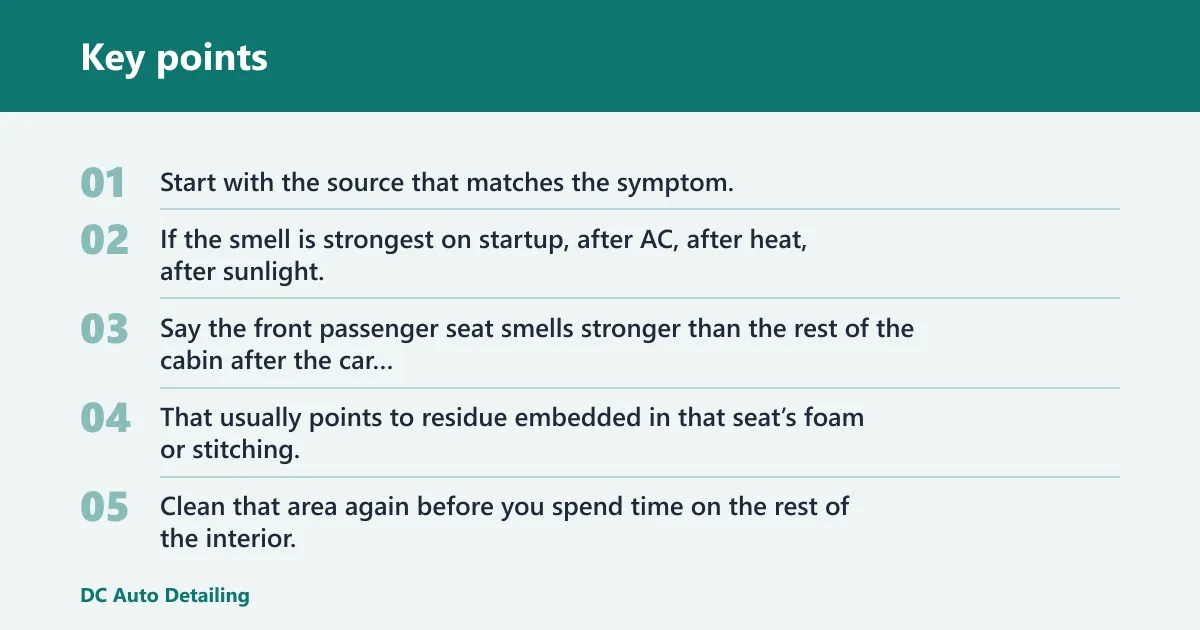
Start with the source that matches the symptom. If the smell is strongest on startup, after AC, after heat, after sunlight, or only in one seat, that tells you where the residue is hiding.
Where the smell is hiding
| When the smell is strongest | Most likely trapped source | How to confirm | Next cleaning step |
|---|---|---|---|
| Smell strongest on startup | Seats, carpet, headliner, and other soft materials | Park the car overnight, then smell each seating area before turning the fan on | Vacuum seams, then clean fabric and carpet again with a fabric-safe product |
| Only with AC or heat | Cabin air filter, vents, ducts, blower, and evaporator area | Run the fan with windows open, then switch between fresh air and recirculation to see when the odor changes | Replace the cabin air filter, then clean vents and intake paths |
| After sunlight or warmth | Embedded residue in foam, cloth, and plastic trim | Let the car warm in the sun, then check whether the smell rises from the seatbacks, bolsters, or headliner | Re-clean soft surfaces and use odor neutralizer after the interior cools |
| Only in certain seats or areas | Localized ash, butts, wrappers, or missed upholstery seams | Test one area at a time by isolating the seat, carpet section, and nearby vent; if the odor stays in one zone, the source is local | Remove all debris, then deep-clean that seat, mat, or pocket area again |
Say the front passenger seat smells stronger than the rest of the cabin after the car sits in the sun for an hour. That usually points to residue embedded in that seat’s foam or stitching, not the whole car. Clean that area again before you spend time on the rest of the interior.
Why the odor lingers in soft materials
Headliners, fabric seats, carpet, and foam act like reservoirs for smoke residue. Industry detailing and OEM-style interior care guidance consistently warns that porous surfaces absorb odor far more readily than hard trim. That is why the same car can look clean and still smell stale when the fabric and foam were only lightly wiped.
What to do first
Use the symptom to decide the order. If the smell shows up before the fan is on, start with fabrics and the headliner. If it appears only once airflow starts, move straight to the cabin air filter and HVAC path. That simple split saves time and prevents repeated cleaning of the wrong area.
Why does the cigarette smell come back when I turn on the AC?
If the odor returns with AC or heat, the cabin air filter is likely filled with smoke, and the HVAC path is carrying it back into the cabin. The filter can hold smoke and dust, and the system can circulate embedded odor through vents, ducts, and the evaporator area. Visible vent cleaning helps, but it is limited: it reaches the slats and openings, not the deeper air path.
This is the failure path many cleanups miss. The visible cabin may look clean, but the blower and air path can still move smoke smell every time the system runs.
How to clean the HVAC path
- Replace the cabin air filter if the smell comes back with AC or heat.
- Vacuum the intake area and accessible vent openings with a crevice tool.
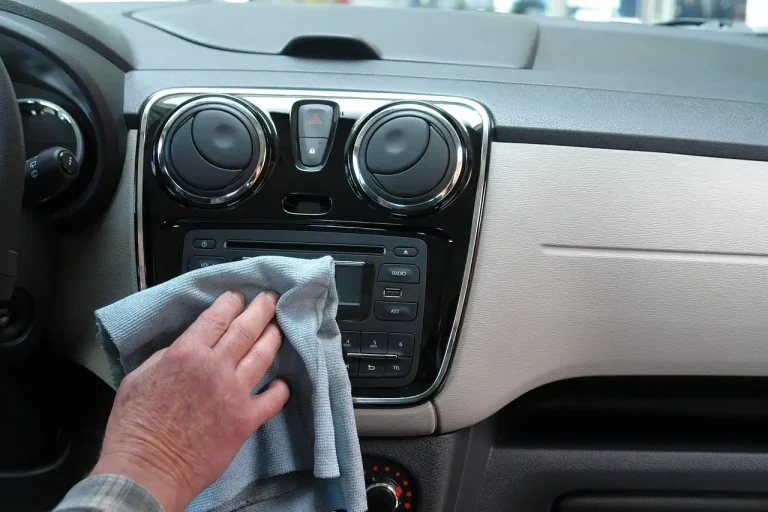
- Clean vent slats with a soft brush and microfiber towel.
- Run the fan on fresh air mode after cleaning so residue in the ducts has a chance to move out.
Suppose the cabin smells fine with the blower off, then turns smoky the moment the fan starts. That pattern usually points to the filter and duct path, not the seats. In that case, filter replacement and vent cleaning are the next step, not another pass over the dashboard.
When deeper HVAC service is needed
If the smell keeps returning after a new cabin air filter and visible vent cleaning, the evaporator case or deeper ductwork may still hold residue. That is when evaporator treatment, HVAC deodorizing service, or professional ozone/hydroxyl remediation may be needed, especially if the odor is strongest only when the system runs.
What part of the car holds cigarette smell the longest?
The headliner, upholstery, carpet, and HVAC path tend to hold smoke the longest. The headliner is one of the biggest mistakes to ignore because it acts like a smoke sponge, and smoke can settle there along with seat cushions and vents. For cleaning smoke from fabric seats, the right method matters more than repeated wiping. Fabric seats may need repeated cleaning when the smell is especially stubborn.
Leather is different. It usually does not trap odor the same way fabric does, but the surrounding stitching, perforations, and nearby soft trim can still hold residue. Clean the material that is actually present, not every interior surface the same way.
How to treat each surface
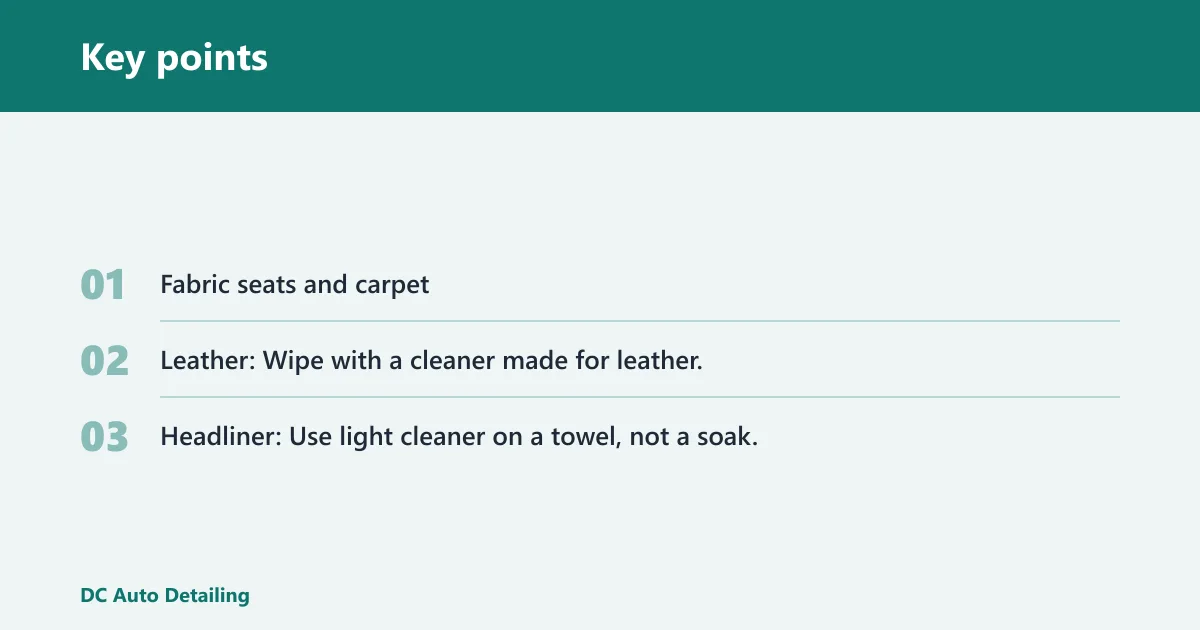
- Fabric seats and carpet: Vacuum first, then use a fabric-safe cleaner; steam cleaning can help because it penetrates deep into upholstery and carpet fibers.
- Leather: Wipe with a cleaner made for leather, then dry it fully so residue does not remain in seams.
- Headliner: Use light cleaner on a towel, not a soak. The material is fragile to over-wetting.
Why fabric keeps holding odor
Fabric, foam, and carpet have open fibers and internal voids that absorb and release odor over time. That is why smoke can remain noticeable after a quick detail but fade only after a deeper fabric-focused clean. The smell often comes back when heat or sun drives trapped residue back into the air.
What should you clean again after a basic detail?
If the odor is still there after a basic detail, clean the sources that keep feeding it: ashtray contents, fabric, the headliner, vents, and the cabin air filter. Do not treat this as one job. Smell in the cabin can come from visible residue and from hidden air-path contamination at the same time.
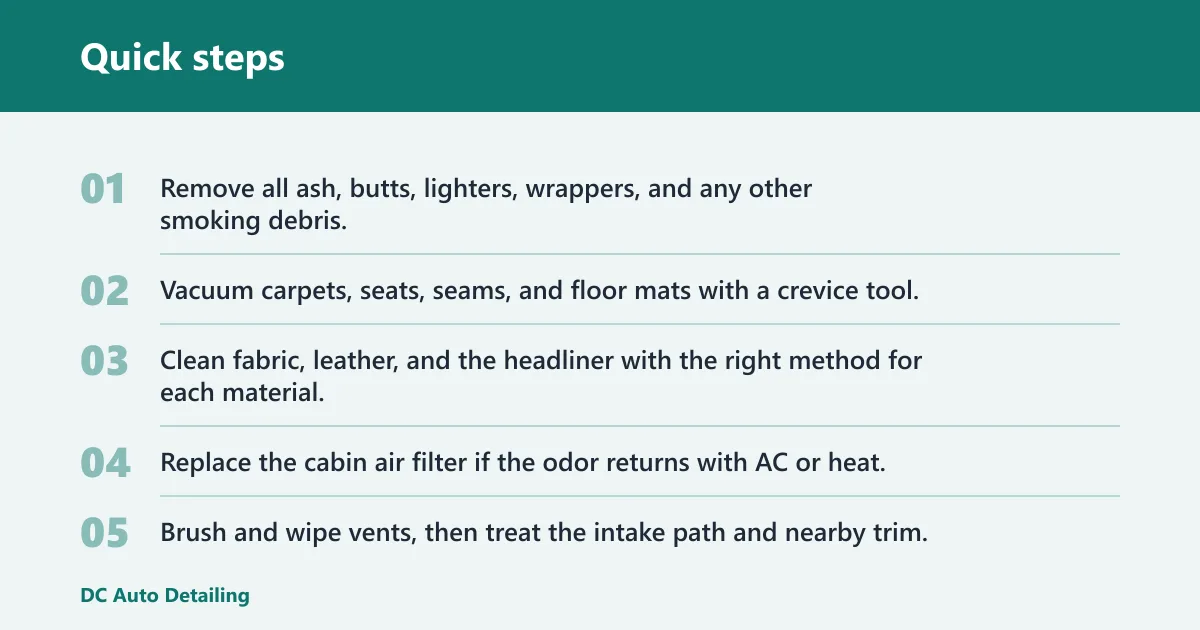
Re-clean in this order
- Remove all ash, butts, lighters, wrappers, and any other smoking debris.
- Vacuum carpets, seats, seams, and floor mats with a crevice tool.
- Clean fabric, leather, and the headliner with the right method for each material.
- Replace the cabin air filter if the odor returns with AC or heat.
- Brush and wipe vents, then treat the intake path and nearby trim.
- Use an odor neutralizer after cleaning, not instead of cleaning.
Air out the car for at least 30 minutes first. Then clean the interior, because ventilation alone will not remove smoke residue. Odor neutralizers such as baking soda or vinegar can help absorb or reduce lingering smell, while air fresheners only cover it. That difference matters when smoke has soaked into soft trim.
When recurring odor needs more than a repeat wipe-down
If the smell returns after the soft surfaces are cleaned, the filter is replaced, and the vent openings are treated, the problem is usually deeper than the visible cabin. At that point, the evaporator, ductwork, or saturated upholstery may need professional attention rather than another basic detail.
Common mistakes
- Masking odor with freshener only: It can hide the smell for a while, then the residue is still there. Clean first, then use a neutralizer.
- Over-wetting the headliner: Too much liquid can damage the glue and backing. Use a lightly damp towel instead.
- Skipping the cabin air filter: If the smell returns with AC, the filter is a likely trap and re-release point.
- Cleaning surfaces but not hidden crevices: Seams, seat tracks, vents, and pockets can keep feeding the odor.
A common first-timer mistake is cleaning the dashboard and seats, then leaving an ashtray full of butts and wrappers in the console. The cabin may look finished, but the active odor source is still inside the car. Empty it, wash the tray, and check the area around it.
If that didn’t work, try this next:
- Repeat a full vacuum of seats, carpet, and seams.
- Replace the cabin air filter if the smell changes with HVAC use.
- Steam clean fabric seats and carpet only if the material can take moisture without soaking.
- Re-clean vents and intake openings, then retest the smell with the fan on and off.
Frequently asked questions
Why does my car still smell like cigarettes after cleaning?
Because smoke residue can live in cloth, foam, plastic, and the air path, a wipe-down often removes only what you can see. Re-clean the soft surfaces, check the ashtray and hidden seams, and replace the cabin air filter if the smell returns with the blower on.
Do I need to replace the cabin air filter if the smell returns?
Yes, if the smell comes back with AC or heat. The cabin air filter can hold smoke and dust, and it can re-release odor when the system runs. Replace it, then clean the vents and intake path so the new filter is not pulling air through the same residue.
Can cigarette smoke stay in car vents after I vacuum and wipe surfaces?
Yes. Vacuuming and wiping do not clean the blower, ducts, or evaporator area. If the smell returns through the vents, treat the HVAC system as part of the cleanup, not as a separate problem. Replace the filter and clean the visible vent openings next.
Why does my car smell worse when it gets warm?
Heat can make embedded residue release more odor from seats, carpet, and trim. If the smell gets worse after sunlight or warmth, focus on soft materials and the headliner first. Odor neutralizer can help after cleaning, but it will not replace deep cleaning of the source.