Scrape vs scratch on a car: How can you tell?
A scrape usually leaves paint transfer or a broad scuff on top of the clear coat; a scratch cuts a line through the finish, and if you can catch a nail in it, treat it as deeper damage. Misreading it can lead you to polish too hard, remove more clear coat, or miss a repair that needs touch-up paint. This guide gives a fast decision tree for transfer, depth, and layer damage, plus the right DIY or pro repair path.
| Decision factor | Scrape | scratch on a car | Winner |
|---|---|---|---|
| Visual clue | Broad scuff, smear, or paint transfer | Line, groove, or cut through the finish | Tie |
| Fingernail result | Nail often glides over the mark | Nail may catch on the edge or groove | scratch on a car |
| Likely layer affected | Clear coat only, or transfer sitting on top | Clear coat, base coat, primer, or metal | Scrape |
| Typical cause | Door bump, brush contact, bumper kiss, shopping cart rub | Edge contact, key-like drag, road debris, deeper impact | scratch on a car |
| Best first fix | Wash, inspect, then polish or a light scratch remover | Wash, inspect, then decide on polish, touch-up paint, or repair | Scrape |
| Risk if ignored | Usually cosmetic unless the mark breaks through the clear coat | Higher chance of rust if primer or metal is exposed | scratch on a car |
What a scrape vs scratch looks like
A scrape usually looks wider than a scratch and often has a cloudy edge, color transfer, or a dull streak across the panel. A scratch on a car is more likely to look like a line or groove. Under angled light, a scrape may seem bigger than it is, while a true scratch usually keeps the same narrow shape.
Why paint transfer can mimic a scratch
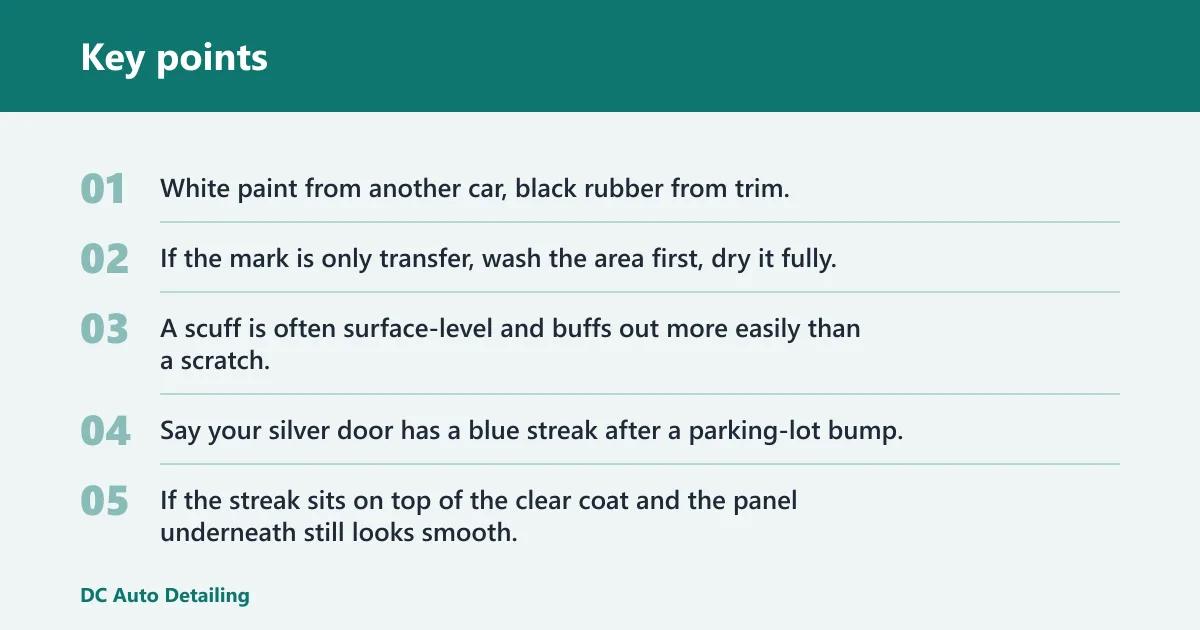
White paint from another car, black rubber from trim, or wax residue can sit on top of your finish and look like damage. If the mark is only transfer, wash the area first, dry it fully, then check again before polishing. A scuff is often surface-level and buffs out more easily than a scratch.
Say your silver door has a blue streak after a parking-lot bump. If the streak sits on top of the clear coat and the panel underneath still looks smooth, that points more toward a scrape than a cut through the paint.
How lighting changes what you see
Inspect the mark after washing and drying the panel. Then check it under angled light, not just straight-on daylight. A shallow scrape can disappear when you move the viewing angle, while a deeper scratch keeps showing the same line because it interrupts the surface instead of sitting on top of it.
What a shallow scrape on a car usually looks like
A shallow scrape often appears broad, hazy, or streaked, with no sharp edge that a nail can clearly catch. It may be a clear-coat scuff or paint transfer, and it often responds to polish or a light scratch remover. If the damage stays on the top clear coat layer, it is usually the easier repair path.
Paint layers that decide the fix
Car paintwork is commonly described as three layers: clear coat, base coat, and primer. Clear coat is the pigment-free protective finish on top. Base coat is the color layer beneath it. Primer sits below the base coat, and when you reach it, the repair gets more serious.
Clear coat, base coat, primer, and metal
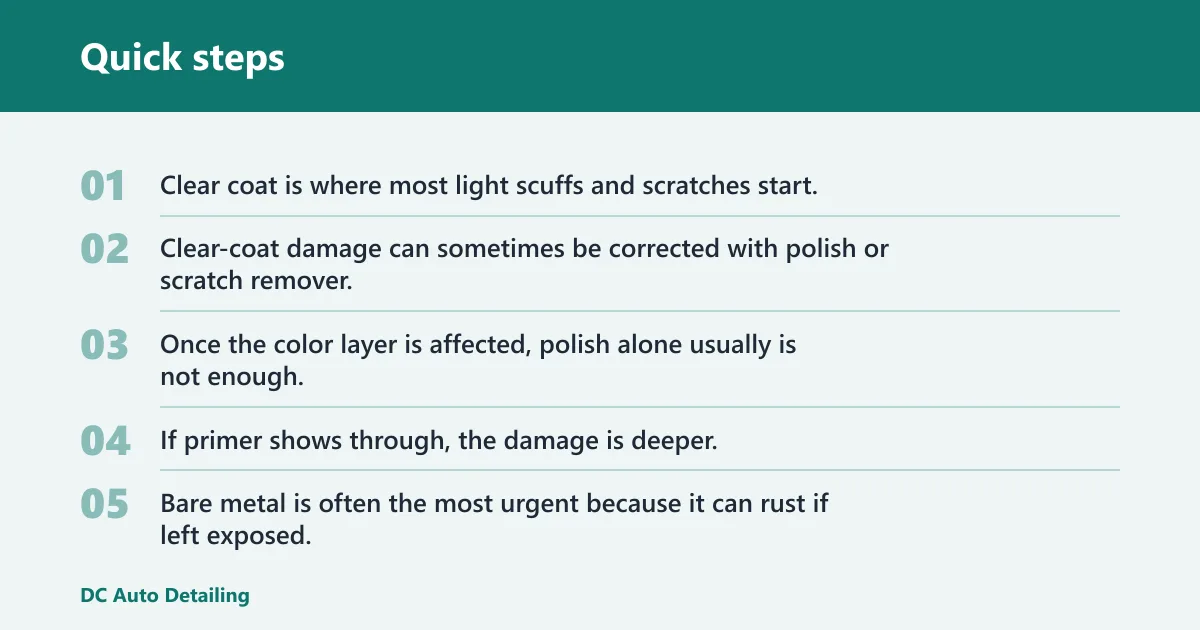
Clear coat is where most light scuffs and scratches start. Clear-coat damage can sometimes be corrected with polish or scratch remover. Once the color layer is affected, polish alone usually is not enough. If primer shows through, the damage is deeper. Bare metal is often the most urgent because it can rust if left exposed.
Base-coat damage usually needs more than polishing and may call for touch-up paint or repainting. Primer exposure often means a multi-step DIY repair or professional work. Metal exposure raises urgency because the exposed area can corrode if left open.
Why clear-coat damage is the easiest to fix
The clear coat is the top layer, so light abrasion does not always reach the color underneath. That is why a micro-abrasive scratch remover can work on a shallow mark, and why a microfiber cloth is the usual application and wipe-off tool. Use clean microfiber cloths and short, gentle circular passes, so you do not grind dirt back into the finish.
What it means when primer shows through
If you can see gray or off-white primer, the scratch has moved beyond the color layer. That means the mark is no longer a simple cosmetic scuff. Touch-up paint may still help, but the repair now depends on color matching, careful layering, and sometimes professional blending.
How can you tell in two minutes?
Wash and dry the area first, then check the mark under angled light and run a fingernail lightly across it. If the nail does not catch, the damage may be limited to the clear coat and could respond to polish or scratch remover. If the nail catches, the damage is likely deeper and may need paint unless inspection shows otherwise.
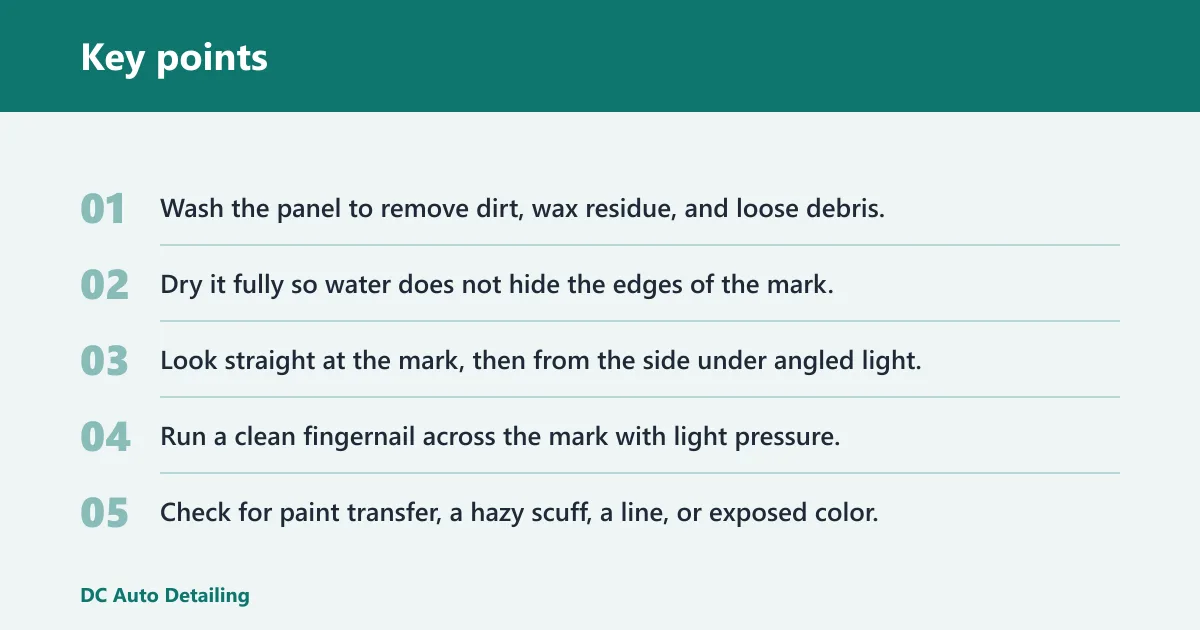
- Wash the panel to remove dirt, wax residue, and loose debris.
- Dry it fully so water does not hide the edges of the mark.
- Look straight at the mark, then from the side under angled light.
- Run a clean fingernail across the mark with light pressure.
- Check for paint transfer, a hazy scuff, a line, or exposed color.
- Match what you see to the repair path in the matrix below.
A common first-timer mistake is polishing a dirty panel because the mark looked minor from one angle. Dirt and rubber can turn a shallow scuff into a false “scratch” reading, and the extra rubbing can add more clear-coat wear than the original damage did.
| Visual clue | Fingernail result | Likely layer affected | Likely cause | DIY fix | When to stop and book a pro |
|---|---|---|---|---|---|
| Paint transfer scuff | Nail does not catch | Clear coat only, or transfer on top | Bumper rub, door tap, rubber contact | Wash, clay if needed, then a light polish or scratch remover | If the mark stays after cleaning or the clear coat looks hazy over a wide area |
| Clear-coat scratch | Nail may graze but not hook deeply | Clear coat | Light abrasion, branch touch, wash-marring | Scratch remover, then polish and microfiber wipe-off | If the line stays obvious after one careful pass |
| Base-coat scratch | Nail usually catches lightly | Base coat | Stronger contact that cuts through the top layer | Touch-up paint matched to the vehicle paint code | If the color mismatch is large or the repair needs blending |
| Primer-exposed scratch | Nail catches clearly | Primer | Deeper strike or repeated abrasion | Multi-step touch-up with primer, color, and clear coat | If the area is larger than a small spot or sits on a visible body line |
| Metal-exposed scratch | Nail catches clearly | Metal | Hard impact, sharp edge, or long scrape | Temporary protection only; full refinishing is usually needed | As soon as possible, because rust risk rises quickly |
| Door-bump scrape | Nail often does not catch | Clear coat, with possible transfer | Parking-lot contact or a door edge brush | Clean first, then polish or scratch remover if the finish is still intact | If the scuff crosses an edge, seam, or trim and will not clean off |
Which DIY fix matches the damage?
Scratch remover is generally for light clear-coat damage, not for primer or bare metal. Polish or compound can help a shallow line if the clear coat is still intact, but stronger products remove more material, so overuse can thin the finish. When the damage reaches the color layer, touch-up paint becomes the right next step.
When scratch remover is enough
Use scratch remover only when the mark is shallow and stays in the clear coat. It works as a micro-abrasive liquid or paste, often with a microfiber cloth or applicator. If the nail does not catch, Auto Express says the mark should be removable with scratch removers or T-Cut.
When polish or compound can help
Polish is a lighter abrasive finish product for minor clear-coat damage. Compound is stronger and can handle more noticeable marks, but it also removes more clear coat if you keep working the same spot. That makes patience important. Stop once the line fades instead of chasing perfection.
Picture a 2-inch gray scuff on a black rear bumper. If washing removes most of the haze and the nail slides over it, a light polish may be enough. If the line still looks carved in after one careful pass, move up in repair level instead of scrubbing harder.
When touch-up paint becomes the right call
Once the damage reaches the base coat or primer, polish is no longer the main fix. Touch-up paint is used when the color layer is broken, and it usually needs a paint-code match to the vehicle. Deeper chips may also need primer and clear coat to close the repair properly.
When should you stop and book a pro?
Stop and book a pro when the nail catches firmly, the color is gone, primer shows, or bare metal is visible. Those signs mean the damage is deeper than clear coat and carries more risk if you keep polishing. SMART repair is often the right professional path for smaller scuffs and scratches that need careful blending.
Signs the damage is deeper than clear coat
If you see color loss, gray primer, or shiny metal, the repair is beyond scratch remover territory. If the mark sits on an edge or body line, home repair also gets harder because the panel shape makes blending more visible. That is where a pro can usually do less harm than repeated DIY passes.
When SMART repair makes sense
SMART repair is built for small-area paint damage that needs precise blending into the surrounding panel. It makes sense when the mark is too deep for polish but too small for a full respray. That often fits deeper scuffs, narrow scratches, and isolated spots on visible body panels.
Why exposed primer or metal raises the urgency
Primer exposure means the finish has already broken below the color layer. Metal exposure is worse, because moisture can reach the substrate and rust can start. Even if the damage looks small, treat those areas sooner rather than later, especially on a leased, financed, or resale-sensitive vehicle.
Choose Scrape if…
Choose Scrape if the mark is broad, hazy, or transfer-heavy, and the fingernail does not catch. That usually points to a clear-coat scuff that may clean up with wash, polish, or a light scratch remover. If the panel still shows intact color after cleaning, this is the lower-risk path.
Choose scratch on a car if…
Choose scratch on a car if the mark is a narrow line, the nail catches, or you can see color loss, primer, or metal. That points to deeper damage that may need touch-up paint or professional repair. If rust risk is part of the picture, do not keep testing the area with stronger abrasives.
Frequently asked questions
How can you tell if a car scratch is only in the clear coat?
Look after washing and drying the panel, then use angled light and a light fingernail pass. If the nail does not catch and the color underneath still looks intact, the damage may be limited to the clear coat. That is the type most likely to respond to polish or scratch remover.
How do you know if a scrape is deeper than a scratch?
A deeper scrape usually breaks through the surface film and into color, primer, or metal. If the nail catches clearly, the mark keeps its edge under different lighting, or you can see a color change, assume it is deeper than a simple scuff. That changes the repair from polishing to touch-up or pro work.
Does a fingernail test tell you how bad a car scratch is?
It gives a quick severity check, not a perfect diagnosis. If the nail glides over the mark, the damage may be shallow; if it catches, the scratch is usually deeper. Use it with washing, lighting, and visual inspection, because dirt and transfer can fool the result.
What does a shallow scrape on a car look like?
A shallow scrape usually looks broad, dull, or smeared rather than cut cleanly into the paint. It may be paint transfer, a clear-coat scuff, or light abrasion from a door or bumper contact. If the surface still feels smooth and the mark does not hook your nail, it is often a lower-level repair.
Can a scratch be buffed out if you can feel it with your nail?
Sometimes, but not always. If the nail only barely grazes the mark and the damage stays in the clear coat, polish or compound may help. If the nail catches firmly, the damage likely reaches primer or bodywork, and buffing alone will not replace missing material.
When does a car scratch need touch-up paint instead of polish?
Use touch-up paint when the damage reaches the base coat or deeper. Polish works on light clear-coat damage, but it cannot restore missing color. If you can see primer or bare metal, touch-up paint, primer, and clear coat become part of the repair, and a pro may be the safer call.
What is the difference between a scuff and a scratch on a car?
A scuff is usually surface-level damage, often from transfer or clear-coat abrasion, and it often buffs out more easily. A scratch is a cut that can penetrate the paint layers and may need touch-up paint or filler. VehicleFreak describes a scuff as staying on the top clear coat layer.