Is a foam cannon worth it for washing your car at home?
A foam cannon is worth it if you wash often, want a stronger pre-soak, and already own a pressure washer; otherwise a foam gun or bucket wash is usually the smarter buy. Pick the wrong setup and you can waste money, add wash time, or leave grit on the paint. This guide breaks down when a foam cannon pays off, when it is optional, and when a cheaper pre-wash works better.
Quick verdict
A foam cannon is a good buy when you already have a pressure washer and wash regularly enough to use it every few weeks or more. It is less compelling if you wash only occasionally or still need to buy the pressure washer. The biggest gain is a safer pre-wash, not miracle cleaning.
Worth it
- You already own a pressure washer.
- You wash weekly or at least often enough to spread out the cost.
- Your vehicle picks up road film, salt, or heavy dust.
- You want a stronger pre-soak before the mitt touches paint.
A foam cannon is worth it when the setup is already in place and the wash routine is regular. In that case, the tool improves pre-wash coverage, helps loosen grime, and adds convenience without turning a basic wash into a major project.
Nice-to-have
- You have a pressure washer but only wash monthly.
- You like a faster, more even pre-rinse but do not need it every week.
- You are willing to pay for convenience more than necessity.
A foam cannon is a nice-to-have when you want better workflow, not because it is essential. It can still make washing easier and more consistent, but the value is softer when usage is occasional and the paint is not especially difficult to keep clean.
Skip it
- You do not own a pressure washer.
- You wash only a few times a year.
- Your budget is better spent on wash media and soap first.
- You are expecting foam alone to replace careful contact washing.
Skip the foam cannon if it would force you to buy extra hardware just to start. In that case, a foam gun, a pre-rinse, or a careful two-bucket wash gives more practical value for less money and less setup complexity.
What a foam cannon does
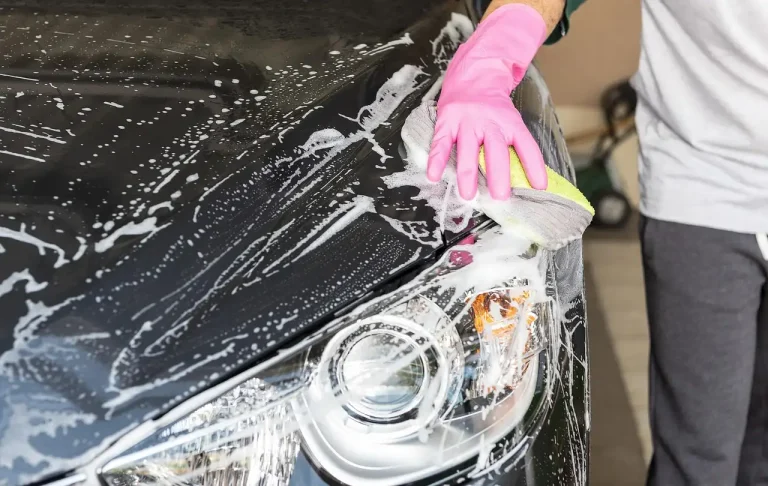
A foam cannon attaches to a pressure washer and uses water pressure to pull soap into a thick foam stream, which lays down a pre-wash layer before you touch the car. The foam clings to the panel long enough to loosen loose grit before contact washing begins.
Why the foam matters
The value is not the look alone. Foam wets the surface evenly, softens road film, and helps carry off some loose dirt during the rinse that follows.
That matters most before contact washing. It does not replace the mitt step, and it does not turn dirty paint into clean paint by itself.
Why it is a pre-wash step
Dwell time is the short window when the foam sits on the panel before rinsing. A typical window is 3-5 minutes. Do not let it dry on the paint.
Use pH-neutral car soap, not random household soap. Household soap is a poor baseline for paint safety and lubrication.
📊 Car and Driver included foam cannon models in a 2026 roundup and named Chemical Guys Big Mouth Max Release best overall. Source: Best Foam Cannons of 2026, Tested.
Does a foam cannon actually help protect paint?
Yes, but only in a limited way. A foam cannon can lower marring risk by loosening loose grit and improving lubrication before the mitt touches the car, yet it does not remove the need for careful contact washing.
What it can do before contact washing
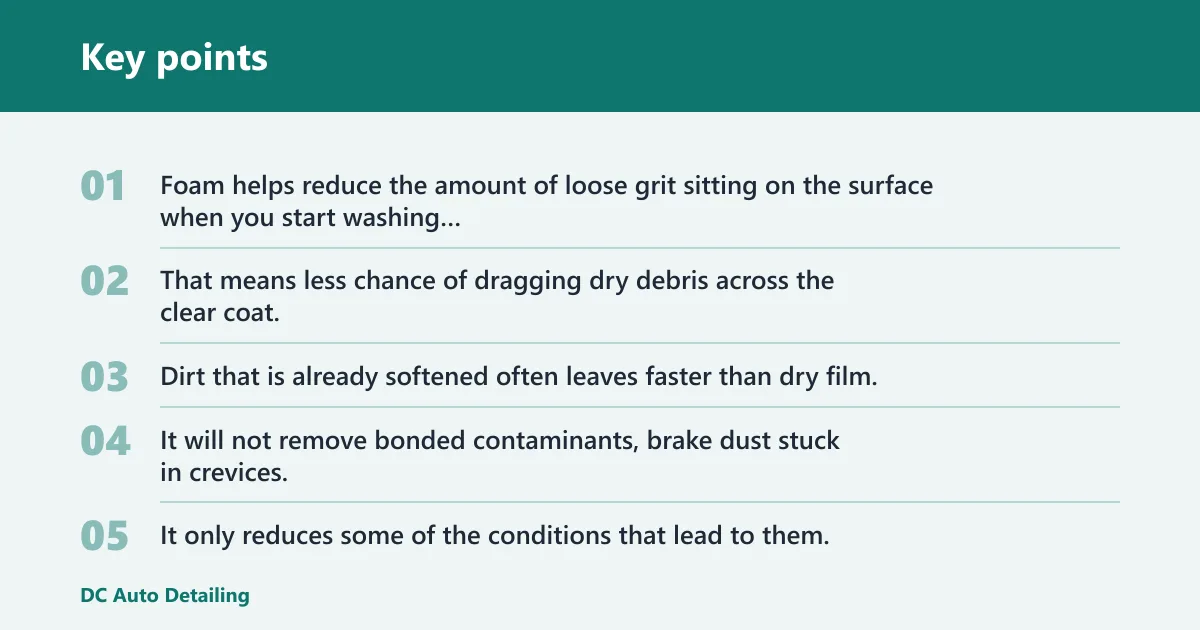
Foam helps reduce the amount of loose grit sitting on the surface when you start washing by hand. That means less chance of dragging dry debris across the clear coat.
It also makes rinsing more efficient. Dirt that is already softened often leaves faster than dry film.
What it cannot do by itself
Foam is not a complete wash. It will not remove bonded contaminants, brake dust stuck in crevices, or every bit of road film on its own.
It also does not make scratches impossible. It only reduces some of the conditions that lead to them.
Why the two-bucket wash still matters
The two-bucket wash method is still the safer contact step after the pre-wash. One bucket holds wash solution, and the other is for rinsing the mitt so you are less likely to put grit back on the paint.
Use the foam cannon first, then the mitt wash. That sequence gives the best return from the tool.
Say your sedan picks up a lot of road film after a wet commute. Foam can soften that film before the mitt touches the hood, but if you skip the rinse and two-bucket wash, you still risk grinding dirt into the clear coat.
Foam cannon vs foam gun
A foam cannon connects to a pressure washer and makes thicker, clingier foam. A foam gun connects to a garden hose and makes thinner, wetter foam that is better seen as a mild pre-soak than a true foam blanket.
Pressure washer setup versus garden hose setup
Because a true foam cannon depends on pressure washer output, it can build denser foam and cover panels more evenly. A foam gun is easier to set up, but the water pressure is lower and the foam is usually less stable.
Which one makes more sense for light use?
If you wash only occasionally and already have a garden hose, a foam gun may be enough. If you want a stronger pre-wash and already own a pressure washer, the foam cannon is the better tool.
Foam thickness and spray differences
Thicker foam does not mean more cleaning power by itself. It mainly means better cling and longer contact time before rinsing.
That is useful, but only up to a point. The rinse step and the mitt wash still do the real cleaning.
Do you need a pressure washer?
For a true foam cannon, yes. Foam cannons are attached to pressure washers for car washing, and consumer units can work reasonably well starting around 1,000-1,500 PSI. Without that pressure, the foam usually comes out thinner and less stable.
What happens with low-flow electric units
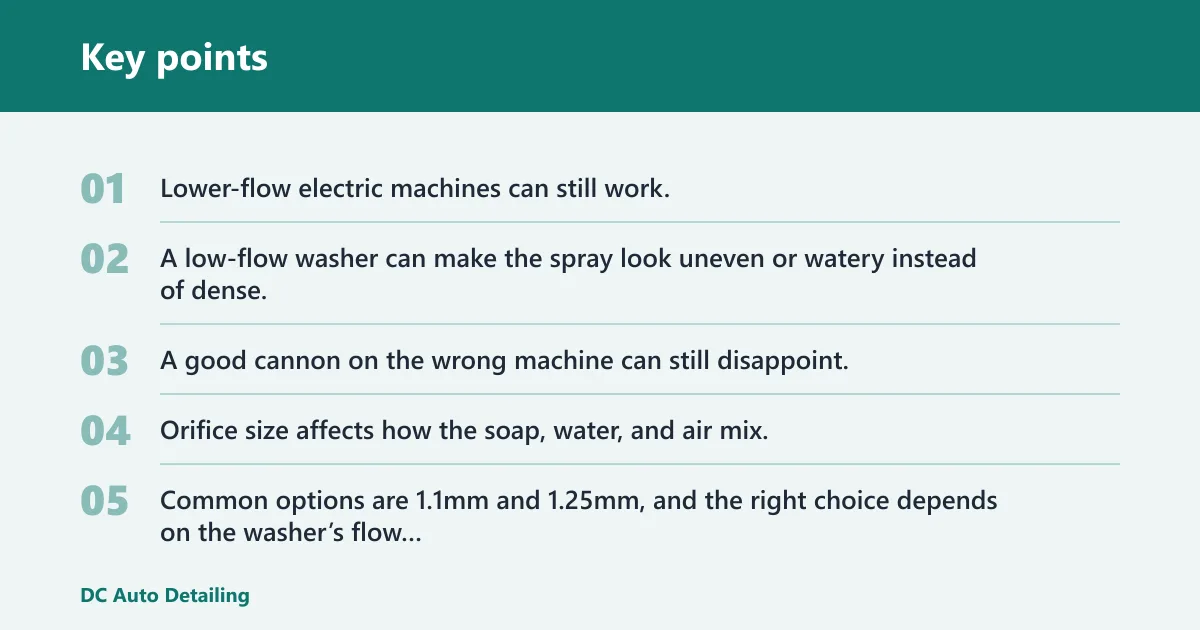
Lower-flow electric machines can still work, but foam quality may suffer if the output is too weak. A low-flow washer can make the spray look uneven or watery instead of dense.
That is where setup matching matters. A good cannon on the wrong machine can still disappoint.
How orifice size changes foam output
Orifice size affects how the soap, water, and air mix. Common options are 1.1mm and 1.25mm, and the right choice depends on the washer’s flow and pressure.
For lower-flow electric machines, a 1.1mm orifice is often the better starting point. If the foam seems thin, a mismatched orifice may be part of the problem.
Picture a compact electric washer with modest flow and a cannon built for a stronger machine. The foam may look watery, even though the soap is good. Swapping to the correct orifice can change the result more than adding extra soap.
Foam cannon cost matrix
The real cost is more than the cannon itself. You also need a pressure washer, soap, and eventually replacement parts. That is why the setup can make sense for some owners and feel expensive for others.
| Scenario | Payoff | Cost | Paint-safety gain | Best alternative |
|---|---|---|---|---|
| Weekly wash | 9/10 | 6/10 | 8/10 | Foam cannon with two-bucket wash |
| Monthly wash | 6/10 | 6/10 | 6/10 | Foam gun or careful bucket pre-rinse |
| Dark paint | 8/10 | 6/10 | 9/10 | Foam cannon if you already own a washer |
| No pressure washer | 3/10 | 9/10 | 4/10 | Foam gun or bucket wash |
| Tight budget | 4/10 | 8/10 | 6/10 | Two-bucket wash and a pre-rinse |
Weekly wash scenario
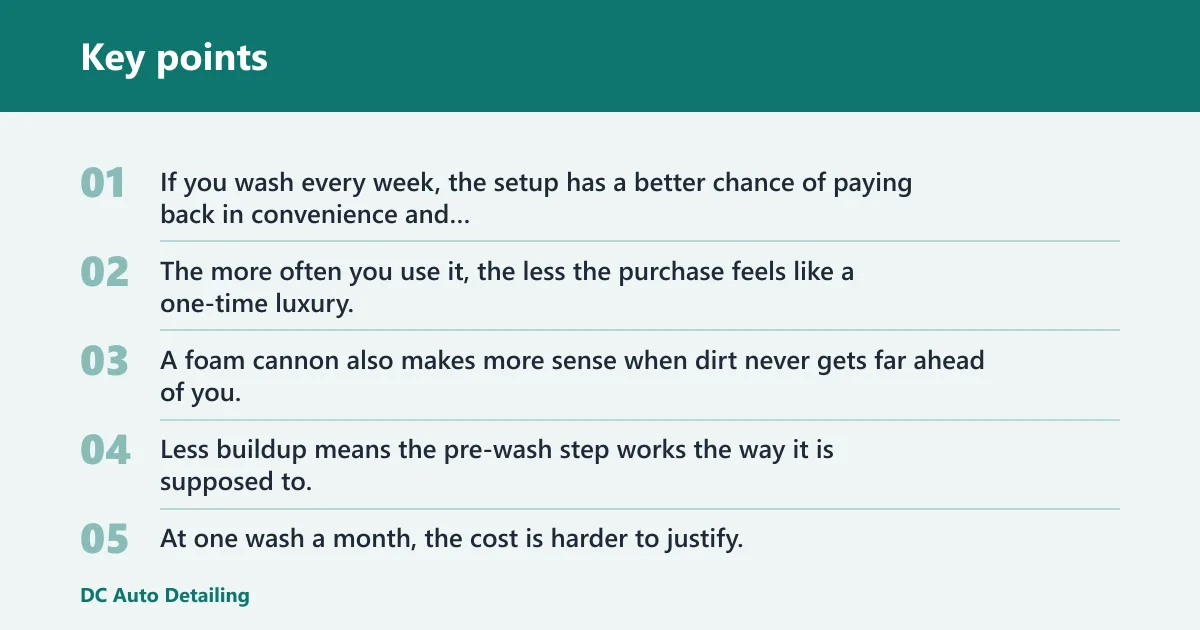
If you wash every week, the setup has a better chance of paying back in convenience and prep speed. The more often you use it, the less the purchase feels like a one-time luxury.
A foam cannon also makes more sense when dirt never gets far ahead of you. Less buildup means the pre-wash step works the way it is supposed to.
Monthly wash scenario
At one wash a month, the cost is harder to justify. You may still like the process, but the savings in time and effort are smaller because you are not using it often.
Dark paint scenario
Dark paint shows marring and wash marks more easily, so a better pre-wash can matter more. The foam cannon is most useful here when it is paired with careful mitt washing and clean drying towels.
No pressure washer scenario
If you do not already own a pressure washer, the cost jumps fast. In that case, a foam gun or a strong bucket wash is usually the smarter buy unless you plan to use the washer for other jobs too.
Tight budget scenario
If budget is the main constraint, spend first on good wash media, pH-neutral car soap, and a careful two-bucket method. Those basics do more for paint safety than a low-quality cannon with the wrong setup.
| Setup | Approximate setup cost range | Per-wash value assumption | Approximate washes to justify it | Why |
|---|---|---|---|---|
| Foam cannon only, with pressure washer already owned | $35-$90 | $2-$4 per wash in convenience/pre-wash value | 15-40 washes | Lower entry cost, mostly convenience and better pre-wash |
| Foam cannon plus midrange pressure washer | $180-$450 | $3-$6 per wash in convenience/pre-wash value | 40-90 washes | Higher upfront cost, better output, more useful for frequent washing |
| Foam cannon plus premium pressure washer | $450-$900+ | $4-$8 per wash in convenience/pre-wash value | 70-150+ washes | Best performance, but the total setup cost is much higher |
How to read the break-even range
These ranges are approximate, not fixed promises. A simple way to estimate them is: setup cost divided by the per-wash value you place on faster prep, better coverage, and easier grime removal. If the setup is $200 and you value each use at about $4, the break-even point is around 50 washes.
Car and Driver’s 2026 roundup noted a wide range of hardware and output specs, which is why the wash-count math changes so much by setup. A runner-up was Griot’s Garage Brilliant Finish Foam Cannon.
When is it worth the money?
A foam cannon is worth the money when you wash at home on a regular schedule, already have a pressure washer, and want a stronger pre-wash before the mitt step. It is also a good fit for dark paint and cars that collect road film quickly.
Frequent washing at home
If you wash weekly or close to it, the setup makes more sense. Regular use spreads the cost across many washes and gives you a more repeatable process.
Cars that pick up a lot of road film
Daily drivers in wet, salty, or dusty conditions often benefit more from a foam pre-soak. The foam can loosen the loose layer before you touch the surface.
Owners who want faster pre-wash prep
A foam cannon is useful when you want a quicker, more even pre-rinse before hand washing. It is a convenience upgrade, but for frequent washers that convenience can be worth real money.
When a cheaper pre-wash is smarter
A cheaper pre-wash is smarter if you wash only sometimes, do not own a pressure washer, or want the lowest-cost path to safer washing. In those cases, a foam gun or a careful bucket method gives most of the benefit for less money.
Occasional washing
If your car is washed a few times a year, the setup cost is hard to defend. A foam cannon may still be fun to use, but it is unlikely to be the best value.
No pressure washer on hand
Without a pressure washer, buying a cannon just creates extra cost and weak results. A foam gun is the better choice because it works from a garden hose.
A budget-first approach
A basic wash kit with pH-neutral car soap, good mitts, and the two-bucket method often makes more sense than chasing foam first. That is the cleaner path when every dollar matters.
Frequently asked questions
Is a foam cannon actually worth it for washing a car at home?
It is worth it when you wash often, already have a pressure washer, and want a better pre-wash step. If you wash only now and then, a foam gun or a careful bucket wash is usually the better buy.
Does a foam cannon reduce scratches compared with a bucket wash?
It can reduce marring risk by loosening loose grit before contact washing, but it does not remove scratch risk entirely. The real protection comes from pairing foam with clean wash mitts, proper rinsing, and the two-bucket method.
How often should you use a foam cannon on a daily driver?
Use it whenever the car has visible road film, dust, or salt that you want to loosen before touching the paint. For a daily driver, weekly use makes the most sense if your washing routine is already regular.
Do you need a pressure washer for a foam cannon?
Yes. A true foam cannon depends on a pressure washer to create the thick, clinging foam people want from the tool. Consumer units can work reasonably well starting around 1,000-1,500 PSI, but weak output can limit foam quality.
How much does a foam cannon setup cost?
Cost depends on whether you already own a pressure washer. The cannon itself is only part of the bill; soap use, replacement parts, and the washer itself all matter. Budget and premium setups differ a lot in total cost.
Can a foam cannon replace the two-bucket wash method?
No. Foam is a pre-wash, not a full wash. You still need a careful contact wash afterward, and the two-bucket method remains one of the better ways to keep grit off the mitt and off the paint.
Sources
- Car and Driver, “Best Foam Cannons of 2026, Tested” — product roundup and pressure-range context for foam cannon setups.
- DC Auto Detailing DN, “Car Wash Soap vs Dish Soap” — guidance supporting pH-neutral car soap for vehicle washing.
- DC Auto Detailing DN, “How to Dilute Car Wash Soap Bucket Wash” — explanation of the two-bucket wash method and why it reduces reintroducing grit.
- Manufacturer guidance and foam-cannon product documentation on orifice sizing, typically comparing 1.1 mm and 1.25 mm inserts for different washer output ranges.
- Industry car-care guidance on dwell time, generally recommending that foams be rinsed before they dry on paint.