What is consumer ceramic coating for cars? How It Works
Consumer-grade ceramic coating is commonly described as a DIY-applied silica-based paint protectant sold in kits or sprays for home use. Choose it only if you can prep paint carefully and accept shorter durability than pro coatings. Poor prep can leave visible high spots, weak bonding, and wasted product. This guide compares DIY kits, ceramic sprays, and true coatings, then shows what to buy or skip before a driveway install.
What consumer ceramic coating means
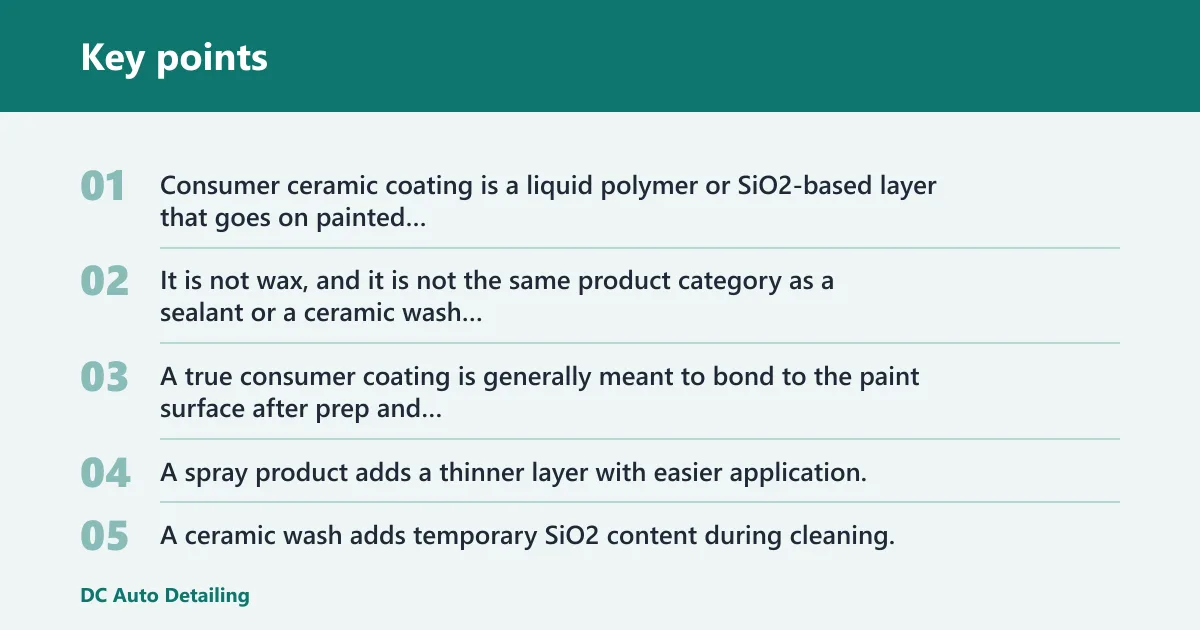
Consumer ceramic coating is a liquid polymer or SiO2-based layer that goes on painted surfaces to change how water behaves, add gloss, and make washing easier. It is not wax, and it is not the same product category as a sealant or a ceramic wash shampoo.
The useful boundary is simple. A true consumer coating is generally meant to bond to the paint surface after prep and then cure. A spray product adds a thinner layer with easier application. A ceramic wash adds temporary SiO2 content during cleaning, but it does not behave like a coating that you level and let cure.
SiO2 is the chemistry label that confuses a lot of buyers. It shows up in consumer coatings, sprays, washes, and hyperwax products, so the ingredient list alone does not tell you whether you are buying a real coating or a maintenance product.
True coating vs spray vs wash
These products can all create beading and slickness, but they do not ask for the same prep, application control, or cure discipline. The label can sound similar while the job site reality is very different.
What each product does
A true consumer coating is built for direct application to prepared paint. A ceramic maintenance spray is a top-up product for gloss and water behavior. A ceramic wash is a cleaning product with added ceramic chemistry, usually chosen for maintenance rather than long-term protection.
That difference matters because the risk changes with the product. If you miss a spot on a true coating, you can lock in streaks or high spots. If you overapply a spray, you usually get smearing or uneven sheeting. If you use a ceramic wash, the main issue is poor cleaning, not permanent application failure.
Where the chemistry overlaps
SiO2 can be part of all three. That is why “ceramic” by itself is not enough to identify the category. One bottle may be a full coating kit, another may be a spray, and a third may be a wash meant for routine maintenance.
A common first-timer mistake is assuming that any product labeled ceramic will behave like a coating. A 16-ounce wash bottle and a 30-milliliter coating applicator solve different problems. They should not be compared as if they were the same item.
Coating decision matrix
| Category | True coating | Coating spray | Ceramic wash |
|---|---|---|---|
| Prep required | Wash, decontaminate, often clay and polish, then panel wipe | Wash and dry well; light prep is usually enough | Normal wash prep only |
| Application difficulty | Moderate to high; leveling and timing matter | Low; spray and wipe or rinse use | Very low; used like a wash |
| Cure sensitivity | High; temperature, humidity, and wipe-off timing matter | Low to moderate; less sensitive than a full coating | Low |
| Expected durability range | About 1 to 4+ years, depending on product and care | Weeks to months, depending on product and washing | Days to a few weeks of noticeable water behavior |
| Cost range | Higher upfront; often the most expensive DIY option once prep supplies are included | Lower upfront; usually the most budget-friendly protection option | Lowest per use, but also the shortest-lived protection effect |
| Rain exposure risk | High during initial cure; water spotting or uneven finish is possible if exposed too soon | Lower, but still avoid immediate wash-off or heavy rain if the label warns against it | Low; rain resistance is not the main purpose |
| Maintenance frequency | Low to moderate; regular pH-neutral washing and periodic topper use help preserve performance | Moderate; may need reapplication more often than a true coating | Frequent; it is part of the wash routine rather than long-term protection |
| Beginner driveway yes/no | No for most first-timers outdoors; yes only with stable weather, shade, and careful prep | Yes | Yes |
| Best-use case | Prepared paint on a garage-kept or carefully maintained daily driver | Beginner protection, topper use, or quick gloss on a daily driver | Routine cleaning with a little extra water behavior |
| Common failure mode | High spots, streaking, rushed wipe-off, poor bonding | Streaking or uneven residue from overapplication | Little lasting effect if the paint is dirty or neglected |
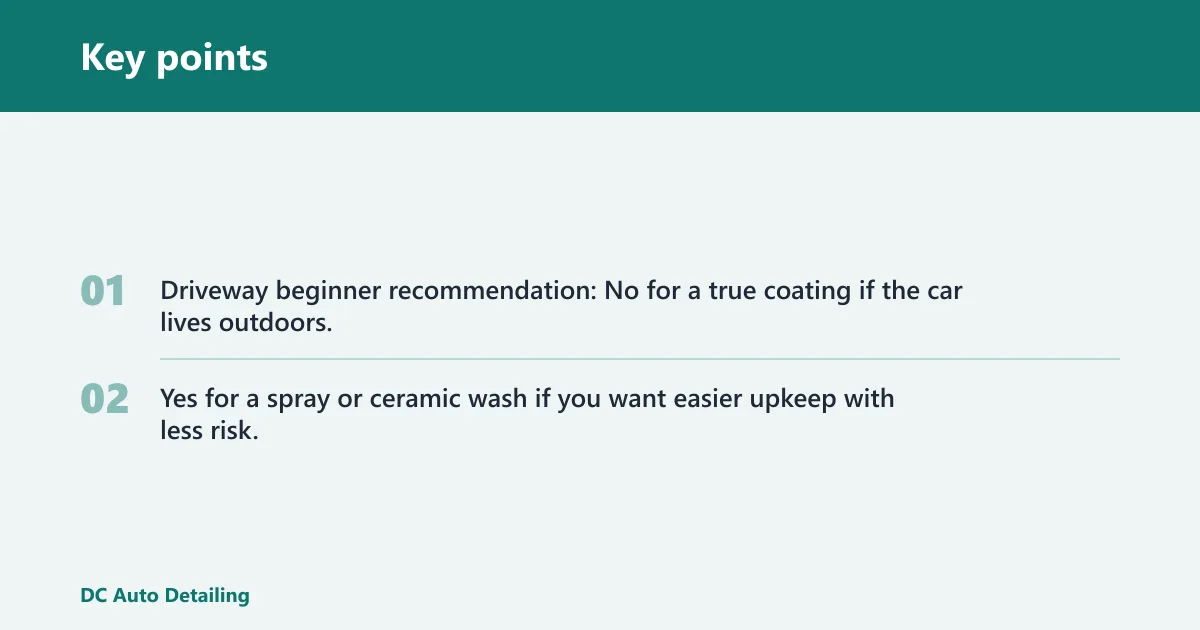
Driveway beginner recommendation: No for a true coating if the car lives outdoors, the weather is unstable, or the paint still needs correction. Yes for a spray or ceramic wash if you want easier upkeep with less risk.
Consumer coating decision matrix and next step
For a daily driver, the decision should start with your prep tolerance, not the label on the bottle. If you can spend time correcting paint, control the environment, and wait for cure time, a true coating makes sense. If you want some water behavior with less risk, choose a spray. If you mainly want cleaner washing, choose a ceramic wash.
Here is the simple rule: stop and choose a spray coating instead of a true coating if the paint still needs correction, you cannot keep the car dry and sheltered during the initial cure, or you do not have the patience to work section by section. That is the safer call for many first-time buyers.
Suppose a sedan sits outside in a driveway, the evening dew starts early, and the owner has only one free hour after work. That is a spray scenario. It is not a good setup for a coating that needs controlled leveling and a stable cure window.
Is it the same as professional coating?
No. Consumer ceramic coating and professional ceramic coating are different product classes, even when both use SiO2 chemistry. Professional products are installer-grade, usually paired with stricter prep standards and tighter application windows, and they are often sold with multi-year durability claims.
Manufacturer technical sheets show why the gap matters. Gtechniq Crystal Serum Light lists up to 5 years of durability with proper maintenance and specifies curing and aftercare constraints, while CarPro CQuartz UK Edition is marketed around roughly 2 years under proper care; both position themselves as coating systems, not wash additives or simple toppers. That is the level of detail shoppers should look for when comparing claims, not just the word “ceramic.”
Professional results assume more control. A clean, heated, well-lit bay is the right environment for application, and that is already more controlled than a driveway. A consumer kit may still work well, but the margin for error is smaller outdoors.
What prep do you need before applying ceramic coating at home?
At-home prep should include a thorough wash, decontamination, and often polishing before you apply a coating. Panel prep is not extra busywork. It is the part that lets the coating bond properly and avoids trapping dirt, old wax, or oxidation under the layer.
Practical prep order
- Wash the paint with a pH-neutral wash.
- Remove bonded contamination with iron removal or clay, as needed.
- Polish the paint if swirls, haze, or oxidation are present.
- Wipe the panel with a prep product or panel wipe.
- Apply the coating in small sections and level it before it flashes.
Claying helps remove contamination that washing leaves behind. Polishing matters when the paint needs correction before you lock in the finish. Panel wipe removes polishing oils so the coating has a cleaner surface to bond to.
pH-neutral wash matters here and during maintenance because it is safer for coated surfaces than harsher cleaners. It is also the better starting point before you apply a consumer coating, since aggressive soaps can leave their own problems behind.
Detailing guidance from coating manufacturers and paint-care sources is consistent on this point: use a gentle, pH-neutral shampoo for routine washing, then preserve the coating with the least aggressive cleaner that still removes road film. Strong alkaline or acidic cleaners may be useful for decontamination in specific cases, but they are not the everyday maintenance choice for coated paint.
Can a beginner apply consumer ceramic coating in a driveway?
Yes, but only in controlled conditions and only if you accept the risk of visible mistakes. Driveway installs are hardest when the surface is hot, the humidity is high, or the light is poor, because all three can shorten the cure window and make wipe-off less forgiving.
Why the cure window matters
The cure window is the time before leveling or wipe-off gets difficult. In a driveway, that window can shrink fast if panels are hot or the air is damp. That is why a coating that seems easy in a product video can turn into streaks or high spots outside.
Adam’s Advanced Graphene Ceramic Coating is presented as a graphene-infused coating with a longer, more forgiving wipe-off window, and it is sold as a kit with everything needed. That kind of product is marketed toward beginners who still want true coating behavior, but it does not erase weather risk.
Say your black hood has been in direct sun for an hour and the panel is warm to the touch. Even a good coating can flash too fast there, so the wipe-off becomes rushed and uneven. Move to shade, cool the panel, or stop and use a spray instead.
If the forecast is unstable, the vehicle is parked outside overnight, or you do not have good lighting, a spray coating is the safer choice. The easiest way to avoid a bad result is to lower the stakes before you open a full coating kit.
What does consumer ceramic coating actually protect against?
It mainly helps with water behavior, cleaning, and some chemical resistance. It does not make paint scratch-proof, and it does not stop rock chips. The right expectation is better maintenance, not armor.
Manufacturer claims and independent paint-care sources are aligned on the limits. Coatings can improve resistance to routine bird droppings, road film, UV, and light chemical exposure, but they are not a substitute for clear coat thickness or physical impact resistance. They also do not prevent swirl marks from improper washing, and they cannot stop marring from abrasive towels or dirty mitts.
That means the useful promise is easier washing and more durable surface behavior, not scratch immunity. A coating can reduce how strongly dirt sticks and can make rinsing easier because water beads or sheets more readily. It may also help against UV exposure and some environmental contamination, depending on the product. But it will not fix swirls already in the paint, and it will not replace proper paint correction.
This is where buyers often mix up appearance claims and protection claims. A glossier finish can look better, but better gloss is not the same thing as impact protection.
How much does ceramic coating cost compared with wax?
Wax is usually cheaper up front, while a consumer coating costs more because of prep, product quality, and cure demands. The tradeoff is that wax is easier to apply and reapply, while a true coating is aimed at longer-lasting water behavior and easier washing.
Centex lists daily-driver coating packages starting at $285 for a 1-year option and a 4-year package starting at $900. By contrast, wax is a lower-cost maintenance product, but it generally does not match the longevity or chemical resistance a coating is trying to provide.
If your budget is tight and you only want easier wash cleanup, a ceramic spray or wash is usually the smarter purchase. If you want longer service and are willing to prep carefully, a true coating is the better fit.
What goes wrong if ceramic coating is applied badly?
Bad application usually shows up as high spots, streaking, uneven gloss, or weak bonding. The product can also cure unevenly if you miss the wipe-off window or if the panel is too hot, too cold, or too humid.
Common failure points
- Skipping panel prep and trapping oils or dirt under the coating.
- Applying too much product and leaving high spots.
- Waiting too long to level the coating.
- Working in direct sun or unstable weather.
- Touching the paint too soon during initial cure.
Competitors often call this “easy” and stop there. The real issue is timing. The coating can be simple to spread but unforgiving to fix once it flashes. That is why first-timers struggle more in uncontrolled temperatures than in a prepared indoor space.
Some consumer-grade products are promoted for easier wipe-off and reduced high-spot risk, but that does not remove the need for careful sectioning and lighting. Easier application helps; it does not change the chemistry of curing or the need for clean paint.
Do consumer ceramic coatings need a cure time before driving?
Yes. Most consumer ceramic coatings need cure time before exposure to water, rain, or heavy washing. The exact window depends on the product, but the key idea is the same: the coating needs time to set before you treat the car normally again.
That cure period is one reason driveway installs fail. If the car gets rained on too soon, sits in humidity, or is handled like a finished surface too early, the finish can spot, streak, or lose part of its intended behavior. A shaded, dry, stable environment reduces that risk.
Many manufacturer instructions call for keeping the vehicle dry for a set period after application, then avoiding aggressive washing for longer while the coating continues to harden. Follow the product sheet for the exact window. A pH-neutral wash is the safer maintenance choice after cure because it is less aggressive on coated paint.
Ceramic maintenance spray: what it is and when to use it
Ceramic maintenance spray is a standalone upkeep product, not a full coating. Use it after regular washes, on clean and dry paint, to refresh gloss, slickness, and water behavior. It is most useful when a coated or uncoated vehicle needs a quick top-up between deeper protection steps.
Use it after the wash and rinse are complete, once the panel is dry or nearly dry, and follow the label for whether it is a wipe-on or spray-and-rinse product. It differs from a spray coating because it is designed as maintenance rather than the main protective layer. It also differs from a ceramic wash because it is not the cleaning step itself. A ceramic wash helps you clean; a maintenance spray helps you preserve the finish after cleaning.
That makes it a useful middle ground for a daily driver. It can extend the feel of a coating without turning every wash into a full reapplication job, and it is much easier to use than a true coating.
Frequently asked questions
What is consumer grade ceramic coating for cars?
It is a DIY paint protectant made for home use, usually built around SiO2 or a related polymer system. It is meant to add water behavior, gloss, and easier washing after careful prep. It is not the same thing as wax, and it is not a substitute for paint correction.
Is consumer ceramic coating the same as professional coating?
No. Professional products are installer-grade and usually assume stricter prep, tighter application control, and longer claimed durability. Consumer kits are built for home use and are more forgiving, though they still need the right environment and careful wipe-off.
How long does consumer ceramic coating last?
Durability depends on product type, prep quality, and how the car is washed and stored. Manufacturer data and established paint-care guidance commonly place true coating durability in the multi-year range, while sprays and wash products last much less time than a true coating.
Is a spray ceramic coating the same as a true ceramic coating?
No. A spray coating is easier to apply and usually less durable. A true coating needs more prep, has a more sensitive cure window, and is meant to bond more like a long-term layer on paint. Both may contain SiO2, but they are not the same product class.