Ceramic spray coating: What it is and how to use it
Ceramic spray coating is a spray-on paint protectant that is often silica-based and may last roughly 1 to 6 months. Use it when you want quick gloss, tighter water beading, and easier washing, but not multi-year protection. Apply it on hot paint, use too much product, or leave residue too long, and you can end up with streaks, uneven beading, and protection that drops off after a few washes. This guide explains what ceramic spray coating is, how it differs from a true ceramic coating, when it makes sense, and the exact prep, application, and maintenance steps that avoid common failures.
The short version: spray ceramics work best as a maintenance-grade layer on properly cleaned clear coat. They are a poor shortcut for oxidized, contaminated, or visibly swirled paint, and they make less sense than a true coating when you want longer durability and can handle the extra prep.
How it bonds and what it can do
Ceramic spray coating is a quick-apply protective layer for a car’s clear coat, often built around SiO2 and sometimes blended with TiO2 or similar additives. It improves water behavior, gloss, and washability, but it does not stop rock chips, prevent swirls, or hide poor paint condition.
What the product is doing on clear coat
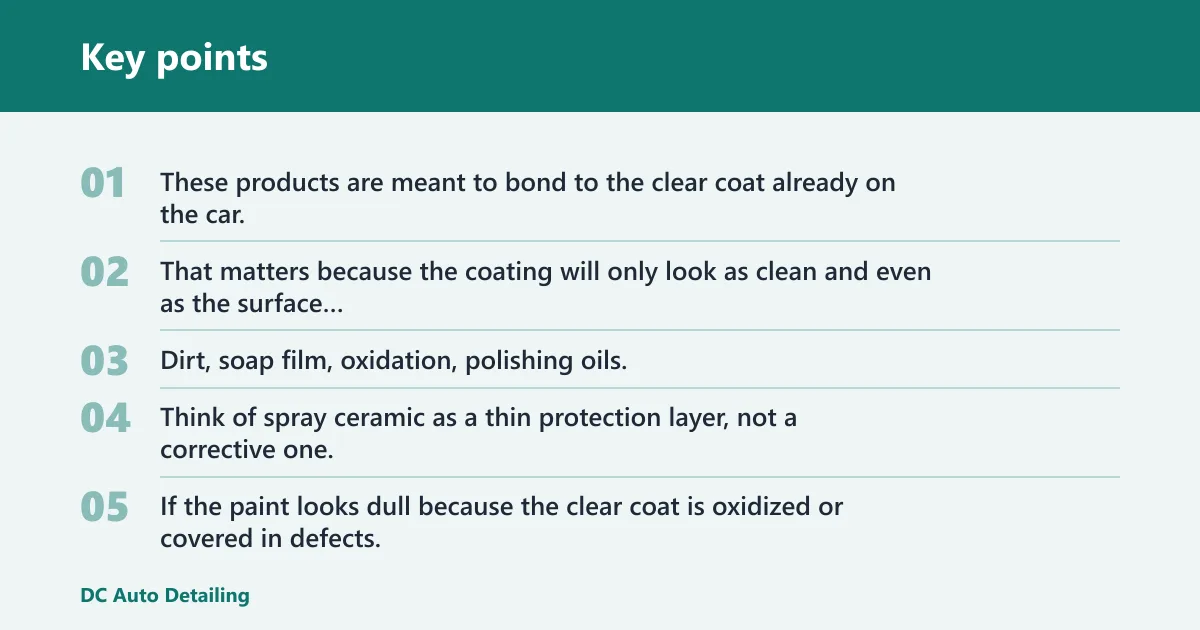
These products are meant to bond to the clear coat already on the car. That matters because the coating will only look as clean and even as the surface underneath it. Dirt, soap film, oxidation, polishing oils, and bonded contamination all interfere with bonding and can leave the finish streaky or uneven.
Think of spray ceramic as a thin protection layer, not a corrective one. If the paint looks dull because the clear coat is oxidized or covered in defects, adding a spray coating usually locks in that look instead of fixing it.
How SiO2 and TiO2 show up in consumer formulas
SiO2 is the common active component in consumer ceramic products. In practice, it is tied to the hydrophobic surface people expect from a ceramic product, along with a cleaner-looking gloss and easier rinse-off during maintenance washes.
TiO2 appears in some formulas as a secondary variable. Brands often tie it to toughness or resilience claims, but label buzzwords matter less than the full formula, the prep under it, and whether the product gives you enough working time for a clean wipe-off.
What benefits are realistic
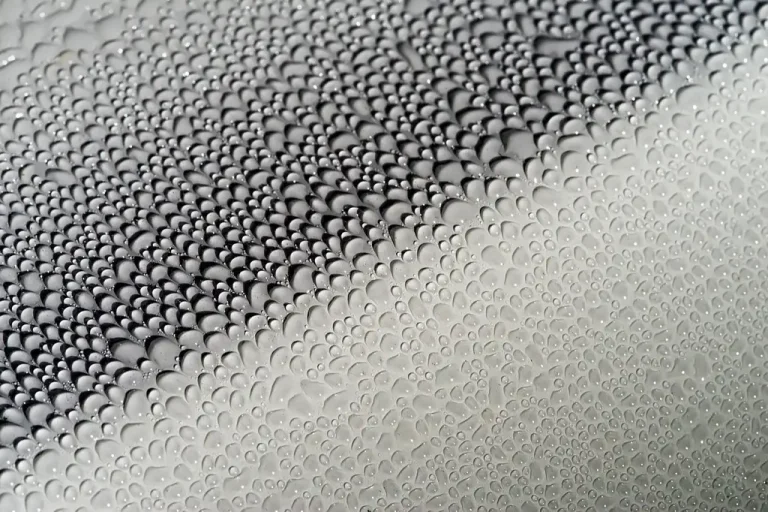
Expect smaller, tighter water beads, a slicker surface, and less stubborn wash dirt. Bird droppings, road film, and UV exposure still matter, but a fresh layer can slow how fast contamination grabs onto the paint.
What you should not expect is scratch-proof paint. Spray ceramics do not prevent wash marring, poor drying technique, automatic brush damage, or stone chips. Their job is to make upkeep easier and add a sacrificial layer, not to act like a hard shell.
How is it different from a true ceramic coating?
Spray coatings are easier and faster, but they sit lower on the durability ladder than true ceramic coatings. A true coating is usually more prep-sensitive, less forgiving during application, and better suited to longer-term protection when the paint is corrected and the cure conditions are controlled.
Bonding strength, solids, and durability gap
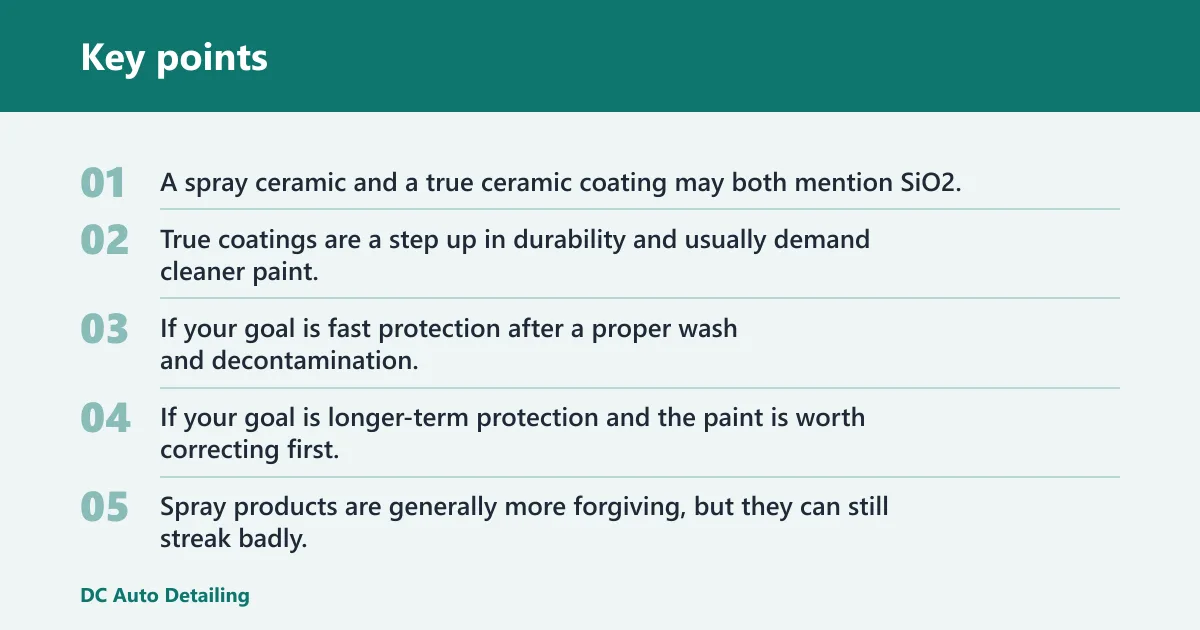
This is where many pages blur the line. A spray ceramic and a true ceramic coating may both mention SiO2, but they are not interchangeable in expected lifespan, bonding strength, or how much prep they justify.
Spray coatings are maintenance-grade. True coatings are a step up in durability and usually demand cleaner paint, tighter application control, and more careful cure conditions. If your goal is fast protection after a proper wash and decontamination, a spray ceramic fits. If your goal is longer-term protection and the paint is worth correcting first, a stronger coating makes more sense.
Application difficulty and high-spot risk
Spray products are generally more forgiving, but they can still streak badly. Flash time is the key variable: it is the working window before wipe-off. Some products dry fast. Adam’s Polishes Graphene Ceramic Spray Coating Advanced dries within one to two minutes. Chemical Guys Carbon Force evaporated within three to four minutes. ValetPRO 24 Plus has a slower flash time to reduce high spots, and ValetPRO says to allow the coating to flash for 1 to 3 minutes depending on temperature.
A shorter flash window leaves less room for delay, especially on warm panels. Leave residue too long and you can get high spots, smeary wipe-off, and patchy gloss.
Where spray coatings fit against waxes, sealants, and boosters
Spray ceramics usually beat traditional wax in water behavior and cleaning ease, but they still sit closer to the easy-use end of the market than a dedicated coating. They can replace wax or a basic sealant for many owners, especially on daily drivers, but they do not replace a true coating when you want a bigger durability jump.
Ceramic booster products are different again. Those are often maintenance toppers meant to support an existing coated surface, not always standalone protection for neglected paint.
Who should choose each type?
Daily-driven cars and leased vehicles are strong candidates for spray ceramics. You get useful protection without turning the job into a correction-heavy project. Older paint can still benefit too, if the surface is clean and the defects are acceptable to you.
If the paint is heavily swirled, oxidized, or rough to the touch after washing, polishing first may do more for the result than any spray product. If you want longer service life and you are willing to prep more carefully, stepping up to a true coating is the better move.
When is spray coating the right choice?
Spray coating is the right choice when your clear coat is in decent shape, you want a quick protection layer, and you can prep the surface well enough for it to bond cleanly. It is the wrong choice when defects, oxidation, or contamination are the main problem, because protection will not correct them.
Best cases: daily drivers, leased cars, and routine protection
For a daily driver, a spray ceramic gives you the main benefits most owners notice: beading, easier washing, and a cleaner-looking finish between washes. For a leased vehicle, it is often enough protection without committing to heavier correction work.
Suppose a commuter vehicle about two years old lives outside, gets washed every two weeks, and the paint still feels smooth after drying. That is a good spray-coating candidate. The surface is stable enough that the product can act like protection instead of a disguise.
When older paint can still benefit
Older paint is not automatically disqualified. If the finish is thinly swirled but clean, and you are not chasing perfection, a spray ceramic can still improve maintenance and water behavior.
What matters is whether the defects will interfere with bonding or make the final look disappointing. If oxidation is visible, contamination is heavy, or polishing oils are still on the paint, the coating layer will struggle.
When it is a poor use of time
If the paint feels gritty after washing, shows chalky oxidation, or has obvious haze from old neglected clear coat, you are past the point where “just add protection” is a smart first move. Decontamination or polishing should come first.
Picture a black hood that looks gray in direct sun and feels rough even after a wash. Spraying ceramic on top may add temporary slickness, but the roughness and dullness stay. Correction, or at least decontamination, is the threshold step.
Surface prep before application
Wash first
Start with a proper wash that removes loose dirt without adding fresh marring. Use quality wash media, rinse thoroughly, and dry the car well before any dry-applied spray ceramic.
Decontamination when needed
Surface prep means more than soap. Use chemical decontamination when the paint has iron fallout, tar, or adhesive residue. Clay only when bonded contamination is present, because claying can add marring that may need polishing afterward.
Clean, bare clear coat gives the product a better chance to bond evenly. That is the whole point of decontamination: removing what your wash did not remove.
When polishing matters more than more product
Polishing is not mandatory every time. It matters when defects, oxidation, or old residue are keeping the paint from looking clear and uniform. If the surface is already in good shape, a wash and decontamination may be enough.
Adding more layers does not fix poor prep. If the first layer smears because the surface was dirty or oily, a second layer usually makes the wipe-off harder.
How do you apply ceramic spray coating correctly?
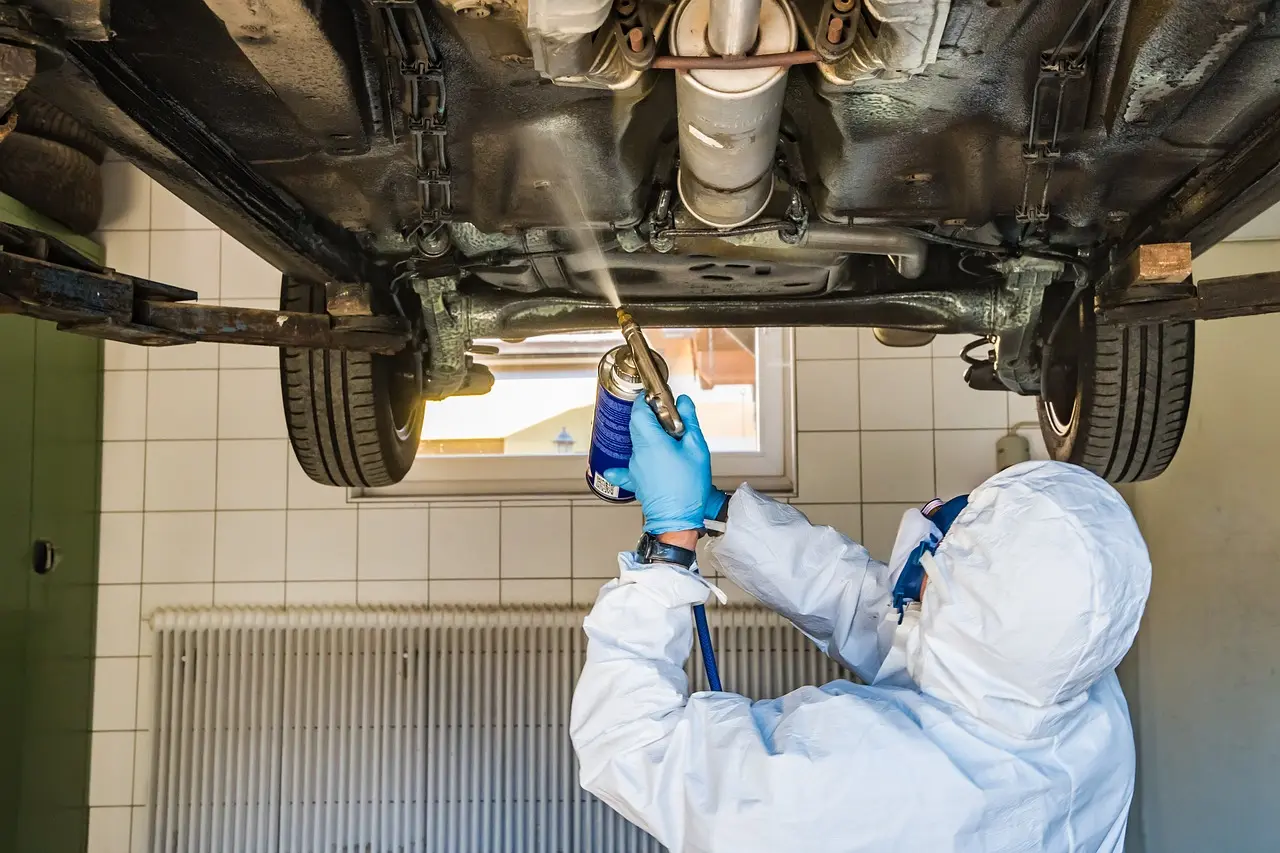
Apply ceramic spray coating to cool, dry, properly prepped paint unless the specific product is designed for wet application. Work one small section at a time, spread a light amount evenly, watch the flash time closely, and use separate clean microfiber towels for initial wipe-off and final buff.
Dry paint vs. wet paint
For most ceramic spray coatings, dry paint is the default. Wet application is only for products specifically designed as rinse aids or wet-applied sealants. If the label does not clearly allow wet use, do not improvise.
Applying to damp paint dilutes some products, changes flash behavior, and can leave you guessing whether the streaking came from water, soap residue, or the coating itself.
What tools you need
- Clean, low-lint microfiber towels
- A second dry buff towel for each section
- A suitable applicator if the product prefers one
- Good lighting to catch residue and high spots
- Quality wash media and drying towels for prep
Microfiber towel management matters more than many guides admit. Do not plan to coat an entire vehicle with one towel. Once a towel loads up, it starts moving residue around instead of removing it.
Panel size, spray amount, and wipe-off sequence
Keep the working area small. ValetPRO recommends spreading the coating across a 40cm x 40cm section, and that is a useful ceiling when conditions are warm or you are new to the process.
- Choose a cool panel out of direct sun.
- Mist a light amount onto the panel or applicator, depending on the product label.
- Spread it thinly and evenly across one section.
- Watch for the flash window to begin.
- Wipe off with the first microfiber towel.
- Follow immediately with a second towel for the final buff.
- Check from multiple angles before moving to the next section.
A common first-timer mistake is spraying half a door, then answering a text, then coming back to buff. On a warm panel, that delay can turn a simple wipe-off into tacky smearing and visible high spots.
Flash time, cure time, and temperature
Flash time changes with temperature, humidity, panel temperature, and product load. More heat usually shortens your working window. That is why a small section and a light product load are safer than broad “spray and wipe the whole side” advice.
Examples from product guidance show how much variation exists. Adam’s Polishes Graphene Ceramic Spray Coating Advanced dries within one to two minutes. Chemical Guys Carbon Force evaporated within three to four minutes. The same source says to allow the coating to flash for 1 to 3 minutes depending on temperature.
Cure time is different from flash time. Flash is when you wipe. Cure is the time before the layer is stable enough for water exposure and routine use. Many products in this category use a no-water window of about 12 to 24 hours, but the label should still be followed. Chemical Guys Carbon Force needs about 24 hours to cure. The same source says the coating should cure indoors for at least 12 hours. (Caranddriver)
Spray coating checklist
Application decision checklist
- If the paint feels smooth, looks clear, and has only minor defects, a spray ceramic is a reasonable choice.
- If the paint feels gritty after washing, decontaminate first.
- If oxidation, heavy swirls, or dull patches dominate the look, polish first before adding protection.
- If you want maintenance-grade protection and easy use, stay with a spray ceramic.
- If you want longer durability and can control prep and cure conditions, move up to a stronger DIY coating.
- If the car is leased or a daily driver and you want low commitment, a spray ceramic usually fits well.
- If weak beading appears quickly, inspect for contamination before assuming the protection is gone.
Ceramic spray coating table
| Paint condition | Ambient temperature | Panel size | Wipe-off timing | Towel count | Recommended product tier |
|---|---|---|---|---|---|
| Freshly washed, smooth, minor defects | 60 to 75°F | 40cm x 40cm | Watch for flash; wipe within the stated window | 2 per section rotation | Spray ceramic coating |
| Clean but lightly contaminated | 60 to 75°F | 40cm x 40cm | After decontamination only | 2 to 3 | Spray ceramic after decon |
| Warm panel, otherwise good paint | 75 to 85°F | Smaller than 40cm x 40cm | Shorter than normal; monitor closely | 3 | Spray ceramic with extra caution |
| Visible oxidation or dullness | Any | Do not coat yet | Not applicable | Not applicable | Polish first |
| Heavy swirls, haze, rough bonded contamination | Any | Do not coat yet | Not applicable | Not applicable | Correction first, then stronger coating or spray |
| Well-corrected paint, long-term goal | Controlled indoor conditions | Per coating label | Per coating label | Multiple towels | True ceramic coating |
Why does ceramic spray coating streak or haze?
Ceramic spray coating usually streaks or hazes because too much product was used, the wipe-off was late, the panel was too warm, or the paint still had residue on it. Most failures come from process, not mystery chemistry, and they are easier to prevent than to polish out later.
Why it happens step by step
Overapplication is the most common cause. A heavy layer does not give you better protection. It gives you more residue to level, more solvent to manage, and less margin before smearing starts.
Heat compresses the flash window. Direct sun and warm panels make the product dry faster, so by the time you reach for a towel, some sections may already be past the easy wipe stage.
Residue on the paint matters too. Soap film, old wax, polishing oils, traffic film, or bonded contamination can all interrupt how evenly the product lays down and flashes.
Troubleshooting
| Symptom | Likely cause | What to do now |
|---|---|---|
| Streaks after buffing | Too much product or saturated towel | Switch to a fresh microfiber towel and rebuff; if needed, lightly re-wet the area with a small amount of product and level it again |
| High spots | Late wipe-off after flash | Try a small amount of the same product to re-soften the spot, then level and buff immediately; if cured hard, polishing may be required |
| Haze on the whole panel | Warm panel, residue underneath, or overapplication | Move to a cooler area, inspect the surface, and rebuff with clean towels; if haze remains, strip residue and reapply correctly |
| Smeary wipe-off | Towel overload or product too watery for the towel condition | Replace the towel early; Cerakote Rapid Ceramic Paint Sealant is described as the most watery of the bunch, so towel saturation can show up fast |
| Weak beading | Poor prep, contamination, or aging layer | Wash and decontaminate first; weaker beading does not always mean zero protection |
Product format can also affect feel during application. Cerakote Rapid Ceramic Paint Sealant is the cheapest and simplest option in the test, comes with a spray bottle and microfiber cloth, and is described as the most watery of the bunch. Adam’s Polishes Graphene Ceramic Spray Coating Advanced uses a larger spray bottle and no dedicated applicators. Those differences do not tell you which is best for every car, but they do show why towel choice and working speed matter.
How long does ceramic spray coating last?
Ceramic spray coating usually lasts about 1 to 6 months in real use, with the exact result shaped by prep quality, climate, wash frequency, and the product tier. Treat it as variable maintenance protection, not as a fixed-duration promise that ignores surface condition and care.
Why the range is wide
A spray product on well-prepped paint that gets safe washes will outlast the same product on contaminated paint run through brush washes. Environment matters too. Heat, frequent rain, road salt, and harsh cleaners all shorten life.
Stronger products sit outside the normal spray range. ValetPRO 24 Plus offers over 2 years of protection with safe wash routines, which puts it in a different class than a simple maintenance spray even though the category labels can overlap.
Weak beading does not always mean failure
Water behavior is the first thing most owners watch, but it is not the only sign of protection. Surface contamination can mute beading before the underlying layer is fully gone.
If the car stops beading sharply after a dirty month, wash and decontaminate it before assuming the layer has failed. Reapply only after the surface is clean enough to judge honestly.
When to reapply
Reapply when the surface has been washed properly, decontaminated if needed, and still shows clearly reduced behavior or cleaning ease. Do not stack fresh product over old smear-prone residue and expect a cleaner result.
What spray ceramic coating actually changes
Spray ceramic coating is best understood as a maintenance-friendly protection layer: it can add gloss, improve water beading, and make routine washing easier, but it will not repair paint defects or protect against impact damage like rock chips. That distinction matters because many problems with spray products come from using them on dirty or poorly prepped paint, which can lead to streaking, haze, or weak results. The spray ceramic guide breaks down what these products can and cannot do, how long they typically last, and how prep and curing affect performance, so you can decide whether they belong in a DIY protection plan.
How do you maintain it after application?
Maintain a ceramic spray coating by keeping the car dry during the initial cure window, washing gently with a pH-neutral shampoo, and avoiding abrasive wash methods that chew through the layer. Early restraint matters as much as the first application because fresh coatings are easiest to disturb before they settle.
The first 24 hours
Keep the car dry if the label calls for it. Many products in this category ask for about 12 to 24 hours before water exposure, and some need indoor cure conditions. Avoid soaps, toppers, and unnecessary touching during that period.
If you can choose parking, covered is better than open during the cure window. Water spots on a fresh layer are harder to evaluate because you cannot always tell whether the issue is minerals, residue, or incomplete cure.
The first 30 days
Wash gently. Skip abrasive cleaners, heavy degreasers, and unnecessary layering while the initial application settles according to product guidance. More product in the first month is usually less helpful than better wash discipline.
Long-term wash routine
Use a pH-neutral maintenance shampoo. IMO recommends using a pH-neutral car shampoo for ceramic-coated cars. Safe wash technique matters too, because the coating does not stop marring from bad mitts, dirty towels, or aggressive brushes.
Brush washes are a poor idea. IMO advises avoiding automatic car washes with brushes for coated cars. Use clean drying towels and inspect them often; a loaded towel can grind grit across the same clear coat you just protected.
Use cases: daily drivers, leased cars, older paint
For a daily driver, keep the routine simple: wash, dry, inspect, then top up only when performance actually drops. For a leased car, that is often enough to keep the finish easier to clean without overinvesting.
For older paint, stay realistic. If the paint has defects you are willing to live with, maintenance-grade protection is worthwhile. If the finish needs correction to look right, maintenance products should follow that work, not replace it.
Frequently asked questions
Do you spray ceramic coating on wet or dry paint?
Dry paint is the main guidance unless the product specifically says it can be used on wet paint as a rinse aid or drying aid. Using a dry-only product on wet paint can dilute it, disrupt flash time, and leave streaks that are harder to diagnose.
Can ceramic spray coating be used after washing?
Yes, but only after a proper wash and only when the paint is actually ready for protection. If the surface is still contaminated, rough, oily, or oxidized, washing alone is not enough. In those cases, decontamination or polishing should happen before application.
What tools do you need to apply ceramic spray coating?
You need clean microfiber towels, a separate final-buff towel, good lighting, proper wash tools, and an applicator if the product prefers one. Towel management is part of the tool list, because one overloaded microfiber can cause smearing across multiple panels.
What is the difference between ceramic spray coating and a true ceramic coating?
Spray ceramic coatings are easier to apply and usually shorter-lived. True ceramic coatings demand stricter prep, are more sensitive to application errors, and are chosen for longer-term protection. Both can use SiO2-based chemistry, but they occupy different tiers in durability and effort.
Can ceramic spray coating replace wax or sealant?
For many owners, yes. A good spray ceramic can replace wax or a basic sealant as the main maintenance protection layer because it usually gives stronger water behavior and easier cleaning. It does not replace a true ceramic coating when you want a bigger durability jump.