What is the best drying towel for cars?
For most cars, a premium twisted-loop microfiber drying towel is often the best all-around choice; waffle weave can suit lighter, budget-friendly drying, and PVA may work if you prefer a firmer, wrung-out sheet for glass or quick touch-ups. The wrong towel can leave water spots, streaking, and fine towel marks, especially on dark paint. This guide compares twisted loop, waffle weave, and PVA towels by vehicle size, paint finish, and drying style so you can choose the right one.
Best drying towels by use case
The right drying towel depends on panel size, paint sensitivity, and how much water you want to move per pass. Microfiber is the safest common drying material for most paintwork because it combines soft contact with strong water pickup. For drying guidance, see safe car drying methods and, for care, microfiber towel washing.
Top pick for a daily driver
A twisted-loop microfiber towel is the strongest all-around pick for a sedan or compact SUV. It usually dries faster than a lighter waffle weave towel, and an edgeless design can reduce edge contact on paint. If you want one towel that handles normal wash-day drying with fewer passes, start here.
Top pick for dark paint
Dark paint makes water spots and streaking easier to spot, so speed matters more. A large twisted-loop towel with an edgeless edge is the safer choice because it covers more area per pass and reduces repeated wiping. For dark finishes, that extra coverage often matters more than low weight. If spotting is already an issue, pair drying with water spot removal guidance.
Top pick for large SUVs and trucks
For larger vehicles, a bigger towel matters more than a small premium weave. A 36 x 24 inch drying towel generally offers more coverage per pass than a compact towel, which can help with speed on hoods, roofs, and doors. If the towel is also high-GSM, it may hold more water, but it will feel heavier once saturated.
Best budget pick for maintenance washes
A waffle weave microfiber towel is the budget-friendly choice for light drying jobs. It is lighter, easier to wring, and often enough for maintenance washes on smaller vehicles or already well-protected paint. If the car is only lightly wet after rinsing, a good waffle weave towel can be perfectly practical. For more towel categories, see detailing towel types.
Drying towel table
Use this table to match towel type to your car, paint, and drying style. Higher GSM usually means a thicker towel, but thicker is not always better if you want less drag or lower weight. Textile care resources and microfiber makers generally treat GSM as a density cue, not a standalone quality score.
| Use case | Towel type | GSM range | Size | Paint sensitivity | Drying speed | Streak risk | Towel weight | Ideal user |
|---|---|---|---|---|---|---|---|---|
| Daily driver sedan | Twisted loop microfiber | 800-1200 | 18 x 24 inches | High | Fast | Low if towel is kept clean | Medium to heavy | Owner who wants one towel for most wash days |
| Dark paint and soft clear coat | Edgeless twisted loop microfiber | 1000-1300 | 36 x 24 inches | Very high | Very fast | Low when blotting or light-drag drying | Heavy when wet | Owner who wants maximum coverage and low edge contact |
| Large SUV or truck | Twisted loop microfiber | 1000-1300 | 36 x 24 inches | Medium to high | Fast | Low | Heavy | Owner who values fewer passes over low towel weight |
| Maintenance wash on a budget | Waffle weave microfiber | 300-600 | 16 x 16 or 18 x 24 inches | Medium | Moderate | Low to moderate | Light | Owner who wants a cheaper, easy-handling towel |
| Glass, quick touch-ups, wrung-out drying | PVA drying towel | Not usually sold by GSM in the same way | 17 x 27 inches | Low to medium | Moderate | Moderate if dragged dry on dirty panels | Light when wrung out | Owner who wants a chamois-like feel and easy wringing |
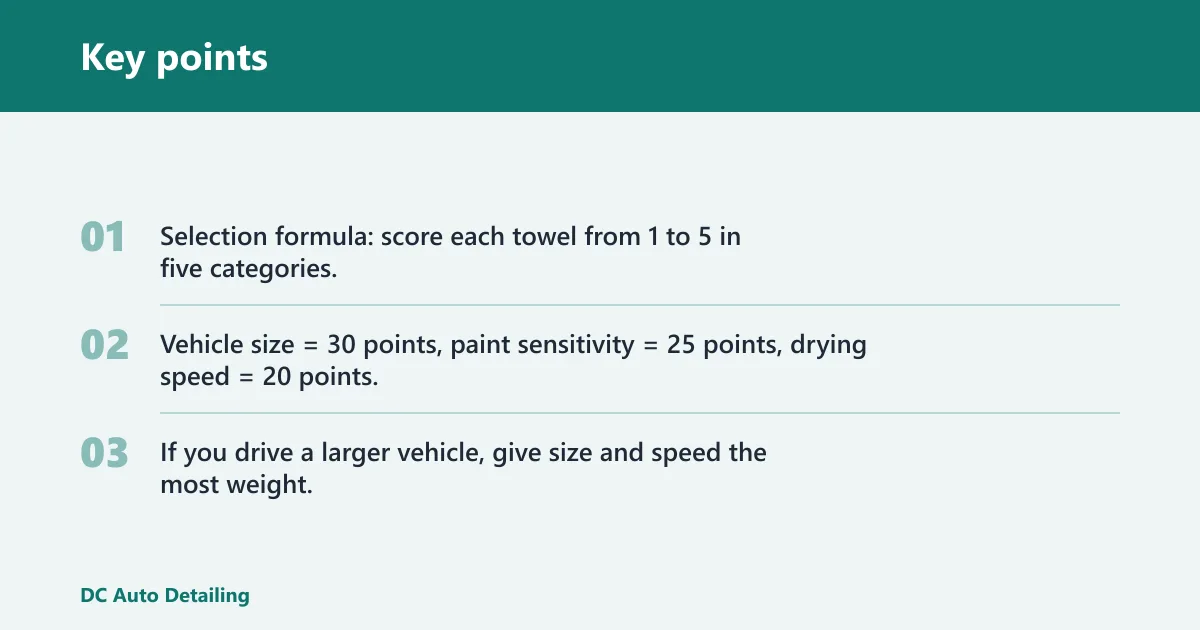
Selection formula: score each towel from 1 to 5 in five categories, then multiply by the weight. Vehicle size = 30 points, paint sensitivity = 25 points, drying speed = 20 points, towel weight tolerance = 15 points, budget = 10 points. The highest total wins. If you drive a larger vehicle, give size and speed the most weight; if your paint is delicate, prioritize paint sensitivity and lower edge contact.
What is the best drying towel for cars?
For most owners, the best drying towel for cars is a premium twisted-loop microfiber towel with an edgeless construction. That combination gives strong absorbency, good coverage per pass, and lower edge contact than a stitched towel. Waffle weave is the better fallback if you want lighter handling or lower cost. Textile standards such as ISO 6330 and ASTM D3776 are commonly used to describe laundering behavior and fabric weight, which is why material specs matter more than branding.
Why there is no single winner
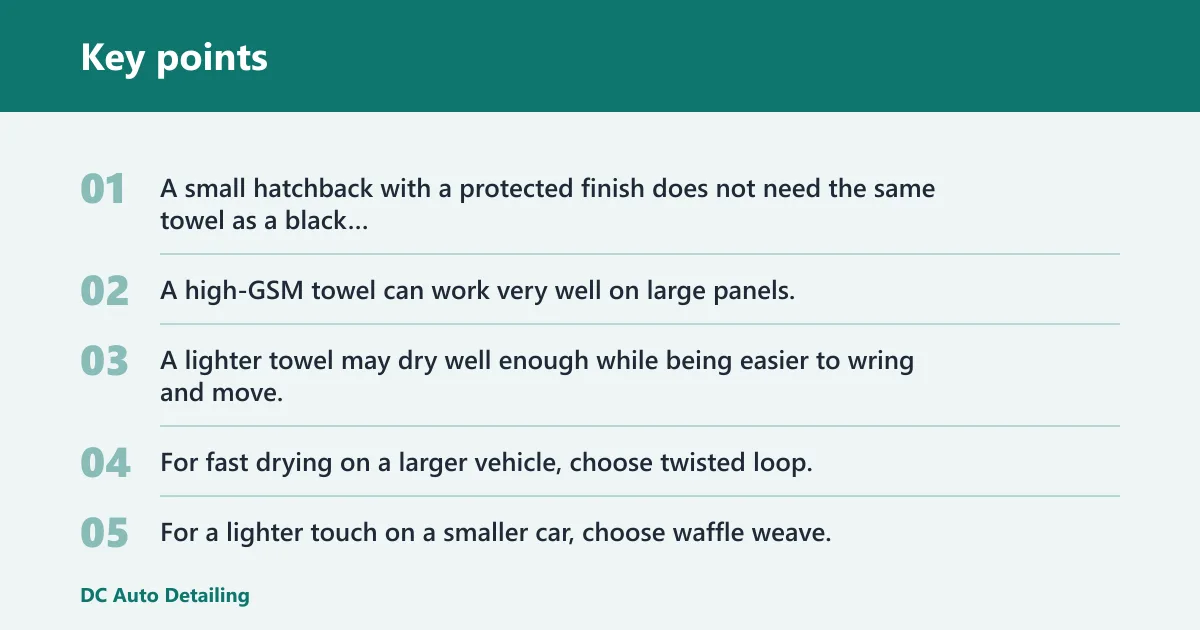
A small hatchback with a protected finish does not need the same towel as a black full-size SUV. A high-GSM towel can work very well on large panels, but it can feel heavy and sluggish on smaller cars. A lighter towel may dry well enough while being easier to wring and move, which is why the best towel is always scenario-specific.
How to choose the best match for your car
Match the towel to the job. For fast drying on a larger vehicle, choose twisted loop. For a lighter touch on a smaller car, choose waffle weave. If you want a rigid, chamois-like cloth for glass or quick water removal, PVA can fit that role, but it does not feel like microfiber.
Say your sedan is parked outside after a wash and you see beads on the roof and doors. A 36 x 24 inch twisted-loop towel can cover more sheet metal per pass, which helps reduce the chance of water spots before the sun bakes the panels dry.
Best twisted loop microfiber towel
Twisted loop microfiber is the strongest choice when you want fast drying and high absorbency. The twisted fibers pull water into the towel rather than pushing it around the panel, and edgeless versions reduce edge contact. That makes it a common premium format for drying paint. Reputable microfiber care guides also emphasize avoiding fabric softener and high-heat mistakes that can reduce performance over time.
Why twisted loop dries fast
Twisted loop towels usually have a denser, more absorbent structure than basic microfiber towels. They are often sold in higher GSM ranges, and that higher GSM usually means a thicker towel. In practical terms, higher GSM can mean more pile and more water-holding capacity, but the best result still depends on construction, fiber quality, and care.
When edgeless construction matters
Edgeless construction helps reduce the chance that a stitched border will touch the paint. That is especially useful on soft paint or fresh, delicate finishes. It is not magic. Dirt caught in the towel can still mar paint, so clean towel care matters just as much as the edge design.
When the weight is worth it
Choose a heavier twisted-loop towel when you care more about coverage and dry speed than towel weight. That tradeoff makes sense on SUVs, trucks, and darker paint. The main advantage is fewer passes, which can matter more than lower hand fatigue when you are drying large horizontal panels.
Best waffle weave microfiber towel
Waffle weave microfiber is the lighter, simpler option. It does not usually hold as much water as a premium twisted-loop towel, but it is easier to handle and often cheaper. For maintenance washes, that can be enough, especially if the car is not heavily wet and the paint has good protection.
Why waffle weave feels lighter
Waffle weave uses a textured pattern that stays comparatively light in the hand. That lower mass can make it easier to fold, flip, and wring. For smaller cars, or for owners who want less drag across the panel, that lighter feel is a real advantage.
Where it makes more sense than twisted loop
Waffle weave makes sense when you want a practical towel for regular drying without paying for extra absorbency you will not use. It fits compact cars, lightly wet paint, and quick post-rinse touch-ups well. It can also be easier to dry and store after washing, which matters for care and longevity.
Who should skip it?
If your vehicle is large, often parked in the sun, or finished in a dark color that shows spotting quickly, waffle weave may feel too slow. In those cases, more absorbency and a larger size are usually worth the extra weight.
Best PVA drying towel
PVA is a synthetic chamois-like material. It is not microfiber, and it feels different on the paint. It can be useful for quick drying or glass, but it is a separate tool with a different drying feel and a narrower role than microfiber. Standards-based textile references are less relevant here than the product’s intended use and care instructions.
How PVA differs from microfiber
PVA tends to feel more rigid and sheet-like when wrung out. That makes it easy to control on certain surfaces, but it does not have the plush hand-feel of microfiber. It can be practical for controlled wipe-downs, though it is not the best match when you want the softest contact on delicate paint.
When a chamois-style towel is a better fit
Use PVA when you want a reusable cloth that works well for quick water removal and glass cleanup. It can be convenient for owners who prefer a flatter drying tool. It is less appealing if you want the softest contact on delicate paint or if the panel still carries grit.
What to watch for with streaking and feel
PVA can streak if it is used dirty, too wet, or on a panel that still has soap residue. It also does not glide like microfiber. If you dislike a firmer feel on paint, microfiber is the safer default.
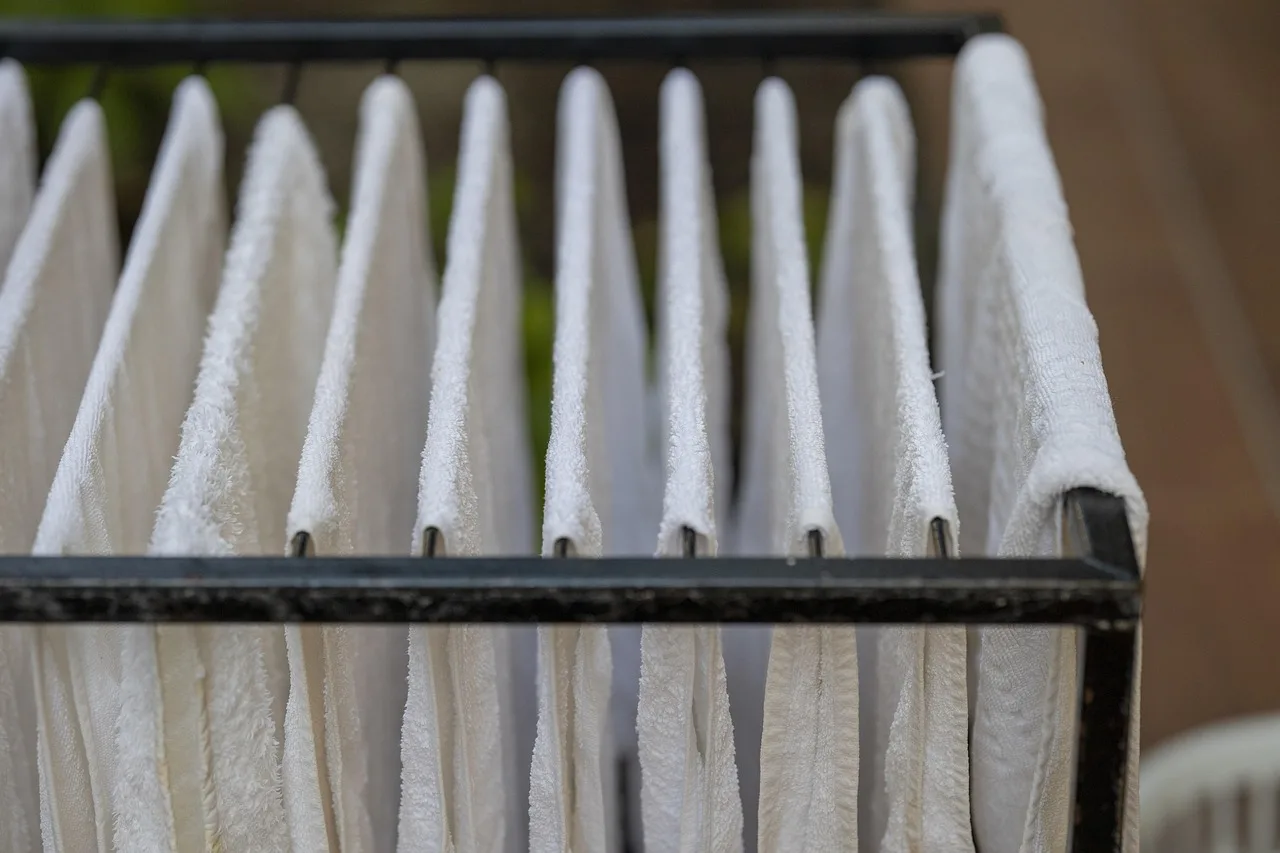
Choose by absorbency first, then size, edge design, and your car’s paint sensitivity. GSM helps compare towel density, but it should not be the only factor. A large, well-made towel can outwork a smaller premium towel simply because it covers more panel with fewer passes.
GSM rating explained
GSM means grams per square meter. Higher GSM generally means a thicker towel, though that does not automatically make it better for every owner. Higher-GSM towels usually feel plusher and hold more water, but they also weigh more when loaded. Textile resources use GSM as a measurable fabric density indicator, not a quality guarantee.
Towel size and coverage
Common drying sizes include about 16 x 16, 18 x 24, and 36 x 24 inches. Smaller towels are easier to manage, but larger towels dry more panel area per pass. That is why a larger towel often speeds up drying on SUVs, trucks, and full-size sedans.
Paint sensitivity and edgeless edges
Edgeless towels can help reduce scratches because there is less edge material touching the paint. That does not remove the need for clean, grit-free towel care. It only lowers one source of contact. On soft or dark paint, that small difference matters.
Drying speed versus towel weight
A high-GSM towel is not always the right answer. If the towel feels too heavy, it becomes harder to move and wring. For small cars or quick maintenance washes, a lighter waffle weave towel may be more efficient than a thick towel that loads up fast.
How many towels you need for one car
For a sedan, one large drying towel can be enough if it is absorbent and you wring it out as needed. For an SUV, plan on one main towel plus a backup. For a truck or large SUV, two towels is the safer starting point, especially if you want to avoid saturation before the panels are dry.
A common first-timer mistake is using one small 16 x 16 towel on a large SUV. It can soak up early, then start leaving streaks because it is loaded with water. A 36 x 24 towel, or a second towel ready to swap in, avoids that problem.
- Start with a clean microfiber towel reserved for paint work only.
- Use the largest size you can control comfortably.
- Choose twisted loop for speed and coverage, waffle weave for lighter handling, and PVA for a firmer chamois-style feel.
- Switch towels before saturation becomes obvious.
- Wash towels without fabric softener, then dry them according to the care label.
What is the best microfiber towel for cars?
The best microfiber towel for cars depends on the job. For drying paint, a twisted-loop microfiber drying towel is usually the better choice. For wiping trim, interior dust, or quick detailing tasks, a general microfiber detailing towel in a pack is more flexible. Do not treat every microfiber towel as a drying towel.
Best microfiber for drying versus general detailing
Drying towels are built for water removal first, while microfiber detailing towels are often sold in packs for many tasks. A drying towel usually has more absorbent structure, more surface area, or both. A multipurpose microfiber towel may work well for sealant removal, glass, or quick detailer use, but it can be too small or too thin for full-panel drying.
What makes a drying towel different from a multipurpose microfiber towel
A drying towel is designed to absorb and release a larger volume of water efficiently. A multipurpose microfiber towel is better viewed as a finishing and utility tool. Keep drying towels dedicated to paint work and wash them separately from greasy shop rags so they stay soft, clean, and effective.
Frequently asked questions
What is the best microfiber towel for drying cars?
The best microfiber towel for drying cars is usually a large twisted-loop towel with an edgeless design. It dries more panel area per pass and reduces edge contact. A waffle weave towel is the better fallback when you want lower weight and less bulk.
How do I choose between twisted loop and waffle weave?
Choose twisted loop if you want faster drying, a larger working surface, and better performance on bigger vehicles or darker paint. Choose waffle weave if you want a lighter towel, lower cost, and easy handling on smaller cars or lighter drying jobs.
What towel size works best for drying a car?
For most owners, 18 x 24 inches is a practical middle ground. If you dry SUVs, trucks, or large sedans, 36 x 24 inches gives more coverage per pass and usually speeds up the job. Small 16 x 16 towels are better for trim or spot work than full-body drying.
How many drying towels do I need for one car?
One large towel can be enough for a sedan if it is highly absorbent and you manage saturation well. For an SUV, plan on one main towel and one backup. For a truck, two towels is the safer choice, especially if you want to avoid streaking as the towel fills with water.
Sources
- Microfiber care guidance from towel manufacturers such as The Rag Company and Griot’s Garage: wash without fabric softener, avoid dryer sheets, and keep towels separate from greasy contamination.
- Textile references for measuring fabric weight and care behavior: GSM usage in textile labeling, ISO 6330 laundry testing principles, and ASTM D3776 fabric mass per unit area.
- Microfiber material primers from detailing suppliers explaining that fiber structure, pile, and edge finish affect absorbency, drag, and paint-contact safety.