How to rinseless wash a car step by step
Use a rinseless wash only on light to moderate dirt: dilute the product at its labeled wash ratio, pre-soak each panel, wipe with one plush towel face, then dry with a second towel; stop if grit is heavy enough to drag. If the towel drags dirt across the paint, it can leave wash marks. This guide gives a step-by-step rinseless wash workflow, towel rotation rules, dilution choices, and clear stop points.
What a rinseless wash
A rinseless wash uses a lubricating solution to suspend dirt so it can be lifted away with microfiber towels instead of being scrubbed across paint. Product directions control the final mix. Some formulas use polymers, surfactants, or hybrid chemistry, and the goal is the same: keep contamination floating long enough to remove it safely. Reputable manufacturer directions from brands such as Optimum No Rinse, Gtechniq, and CarPro all emphasize using the label ratio and clean microfiber.
That works best on light to moderate grime. It is not the right move for caked mud, heavy sand, or abrasive buildup that will load your towel too fast. A hose, pre-rinse, or traditional wash is safer when the surface is coated with real debris. Best-practice washing guidance from detailing sources and water-spotting references also favors faster drying, clean towels, and avoiding dirty wash media.
Why it suits light dirt
On a lightly soiled car, the towel can glide over the panel while the solution carries dirt away from the paint. Manufacturer guidance on rinseless products generally frames this as a low-water wash for light contamination, not a substitute for blasting off heavy debris. Each wipe should move loose soil off the surface, not drag it in circles.
When a hose is still the better choice
If the car has dried mud, thick road film, or grit that makes the paint feel rough before you even start, a rinseless wash is the wrong tool. The same is true when the towel turns dirty after only a pass or two. At that point, stop and switch methods before you create scratches. Water-spotting and wash-method guidance agree that heavy contamination deserves a rinse-first approach.
Mix the solution per the bottle, wash one panel at a time, and dry each section right away. The roof comes first, followed by the upper sides and then the lower panels. Small sections are safer because the solution stays wet long enough to suspend dirt instead of drying on the paint. If the surface starts to feel gritty, the panel has crossed from safe to unsafe.
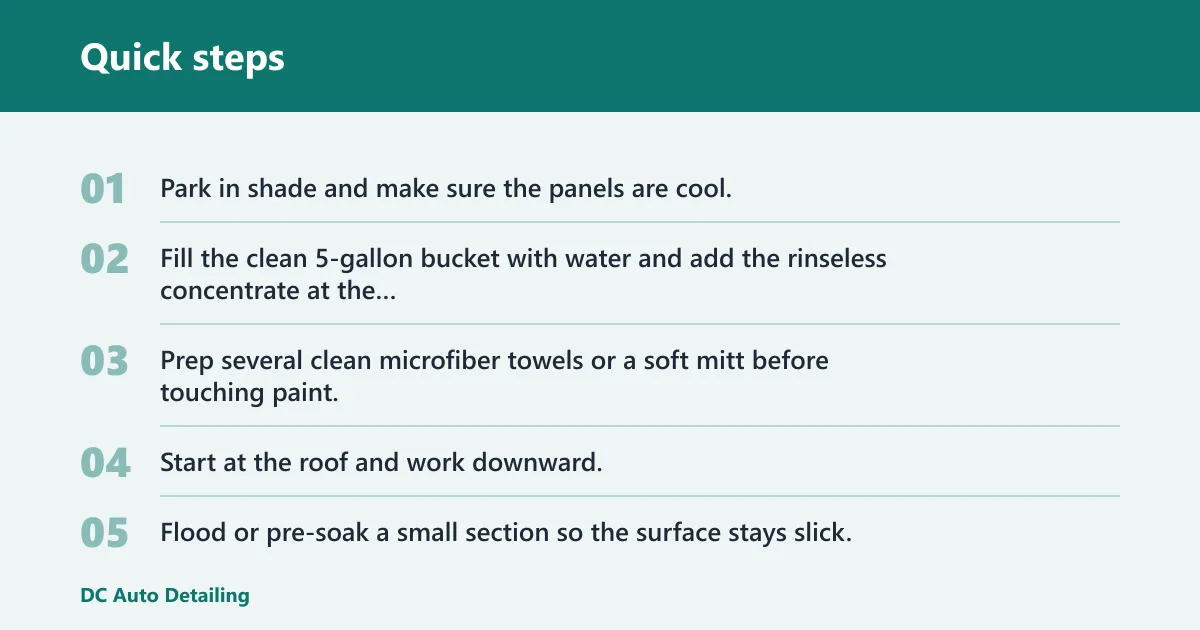
- Park in shade and make sure the panels are cool.
- Fill the clean 5-gallon bucket with water and add the rinseless concentrate at the labeled ratio.
- Prep several clean microfiber towels or a soft mitt before touching paint.
- Start at the roof and work downward.
- Flood or pre-soak a small section so the surface stays slick.
- Wipe in straight lines with light pressure, using one towel side for the first pass.
- Flip to a fresh side or switch towels as soon as the towel face looks loaded.
- Dry or blot the panel immediately with a clean towel.
- Move to the next section only after the first section is clean and dry.
Picture a compact sedan with a dusty roof and clean doors. One towel side may cover the roof section, but the lower rocker area may need a fresh side sooner because the dirt is heavier there. The workflow stays the same. Only the towel rotation changes.
Suppose a midsize SUV sits outside after a light rain that dried on the paint. The top surfaces may still be rinseless-wash friendly, but the lower doors may load the towel too quickly. That is the warning sign. Stop after the upper half if the lower half turns gritty.
Safe vs unsafe dirt levels
Safe conditions usually mean dust, light road film, or a thin layer of grime that does not rapidly load the towel. Unsafe conditions usually mean mud, heavy grit, sand, or a finish that feels rough before you begin. If you can see gritty runoff on the towel after the first small section, you are already near the cutoff and should switch methods.
When to switch from towel to mitt or sponge
Use a towel for most light rinseless work, then switch to a softer mitt or sponge only if the product and panel condition call for a more cushioned glide. A mitt can help on larger, flatter panels when it stays fully saturated and clean. Switch back to towels if the mitt starts dragging, because the safest media is the one that stays cleanest and easiest to refresh.
How many towel sides per panel
A practical starting point is one fresh towel side for a small upper panel, then a second side only if the towel stays clean enough. For medium panels, plan on two to three sides. For dirtier lower panels, four or more sides may be needed, or the wash should stop. If a side feels loaded before the panel is done, retire it immediately.
When two-bucket rinsing helps
Two-bucket rinsing is most useful when the paint is moderately dirty, the vehicle is large, or you want an extra contamination buffer. It is less useful on very light dust, where the rinse bucket may add little value. Use it when you expect repeated towel refreshes or when the lower panels are close to the safe limit, because it helps keep spent soil out of the wash solution.
Is your car dirty enough for rinseless wash?
Check the soil level before you mix anything. If the car has light dust, road film, or a thin layer of everyday grime, rinseless washing can work well. If it has heavy contamination, the finish feels gritty, or the lower panels are packed with debris, it is safer to pre-rinse or use a traditional wash. That threshold is the main safety filter.
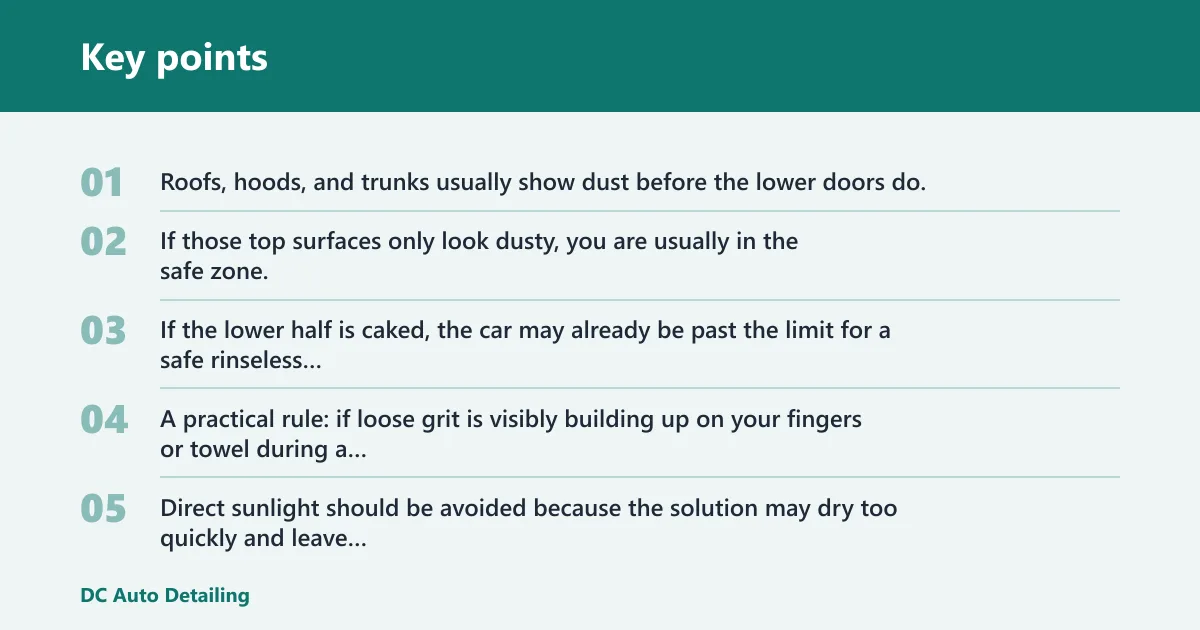
Soil level check before you mix
Look at the horizontal panels first. Roofs, hoods, and trunks usually show dust before the lower doors do. If those top surfaces only look dusty, you are usually in the safe zone. If the lower half is caked, the car may already be past the limit for a safe rinseless wash. A practical rule: if loose grit is visibly building up on your fingers or towel during a dry touch, do not start.
Weather and surface temperature checks
Wash in shade on a cool panel. Direct sunlight should be avoided because the solution may dry too quickly and leave residue. Manufacturer wash directions and water-spot best practices both point to cool panels and manageable drying conditions. A cool surface matters more than chasing a perfect forecast, because faster drying raises streak and spotting risk.
When to stop and switch methods
Stop if the towel loads up fast, the panel starts feeling grabby, or the car is dirtier than expected once you reach the lower sections. A common first-timer mistake is trying to finish the whole car after the first towel already looks filthy. That is the point to switch to a pre-rinse or another wash method. As a threshold, if you need to refresh the towel every few wipes on more than one panel, the dirt level is too high for a safe rinseless wash.
Rinseless wash decision table
This table gives a practical decision rule, not a universal formula. Always check the bottle first. If the product label differs, follow the label. When the car is dirtier, the weather is hotter, or the panels are larger, increase towel count or stop sooner.
| Soil level | Weather / surface condition | Panel size | Recommended ratio | Towel count to prep | Decision |
|---|---|---|---|---|---|
| Light dust | Shade, cool panel | Small panel | Use the label; common guidance is about 1 oz per 2 gallons | 2 towels minimum | Continue |
| Light to moderate grime | Shade, cool panel, low wind | Medium panel | Label first; a common light-use reference is 1 oz per gallon | 3 to 4 towels or sides | Continue if towel stays clean enough |
| Moderate road film | Cool panel, overcast or shaded | Large panel | Label first; some guides list 1.5 oz per gallon for moderate use | 4 to 6 towels or sides | Continue only if wipe remains slick |
| Heavy dirt, grit, or visible mud film | Any | Any | Do not force a rinseless wash | Do not start | Stop and switch methods |
| Dusty but drying fast | Warm air, sun exposure, low humidity | Small panel | Label first; increase section size only if the panel stays wet | Extra towels ready | Continue only if you can dry immediately |
What you need to set up
The beginner setup is simple and usually includes rinseless wash concentrate, a clean 5-gallon bucket, microfiber wash towels or a soft mitt, and dry towels for blotting. Use clean, pre-washed microfiber. Manufacturer care guidance for microfiber generally supports washing out lint and residues before first use, then keeping towels free of fabric softener, bleach, and heavy contamination. Higher-GSM towels give more fiber depth for holding soil away from paint.
Rinseless wash concentrate and bucket
Use the bottle label first. Manufacturer dilution guidance commonly varies by product: some rinseless washes are mixed at about 1 ounce per 2 gallons, while others call for roughly 1 ounce per gallon or more for dirtier conditions. The label controls. A clean 5-gallon bucket keeps the mix free from old grit.
Microfiber towels, mitts, and sponge choices
Microfiber towels are the safest all-around choice when they are plush, clean, and pre-washed before use. A wash mitt or cross-cut sponge can also work if the design is soft and the motion stays straight. The goal is not scrubbing. The goal is to gather dirt and lift it away with minimal pressure. Microfiber-care guidance from detailing suppliers and textile-care sources favors clean, residue-free towels with no fabric softener.
Optional second bucket and RO or DI water
A second bucket is optional contamination control, not a requirement. In traditional advice, it separates wash solution from rinse water. Some product and maintenance guides also recommend RO or DI water when available to reduce spotting risk, especially on dark paint or in hard-water areas. Helpful, not mandatory. For related setup guidance, see the bucket wash method and water spot removal.
How do you avoid swirl marks?
Use straight-line passes, light pressure, and fresh towel sides before the towel gets dirty enough to drag grit. Swirl marks come from trapped grit being dragged in circles. If the wipe starts to feel sticky or the towel face no longer looks clean, change it immediately. Manufacturer care guidance and wash best-practice sources both point to clean media and low-pressure contact.
Straight-line passes and light pressure
Keep the motion linear. Short front-to-back or side-to-side passes are safer than looping motions. The mitt or towel should glide, not press. If you need force, the panel is probably too dirty for a rinseless wash. A safer pass is one that removes dirt without making the towel feel like it is plowing.
Towel rotation and fresh sides
Plan the towel count before you start. Light dust on a small car may need only a few sides. Moderate grime on a larger car may need several towels. Rotate to a fresh side after each section, or sooner if the towel face looks contaminated. Do not wait for it to feel “fine.” For related maintenance, see microfiber towel care.
Signs the towel is no longer safe
If the towel leaves a draggy feel, picks up visible grit, or starts leaving faint trails, retire that side at once. The towel may still be usable on glass or dirty jambs, but it should not go back on clean paint without being washed first. If you notice repeated loading after each pass, stop and reassess the dirt level.
Common mistakes and failure signs
Streaks, haze, and true swirl marks are different problems. Streaks and haze usually come from drying residue or uneven buffing. Swirl marks are paint defects caused by abrasive contact. If the panel looks cloudy after drying, that is not the same as marring, but it still means the process needs adjustment. The checklist below gives exact symptoms, causes, and fixes.
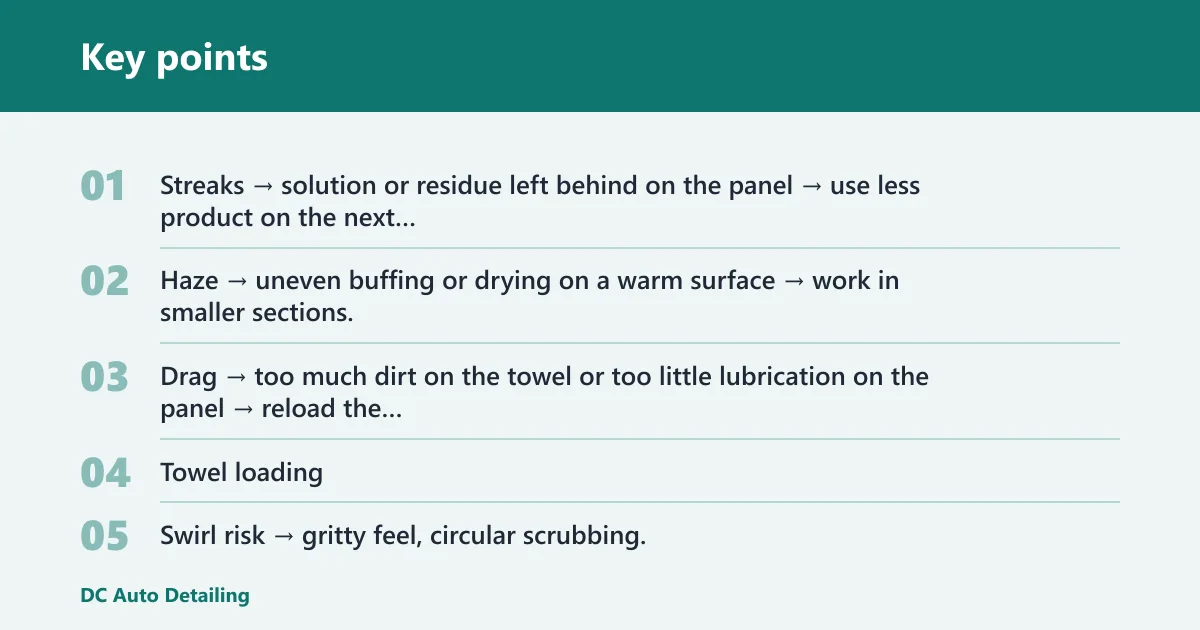
Wash car step by checklist
- Streaks → solution or residue left behind on the panel → use less product on the next section, dry immediately with a clean towel, and avoid hot panels.
- Haze → uneven buffing or drying on a warm surface → work in smaller sections, wipe with a lighter touch, and switch to cooler conditions or shade.
- Drag → too much dirt on the towel or too little lubrication on the panel → reload the towel, use a fresh side, and stop if the surface is too dirty.
- Towel loading → towel face turns visibly gray or grabs after one section → switch to a new towel side or a clean towel, then reassess whether rinseless is still safe.
- Swirl risk → gritty feel, circular scrubbing, or repeated passes on a contaminated area → stop the wash, pre-rinse or foam the car, and reserve rinseless for lighter soil only.
Towel saturation and grit loading
When a towel becomes saturated, it stops trapping dirt well. That is when the risk jumps. A loaded towel can smear residue or drag grit across the finish. Keep spare towels ready, especially on larger panels or dirtier cars. One towel is rarely enough for every vehicle. Best-practice microfiber care also means washing towels after use so dried contamination does not stay trapped in the fibers.
When the finish says stop
If the panel starts grabbing the towel, the solution flashes too fast, or the towel face turns visibly dirty after a single section, stop. Those are not signs to push harder. They are signs to change tools, change the mix, or change the wash method. If winter salt or packed road film is present, a pre-rinse is usually the better first step; see winter salt pre-rinse guidance.
Windows, wheels, winter salt, and ceramic-coated cars all have their own details. The main workflow still helps, but those edge cases need separate handling. For coated vehicles, maintenance advice often favors gentle washing, clean microfiber, and controlled drying, which is why the core rinse-less process still applies with careful towel discipline. See ceramic-coating maintenance for related care context.
Frequently asked questions
How do you use rinseless wash step by step?
Park in shade, mix the solution per the label, then wash one panel at a time from the roof downward. Use a clean microfiber towel or soft mitt, keep straight-line passes, and dry each section immediately. Stop if the towel loads up fast or the surface starts to feel gritty. That simple sequence is the safest way to keep contamination off the paint.
What dilution ratio should I use for a rinseless wash?
Use the product label first. Manufacturer guidance commonly varies by product, with some formulas calling for about 1 ounce per 2 gallons and others using roughly 1 ounce per gallon for lighter use. Heavier conditions may call for more product, but the bottle should set the final mix. If the label and any related product sheet differ, the product instructions win.
Can I wash one panel at a time with rinseless wash?
Yes. That is the safer way to do it. One panel at a time keeps the solution wet longer and limits how much dirt can build up on the towel. Start at the roof and move downward so the dirtiest lower panels are handled last. This also makes it easier to stop early if the towel starts loading too quickly.
What towel or mitt is safest for rinseless washing?
A plush microfiber wash towel is the most flexible choice, and a soft wash mitt or cross-cut sponge can also work. Manufacturer and microfiber-care guidance both favor clean, pre-washed towels that are free of softener residue and heavy lint. Use clean media only, and rotate to fresh sides often. If you need a related overview, see wash mitt vs sponge.
Should you wash a car in shade for rinseless wash?
Yes. Shade is the safer choice because direct sunlight can dry the solution too quickly and leave residue. A cool panel also gives you more working time. If the panel is hot to the touch, wait until it cools before starting. Faster drying also raises the chance of streaking and water spotting, especially on dark paint.
How dirty can a car be before rinseless wash is unsafe?
Light to moderate dirt is the practical limit. Once the car has caked mud, heavy grit, or road film that loads the towel too quickly, the method becomes risky. If the finish feels rough before you start, use a pre-rinse or another wash method instead. As a practical threshold, if the lower panels visibly overwhelm the towel, rinseless is no longer the right call.