Budget vs premium drying towels: Worth It?
Premium drying towels usually give you more water pickup, less lint, and longer service life. Budget towels can still work for light-duty drying if you replace them sooner and use careful technique. Cheap towels can drag grit, leave streaks, and lose absorbency after repeated washes, which raises scratch risk and replacement cost. This guide compares fiber type, GSM, edge design, size, and cost per use so you can pick the right towel for your wash routine.
How budget and premium towels compare
| Factor | Budget | premium drying towels | Winner |
|---|---|---|---|
| Up-front cost | Lower entry price, often sold in multi-packs | Higher price per towel, often sold singly or in small packs | Budget |
| Water pickup and drying speed | Usually adequate, but often needs more passes and more wringing | Usually higher pickup from twisted-loop or denser plush build | premium drying towels |
| Edge and trim safety | More likely to have sewn binding or rougher trim | More likely to use edgeless or soft-band edges | premium drying towels |
| Wash durability | More likely to mat, lint, or lose absorbency sooner | Usually holds structure longer if washed correctly | premium drying towels |
| Best-fit use case | Small cars, light maintenance washes, backup towel duty | SUVs, trucks, frequent washing, and faster one-towel drying | Depends on use |
Up-front cost
Budget towels win on sticker price, and that matters if you need several towels for trim, wheels, and paint. The catch is simple: a lower price only helps if the towel still absorbs well after washing and does not force extra passes.
Water pickup and drying speed
Premium drying towels pull more water per pass because their construction gives the fibers more usable surface area. Twisted-loop designs are common for that reason, and they are often chosen when the goal is to reduce streaking and cut panel-by-panel drying time. Budget towels can still dry a car, but they more often need additional passes on the same panel, especially once they begin to saturate.
Edge and trim safety
Edgeless towels reduce trim-related marring risk because there is less stiff material contacting the paint. Soft-banded or carefully stitched edges can also be safe, but aggressive binding on a budget towel can become the first wear point and the first place that drags if the towel is poorly made. The safer the edge, the less likely the towel is to snag on body lines or leave a hard contact point on clear coat.
Wash durability
Durability is where ownership cost changes most. A towel that mats after a few wash cycles, sheds lint, or loses absorbency quickly becomes expensive because you replace it sooner and trust it less on paint. Microfiber care matters here: gentle laundering, no fabric softener, and avoiding high heat help preserve absorbency and reduce premature breakdown.
Best-fit use case
Budget makes more sense for a small sedan that gets careful, frequent washing and only needs one light drying pass. Premium drying towels make more sense when you are drying a larger vehicle, working in warmer weather where water spots form quickly, or trying to cut the number of passes on the paint. For owners who prefer drying aids, premium towels also tend to pair better with a glide-friendly spray because the towel can stay flatter on the panel while moving water off the surface.
What do you actually get for more money?
You pay for construction, not for a magical drying effect. The main gains are better water pickup, safer edges, and slower performance drop after repeated wash cycles. The price difference matters most when a towel is large enough to cover more panel area, yet still easy to wring out and keep flat on paint. In practical terms, premium towels often shift from “replace sooner” to “keep longer,” which lowers cost per use even when the sticker price is higher.
Construction details that matter
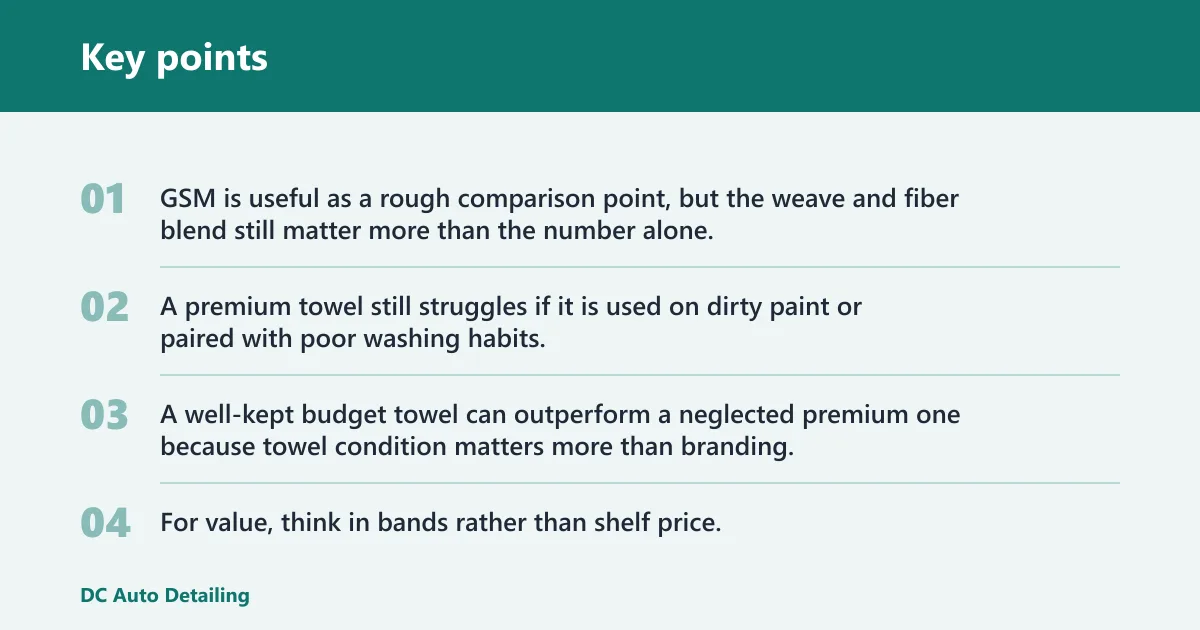
Microfiber blends with more polyamide tend to feel softer and absorb more freely than bargain blends with less refined fiber content. Pile height also changes how the towel behaves: higher pile gives more water retention and a plusher feel, while shorter pile is easier to wring and may be less awkward once saturated. GSM is useful as a rough comparison point, but the weave and fiber blend still matter more than the number alone.
When the extra money does not help much
A premium towel still struggles if it is used on dirty paint or paired with poor washing habits. If the towel is not rinsed often, or if it picks up grit from a bad prewash, the price tier matters less than contamination control. A well-kept budget towel can outperform a neglected premium one because towel condition matters more than branding.
Cost per use: a better way to compare value
For value, think in bands rather than shelf price. A budget towel usually has the lowest initial cost, but it may need earlier replacement if it mats, sheds, or stops absorbing well. That puts it in a short-life, lower-value band if you wash often. A midrange towel usually lands in the middle: it costs more upfront, but if it keeps its structure through more cycles, the cost per use can improve noticeably. Premium towels sit in the highest buy-in band, but they can become the best value when you wash frequently, dry larger vehicles, or want a towel that stays effective long enough to replace two cheaper towels over its life.
Drying towels comparison matrix
This matrix breaks the field into common towel categories. Price bands vary by size and brand, but the patterns below are the ones that matter when you compare construction, wash life, and ownership cost.
| Towel category | Price band | GSM range | Fiber blend range | Saturated weight | Edge type | Typical size | Expected wash durability | Best use case | Ownership-cost note |
|---|---|---|---|---|---|---|---|---|---|
| Thin budget waffle-weave | Low | 300-450 | Polyester-heavy blend with lighter polyamide content | Light to moderate | Sewn or hemmed | 16 x 24 to 20 x 30 in | Moderate if washed gently | Glass, door jambs, quick touch-up drying | Cheap to replace, but may streak sooner and need more passes. |
| Budget plush terry-style | Low to mid | 500-700 | Mixed polyester and polyamide, usually with less refined fiber content | Moderate to heavy | Bound edge or basic hem | 16 x 16 to 24 x 36 in | Moderate, often loses loft faster | Small cars and light maintenance washes | Feels soft at first, then may mat and shed enough to force earlier replacement. |
| Midrange waffle-weave | Mid | 350-500 | Balanced polyester and polyamide blend | Moderate | Soft band or stitched edge | 20 x 30 to 24 x 36 in | Good with proper laundering | Daily driver drying, glass, and utility use | Lower cost per use if you want one towel for several tasks. |
| Twisted-loop microfiber | Mid to high | 600-900 | Refined polyester-polyamide blend with stronger absorbent face yarns | Moderate to heavy | Edgeless or soft-trimmed | 20 x 30 to 26 x 36 in | Good to very good | Fast body-panel drying on sedans, SUVs, and trucks | Higher buy-in, but often fewer towels and fewer passes per wash. |
| Premium plush terry-style | High | 800-1,200 | Higher polyamide blend with dense plush construction | Heavy when saturated | Edgeless or soft band | 20 x 30 to 25 x 35 in | Very good if not over-washed on hot cycles | Careful drying where glide matters more than speed | Comfortable on paint, but thicker towels can be slower to wring and dry. |
| Large-format premium twisted-loop | High | 700-1,000 | Refined polyester-polyamide blend | Heavy when saturated | Edgeless | 24 x 36 to 30 x 40 in | Very good | Large SUVs and trucks | Strong value if one towel replaces two smaller towels without becoming too heavy when soaked. |
| Utility glass and trim towel | Low to mid | 250-400 | Polyester-heavy blend | Light | Hemmed or stitched | 16 x 16 to 16 x 24 in | Good | Glass, mirrors, and final wipe-downs | Low cost and long service life if kept away from heavy paint contact. |
How do microfiber GSM and pile height change performance?
GSM is a rough density signal, not a full quality score. Higher GSM often means more material in the towel and a plusher feel, but weave design, fiber blend, edge work, and pile height can matter more than the number on the label. Pile height changes glide, water retention, and how easy the towel is to wring out. For microfiber drying towels, a useful comparison usually comes from the whole build, not the density number by itself.
What GSM tells you
Budget towels are often reported in the 300-700 GSM range, while premium drying towels are commonly listed around 700-1,200 GSM. That range can help you compare similar constructions, but it does not tell you whether the towel uses twisted-loop yarn, a better polyamide mix, or a safer edge. Higher GSM can also mean a towel feels more substantial without necessarily drying faster if the weave is inefficient.
Why pile height changes behavior
Higher pile gives the towel more fiber volume to hold water, which can improve pickup on the first pass. Shorter pile is usually easier to wring and may feel less bulky on the panel. A very thick towel can become awkward once saturated, especially on a hood or roof. That is why a towel that is “heavier” on paper is not always the best match for quick maintenance washes or drying-aid users who want a lighter, more controlled glide.
Are premium drying towels worth it?
They are worth the money when drying time, towel safety, and repeat use all matter in the same wash routine. Premium towels make more sense for larger vehicles, frequent washing, or owners who want one towel to do most of the job with fewer passes and less lint. They also make more sense when you care about ownership value beyond the first purchase, because a longer-lasting towel can lower the cost per use over time.
When premium towels save time
Twisted-loop microfiber often dries faster because it grabs water efficiently without needing a plush, bulky face. On a truck or SUV, that can mean fewer passes across the panel and fewer opportunities to reintroduce grit if the towel is rinsed and handled correctly. This is also the towel type most likely to make sense if you are comparing a single premium towel against multiple cheaper towels used in rotation.
Say your crossover is rinsed in warm, sunny weather and water spots start showing quickly on the roof. A large twisted-loop towel with a soft edge can finish the top panels faster than a small budget towel, especially if a drying aid is used for glide.
When a budget towel is the better buy
Budget towels are a sensible choice when the car is small, the wash is gentle, and the towel is used only for light drying or final touch-up work. If the towel will be replaced often anyway, paying extra for premium construction may not return much value. That is especially true for small-car owners who want a low-risk, low-cost towel for maintenance washes and are not trying to maximize towel life over many cycles.
Picture a compact sedan that is washed weekly and dried in shade. A midrange waffle-weave towel can be enough if you keep it clean, use a drying aid, and avoid overloading it with water.
Do budget drying towels scratch paint?
Budget towels are more likely to scratch paint when trim, stitching, contamination, and wash care are poor. The risk rises when a towel has stiff binding, shed fibers, trapped grit, or an edge that catches on soft clear coat. A clean, well-kept budget towel can be safe enough for careful use, but it should be inspected and retired from paint work sooner if it starts to feel rough.
Where the risk usually comes
The main threat is not the price label. It is contamination, hard edges, and a towel that has lost its structure after repeated laundering. A cheap towel that is washed gently and kept clean can be safer than an expensive towel that is dirty or badly maintained. That is why microfiber care guidance matters as much as the purchase choice.
Why trim and stitching matter
Edgeless towels reduce the amount of hard material touching paint. If the towel has stitched seams, the quality of that stitching matters because rough thread ends and stiff hems can be the first place that drags on body panels and around body lines. Soft trim is not just a comfort feature; it is part of how the towel stays safe as it ages.
-
Inspect the edge.
Run your fingers around the perimeter before the first use. If the trim feels stiff, uneven, or scratchy, keep that towel for glass or lower-risk work rather than fresh paint. -
Pre-rinse after each panel.
Rinse the towel when it starts to feel loaded, not when it is already dragging. This keeps debris from staying trapped in the pile and reduces the chance of streaks. -
A microfiber drying towel should generally be washed separately with microfiber-safe detergent and without fabric softener.
Use a microfiber-safe detergent and avoid fabric softener. Softener can coat fibers and reduce absorbency, which matters more on drying towels than on many other towel types.
Choose Budget if… / Choose premium drying towels if…
Choose Budget if you dry a small car, wash carefully, and want a lower replacement cost. Choose premium drying towels if you dry larger vehicles, want faster water pickup, and want a towel that keeps its edge and absorbency through more wash cycles. If your priority is ownership value, the better towel is the one that survives the most useful wash cycles without turning into a less effective, more frustrating tool.
Choose Budget if…
- You mainly dry a sedan, hatchback, or other compact vehicle.
- You are comfortable using one or two extra passes.
- You want a backup towel for glass, jambs, or interior tasks.
- You replace towels more often and keep them in light-duty rotation.
Choose premium drying towels if…
- You dry an SUV, crossover, pickup, or van.
- You want fewer passes and better water pickup per towel.
- You care about edgeless or soft-trim paint contact.
- You want lower cost per use over more wash cycles.
Frequently asked questions
Are premium drying towels worth the money?
They are worth it when you want better water pickup, less lint, and longer service life from one towel. The value shows up most on larger vehicles and frequent wash routines. If you only dry a small car occasionally, a lower-cost towel can still do the job well enough.
What do you actually get with an expensive drying towel?
Usually better construction, not a miracle. You are paying for higher-quality edges, a more effective weave such as twisted-loop, a more consistent fiber blend, and a towel that keeps working after more wash cycles. That can lower replacement frequency and reduce frustration during drying.
How much should a car drying towel cost?
There is no single correct price, but budget options are often the low end of the market and premium towels usually cost more because of construction and size. The better question is cost per use. A pricier towel that lasts longer and dries faster can be cheaper over time.
Do budget drying towels scratch car paint?
They can, but the main causes are contamination, rough trim, and poor washing habits rather than price alone. A clean budget towel used with a drying aid and gentle technique is far safer than a dirty premium towel with stiff edges. Inspect the towel and reserve any questionable one for lower-risk surfaces.
What makes a microfiber drying towel premium?
Premium usually means better construction details: higher GSM, a more effective fiber blend, twisted-loop or carefully built plush pile, and safer edging. The label alone is not enough. Look for edgeless or soft-band trim, clear size information, and a design meant for repeated wash cycles.
How long should a good drying towel last?
With proper washing, a good towel should keep drying well for many cycles, but exact life depends on heat, detergent, and how often it is contaminated. Watch for matting, linting, frayed edges, and a noticeable drop in absorbency. Those are the signs that replacement is due.