Twisted loop vs waffle weave drying towel: Which is better?
Twisted loop is better for maximum water pickup on paint; waffle weave drying towel is better for faster handling and glass-friendly finishing, so choose twisted loop for large or heavily wet panels and waffle weave drying towel for lighter, quicker drying. Pick the wrong towel and you spend extra time chasing streaks, missed water, and repeated passes. This guide compares both weaves, where each fits best, and how vehicle size and drying style affect the choice.
| Factor | Twisted loop | waffle weave drying towel | Winner |
|---|---|---|---|
| Water pickup on paint | Looped pile holds a lot of rinse water and excels on wet panels. | Absorbs well, but usually gives up peak pickup for lighter handling. | Twisted loop |
| Handling speed between panels | Can feel heavier as it loads with water. | Lightweight and fast-drying, so it is easier to move, wring, and keep working. | waffle weave drying towel |
| Glass and final finishing | Works, but the deeper pile is not the first pick for glass. | Honeycomb texture is well suited to windows and final touch-ups. | waffle weave drying towel |
| Large vehicle coverage | Better when you want maximum pickup on big, wet panels. | Useful for fast turnover, but can need more passes on very wet surfaces. | Twisted loop |
| Budget and value | Walmart lists a 2-pack option with a 4.7-star rating from 174 reviews. | Often costs less per towel in basic versions, but value depends on size and GSM. | tie |
Water pickup, handling, and best uses
Twisted loop microfiber uses a looped pile built for high water pickup, which makes it the stronger choice when a panel is still heavily wet. A waffle weave microfiber towel has a honeycomb pattern with raised squares, and that texture usually makes it lighter, quicker to handle, and easier to use on glass.
The practical difference is simple. Twisted loop wins when the towel has to move a lot of water at once. Waffle weave drying towel wins when handling speed, quick wringing, and clean finishing matter more than plush feel.
Water pickup, glide, and speed
Twisted loop usually gives you the highest single-pass pickup on paint because the looped microfiber pile has more structure to hold rinse water. That matters most on hoods, roofs, and large doors where a towel can saturate quickly.
Waffle weave drying towel moves fast across panels and is easier to manage when you are working around trim, mirrors, or glass. It can feel quicker in hand, even if twisted loop removes more water per pass.
Where each towel construction fits best
Twisted loop fits best when the car is still very wet after a rinse, when the vehicle is large, or when you want fewer towel swaps on paint. Waffle weave drying towel fits best for lighter drying, windows, final touch-ups, and situations where a low-bulk towel is easier to control.
Neither construction replaces careful technique. Reduced pressure and a clean towel matter more than the weave alone if you want to reduce wash-induced marring.
Drying towel decision matrix
| Scenario | Pick | Why-notes | Absorbency | Glide | Speed |
|---|---|---|---|---|---|
| Vehicle size | Twisted loop | Better for midsize SUVs, trucks, and larger panels because it holds more water before you stop. | 5 | 3 | 4 |
| Paint sensitivity | waffle weave drying towel | Lower bulk and lighter drag can feel safer on soft paint when you use very light pressure. | 3 | 5 | 4 |
| Drying style | Twisted loop | Best for drag-free blotting or laid-flat drying on wet paint when you want maximum pickup first. | 5 | 3 | 4 |
| Glass use | waffle weave drying towel | Honeycomb texture is the better fit for windows, mirrors, and final finishing without a plush trail. | 3 | 5 | 5 |
| Budget | waffle weave drying towel | Basic waffle weave options often cost less, but total value depends on size, GSM, and how long it keeps absorbing. | 3 | 4 | 4 |
The matrix favors twisted loop for the biggest water-removal jobs and waffle weave drying towel for handling, finishing, and glass. That split works because the best towel is often the one that matches the panel, the surface, and how much water is still sitting on the car.
Which dries a car faster?
Twisted loop usually dries a car faster in the sense that it removes more water before saturation, especially on larger, wetter panels. Waffle weave drying towel can feel faster in hand because it is lighter and easy to move, but it may need more passes on heavily wet paint.
How towel size changes perceived speed
Size changes how quickly a towel covers panels and how often you need to stop. Car-drying towels often come in sizes like 30×36 inches and 36×24 inches, and a larger footprint can mean fewer passes over big sections.
That is why towel size matters as much as weave. A larger twisted loop towel can feel very efficient on an SUV, while a smaller waffle weave drying towel may be better for quick spot work and windows.
How much panel area each towel handles
Competitors often stop at “more absorbent” versus “less absorbent,” but the real question is how much panel area you can dry before the towel starts to feel loaded. Twisted loop generally holds more rinse water on paint, so it is better when you want to work longer before swapping towels.
Waffle weave drying towel can still be efficient, especially for maintenance washes and lighter rinse water. The trade-off is that on a very wet vehicle, the towel may feel full sooner and need more wringing or more frequent flips to a dry section.
Which towel is safer on paint?
Neither weave eliminates swirl marks by itself. Twisted loop and waffle weave drying towel can both be paint-safe when you use clean microfiber, reduced pressure, and a careful drying pattern, but the safer choice for black paint often depends more on softness, cleanliness, and how much drag you feel than on the name of the towel.
Soft paint, black paint, and marring risk
On black paint and other soft clears, a towel that drags is a problem no matter what it is made of. Twisted loop can be gentler when it glides well, but if it gets saturated and starts to tug, you can create the kind of contact that leaves marks.
Waffle weave drying towel can feel safer on delicate surfaces when used with very light pressure because it is easier to control and less bulky in tight areas. That said, a rough panel, dirt left behind, or an overloaded towel can still mark paint.
What changes on coated cars
On a coated car, both towels work well because coatings help water release, which reduces the amount of wiping needed. Twisted loop is useful for the main body panels, while waffle weave drying towel is often the cleaner choice for glass, trim edges, and final touch-ups after the main dry.
Say your sedan has a ceramic coating and beading is strong after the rinse. A twisted loop towel can clear the doors quickly, while a waffle weave drying towel can finish the mirrors and windows without leaving a heavy towel trail.
Paint-safe drying technique
Start with a clean towel. Use a microfiber towel that has been washed without fabric softener or dryer sheets. Any trapped grit or residue raises the chance of dragging on paint.
Lay the towel flat. Place it on the panel and pull it with very light pressure instead of pressing down. Less pressure lowers friction and helps the fibers do the work.
Flip before saturation. Turn to a dry section as soon as the towel feels heavy or starts to slow down. A towel that is too wet loses glide and can smear water instead of lifting it.
Finish with separate glass passes. Use the cleaner side of the waffle weave drying towel for windows and mirrors, or dedicate one towel to glass only. That keeps polish residue and road film from transferring back onto the paint.
Choose Twisted loop if… / Choose waffle weave drying towel if…
Choose Twisted loop if you want maximum water pickup on paint, if you dry larger vehicles, or if your routine leaves panels very wet after rinsing. Choose waffle weave drying towel if you want lighter handling, faster wringing between panels, cleaner glass work, or a towel that feels easier to manage on quick maintenance washes.
Choose Twisted loop if…
- You dry a midsize SUV, truck, or other large vehicle and want fewer towel swaps.
- Your paint is still very wet after the rinse and you want the towel to carry more water per pass.
- You want a 2-pack option and value strong pickup over the lightest possible feel.
- You are drying broad paint panels more than glass or trim.
Choose waffle weave drying towel if…
- You want a lighter towel for quicker movement and easier handling.
- You dry windows, mirrors, and final touch-up areas often.
- You want a towel that is usually easier to wring out and dry after washing.
- You prefer a towel that can work well for maintenance washes where the car is not drenched.
What size and GSM should you look for?
GSM, or grams per square meter, is the density figure most buyers use to compare microfiber towels. Higher GSM generally signals more material and absorbency, but it can also mean a heavier towel that takes more effort to wring out or dry between uses.
How GSM affects density and absorbency
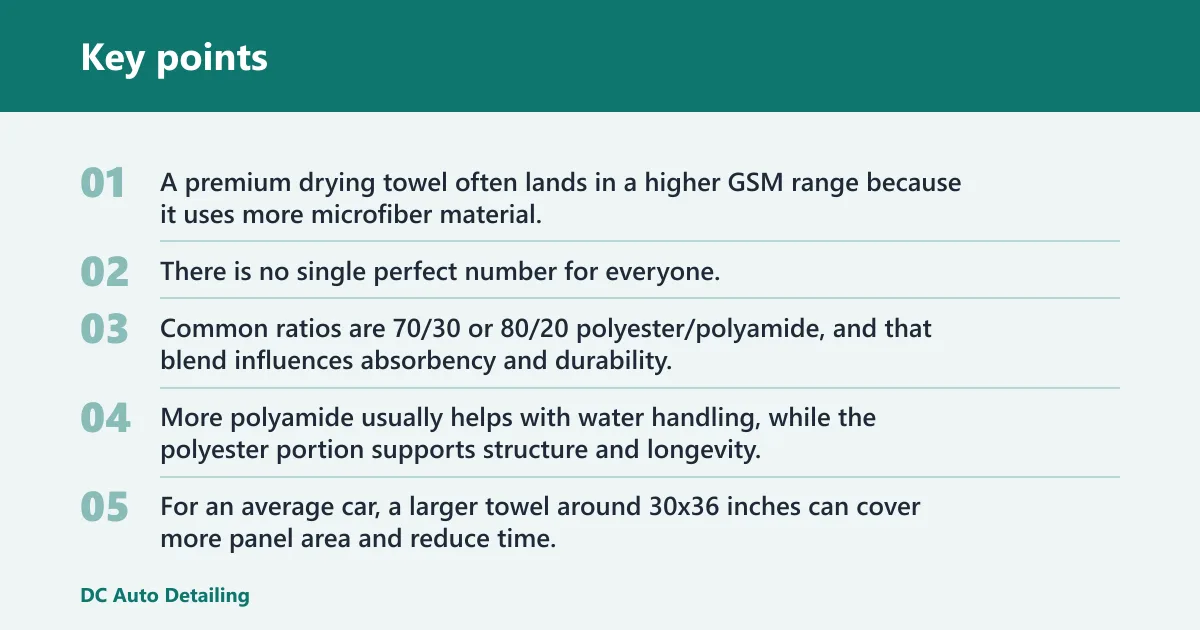
A premium drying towel often lands in a higher GSM range because it uses more microfiber material. The Rag Company Gauntlet towel is listed at 900gsm, and an ENRUNEST car drying towel is listed at 1300 GSM, which shows how wide the range can be among drying towels.
There is no single perfect number for everyone. A higher GSM towel often suits maximum paint pickup, while a lower or midrange towel can be easier to move, especially for glass and lighter maintenance drying.
How size and blend change the feel
Size affects more than coverage. The Gauntlet towel is listed at 30in x 36in, while the ENRUNEST towel size is 36 x 24 inches, and those dimensions change how the towel drapes, folds, and reaches across panels.
Microfiber blend also matters. Common ratios are 70/30 or 80/20 polyester/polyamide, and that blend influences absorbency and durability. More polyamide usually helps with water handling, while the polyester portion supports structure and longevity.
What to look for in a practical setup
For an average car, a larger towel around 30×36 inches can cover more panel area and reduce time. A smaller towel around 36 x 24 inches can be easier to manage around mirrors, emblems, and glass edges, especially if you want less bulk in the hand.
Picture a compact car with a light rinse film versus a full-size SUV with standing water on the roof. The compact car can do well with a lighter waffle weave drying towel, while the SUV is usually better served by a larger twisted loop towel that can hold more water before slowing down.
Care and value over time
Care changes total cost per use more than sticker price alone. A towel that keeps its absorbency and stays lint-free longer can cost less over time than a cheaper towel that needs earlier replacement.
How to wash waffle weave towels
Wash cold. Use cold water and a mild detergent. Nossara recommends cold washing for waffle towels, which helps protect the fibers and absorbency.
Avoid additives. Do not use fabric softener or dryer sheets. Nossara advises against both because they can coat the fibers and reduce water pickup.
Dry on low. Tumble dry low to protect absorbency and reduce stiffness. High heat can shorten the useful life of the towel and make it feel less flexible.
What affects linting, stiffness, and absorbency retention
Linting usually comes from contamination, rough laundering, or towels that are already breaking down. Stiffness often points to heat damage or detergent residue. When either shows up, the towel may still dry, but it will usually feel less pleasant and less predictable on paint.
Twisted loop towels are not automatically hard to wash or wring out, but their higher water load can make them feel heavier after use. That is the trade-off for stronger pickup. Waffle weave drying towel is usually faster to wring and dry, which can help if you cycle through towels often.
Price, replacement, and total cost per use
Retail listings help here, but the value question is bigger than the tag. Walmart lists a Platinum Series Pro Spec Twisted Loop Car Drying Towel 2 Pack, and that same listing shows a 4.7-star rating from 174 reviews. That is useful as a retail data point, but not proof that one weave wins for every car.
If you replace a towel less often because it keeps its absorbency and stays useful on the surfaces you dry most, the cost per use drops. A more expensive towel can still be the better value if it fits your drying style and lasts longer before it starts to drag or lint.
Frequently asked questions
Which dries a car faster, twisted loop or waffle weave?
Twisted loop usually dries faster on wet paint because it removes more water before it saturates. Waffle weave drying towel can feel quicker to handle, but on a heavily wet car it may need more passes or more frequent wringing. Size matters too, since a larger towel covers more panel area per pass.
Which towel is safer for black paint and swirl marks?
Neither towel prevents swirl marks by itself. Black paint is safer when you use a clean microfiber towel, very light pressure, and a towel that does not drag. Waffle weave drying towel can feel gentler on delicate paint because it is lighter, but a clean twisted loop towel can also be safe if you keep friction low.
How many towels do I need for a midsize car?
For a midsize car, two towels is a common baseline if one gets saturated or dirty. A larger twisted loop towel may get you through the body with one main towel and a backup, while waffle weave drying towel is often helpful as a second towel for glass and final touch-ups.
Can waffle weave towels leave streaks or drag on paint?
Yes. Waffle weave drying towel can streak if it is overloaded, dirty, or used on a panel with residue left behind. It can also drag on rough paint or on a surface that still has too much water. Keeping the towel clean and using light pressure reduces both problems.
Are twisted loop towels harder to wring out or wash?
They can feel heavier to wring out because they hold more water, especially after a full drying pass. Washing is still straightforward if you avoid fabric softener and high heat, but the towel may take longer to dry than a lighter waffle weave drying towel. That extra mass is part of the absorbency trade-off.
Can I use a waffle towel on windows and glass too?
Yes. Waffle weave drying towel is often a strong choice for windows, mirrors, and final finishing because the honeycomb texture tends to work well on glass. Use a clean side, keep pressure light, and avoid using the same section that already touched heavy paint contamination.