Tire shine spray vs gel: Which should you choose?
Choose tire shine spray if you want fast, even coverage on daily-use vehicles. Choose gel if you want tighter control and a wetter finish, even though it takes longer to apply. Pick the wrong format and you can end up with streaks, sling on body panels, or an uneven look that wastes product. This guide compares application speed, finish, durability, and cleanup so you can choose the right tire shine format.
| Factor | Tire shine spray | gel | Winner |
|---|---|---|---|
| Application speed | Faster on large sidewalls and quick maintenance details | Slower because you place it by hand with an applicator pad | Tire shine spray |
| Placement control | Good coverage, but overspray can reach wheels and trim | More control on sidewall edges and targeted spots | gel |
| Finish preference | Can look glossy or satin depending on formula | Often chosen for a deeper wet look | gel |
| Mess risk | Higher overspray and wheel contamination risk | Lower mess when applied with a foam pad and light product amount | gel |
| Best fit for daily upkeep | Works well for fast, even refreshes between washes | Works well only if you do not mind slower application | Tire shine spray |
Speed, coverage, and finish
The trade-off is simple: Tire shine spray is built for speed and wide coverage, while gel gives you more control and a wetter gloss. Spray fits quick, even results on daily drivers. Gel fits jobs where placement matters more than speed.
That split matters because tires are not all the same. Large SUV and truck sidewalls take more product area, textured sidewalls can hide coverage gaps, and driving speed changes how much sling risk you can tolerate.
Application speed and coverage
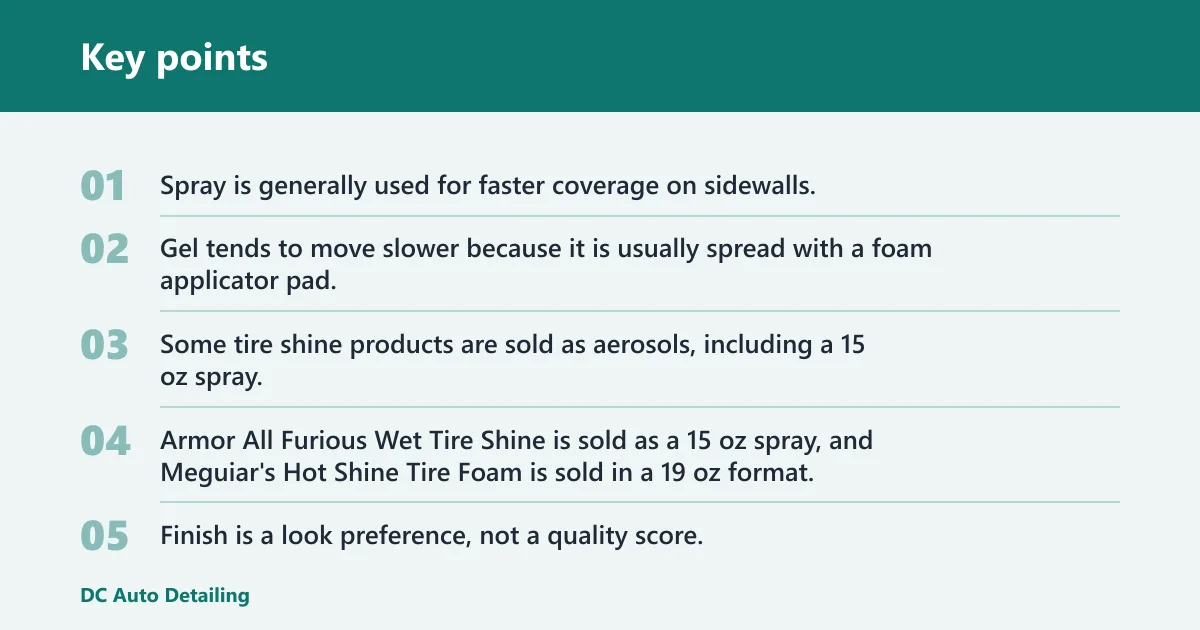
Spray is generally used for faster coverage on sidewalls. Aerosol, trigger spray, and pump spray all let you cover a sidewall faster than hand-applying a thicker product, and that speed matters most on larger tires or when you are doing a quick maintenance detail.
Gel tends to move slower because it is usually spread with a foam applicator pad. That slower pace is the price of control, especially near the tire bead, lettering, and the edge where the sidewall meets the wheel.
Some tire shine products are sold as aerosols, including a 15 oz spray. Armor All Furious Wet Tire Shine is sold as a 15 oz spray, and Meguiar’s Hot Shine Tire Foam is sold in a 19 oz format. Those package sizes matter because larger formats are usually aimed at repeated use or larger vehicles.
Finish, control, and appearance
Finish is a look preference, not a quality score. Spray can land anywhere from satin to glossy depending on formulation and how much you apply, while gel is often chosen when the goal is a higher gloss, wet look.
The guide frames gel as better for precise, controlled application, and it describes the gel formula as thicker than sprayable shines. That thickness gives you more placement control, especially if you want the tire edge to look clean rather than heavily coated.
Water-based dressing usually provides a satin or matte finish. Solvent-based dressings create an extreme tire shine, so the finish you want often tells you more than the format alone.
Sling risk, dry time, and upkeep
Sling usually comes from excess product or from not wiping down the tire after application. It shows up more often at higher driving speeds, because any loose dressing can move from the sidewall to body panels or paint.
Dry time changes that risk. One gel product is listed with a 10-15 minutes dry time, and that kind of wait helps the product settle before the tires spin at road speed. A finish that lasts longer also depends on chemistry and application amount; Black Magic Tire Wet is marketed as lasting up to 4 weeks, while another gel product is listed as lasting 1-2 weeks.
Suppose a daily driver gets dressed right before a freeway commute. If too much product is left on the sidewall, the first few miles can throw sling onto the lower doors. A shorter cure time, a lighter coat, and a final buff-down reduce that risk.
Which tire size and texture fit each format best?
Large tires and textured sidewalls change the job. Tire shine spray is usually easier when you need broad, even coverage across more rubber, while gel is better when you want tight placement on the sidewall edge or around raised lettering.
The right choice often comes down to how the tire looks before dressing. Smooth sidewalls show streaks more easily, while textured sidewalls can hide missed spots unless the product spreads evenly.
Large SUV and truck sidewalls
Can I use tire shine spray on large SUV tires? Yes, and that is one of the clearest reasons to pick spray. The faster coverage matters when the sidewall is tall, the surface area is larger, or you are trying to dress multiple tires without spending extra time on each one.
For trucks and full-size SUVs, spray often wins on practicality. A trigger or pump spray gives you more control than aerosol, but all three are still faster than working gel across a big sidewall with a pad.
Textured versus smooth sidewalls
Do sprays give a more even finish than gels? On some tires, yes. Spray can cover textured sidewalls more evenly because the product reaches dips and grain that a thin hand-applied layer may miss.
Gel can still look better on smooth sidewalls when you want a defined edge and a wet finish. The key is to keep the layer thin and even, because a heavy spot on smooth rubber stands out fast.
How do spray and gel differ on mess and control?
Spray is easier to use quickly, but it is also easier to mist onto wheels, trim, and floor surfaces. Gel gives you more control, especially with a foam applicator pad, so it usually creates less overspray and less cleanup.
Aerosol, trigger spray, and pump spray are not the same experience. Aerosol tends to spread fastest and can be the hardest to confine; trigger spray gives more directed aim; pump spray usually sits between them in speed and precision.
Aerosol, trigger, and pump spray
Aerosol sprays are the quickest to lay down, but they also have the highest chance of drifting past the tire if you are not careful. Trigger and pump spray formats give you a little more control over where the product lands, which helps when wheel design leaves little room between the tire and the rim.
For garage use with several vehicles, a sprayable option is often better for high-volume work because it trims application time. For one vehicle, the user experience matters more: a trigger bottle is usually easier to aim, while aerosol is faster but less selective.
Foam applicator pad use with gel
Gel works best with a foam applicator pad. The pad helps you spread the product in a thin layer, control placement near the edge, and avoid wasting product on the ground or wheel face.
-
Clean the tire first.
Remove dirt, old dressing, and road film before you apply anything. Clean rubber takes product more evenly and lowers the chance that residue turns into streaks. -
Apply a small amount.
Put a light line of gel on the foam pad instead of flooding it. A thin coat is easier to control and dries more evenly. -
Work the sidewall edge.
Spread the product from the outer edge inward in short passes. That keeps the bead area neat and helps avoid excess on the wheel lip. -
Buff off extra product.
Wipe away visible wet spots after spreading the gel. This reduces sling, especially if the vehicle will be driven soon after application.
Overspray, wheel contamination, and waste
Overspray is the main downside of spray, especially on open wheel designs. If the tire is close to painted surfaces or the wheel barrel is easy to hit, product can land where you do not want it and leave cleaning work behind.
Gel wastes less when you use a pad correctly. It still needs restraint, though, because overloading the pad can create the same slippery residue that causes sling and attracts dust.
Tire shine decision table
| Scenario | Best format | Expected finish | Risk of sling | Tool needed | Reapplication cadence |
|---|---|---|---|---|---|
| Daily driver | Tire shine spray | Even, moderate gloss or satin depending on formula | Moderate if overapplied; lower with proper wipe-down | Trigger or pump spray | After washes or when the finish fades, often within 1-4 weeks depending on product and weather |
| SUV/truck | Tire shine spray | Broad, even coverage across large sidewalls | Moderate; higher if too much product is left on the surface | Aerosol, trigger, or pump spray | After wash cycles or whenever the sidewalls start to look dull |
| Show car | gel | Deeper wet look with tighter edge control | Low to moderate if applied thinly and allowed to cure | Foam applicator pad | Before events or after careful cleaning, based on how long the gloss remains visible |
| Quick maintenance wash | Tire shine spray | Fast refresh with consistent coverage | Lower when the product is applied lightly and wiped | Trigger or pump spray | As needed between washes |
| First-time user | gel | Controlled, predictable finish | Lower if you work slowly with a pad | Foam applicator pad | After you can apply evenly and judge how much product the tire needs |
Choose Tire shine spray if… / Choose gel if…
Choose Tire shine spray if you care most about speed on a daily driver, a quick maintenance wash, or a larger SUV or truck tire. It also fits better when you want fast, even coverage and less time spent spreading product by hand.
Choose gel if you want tighter control, a wetter finish, and a lower-mess application on a show car or for a first-time user who is willing to work slower. Gel also makes more sense when you want cleaner edges and do not mind using a foam applicator pad.
Say your crossover has tall, lightly textured 20-inch sidewalls and you want a fast refresh after a wash. Spray is the practical choice because it reaches the full surface faster and keeps the job moving.
Picture a weekend car with smooth sidewalls and a display-day goal. Gel is the better fit because you can place the product more precisely and build the wet look without spraying onto the wheel face.
Frequently asked questions
Is tire shine spray or gel better for daily drivers?
Tire shine spray is often a better fit for daily drivers because it is faster to apply, easier to cover evenly on larger sidewalls, and simpler to refresh after routine washes. Gel can work, but the extra time and the need for a foam applicator pad make it less convenient for frequent upkeep.
Which lasts longer, tire shine spray or gel?
Durability depends more on product chemistry, weather, wash frequency, and how much you apply than on format alone. Some sprays are marketed to last up to 4 weeks, while some gels are listed at 1-2 weeks. The more product you leave on the tire, the more likely you are to attract dust or create sling.
Which is easier to apply without sling?
Gel is usually easier to apply without sling because it gives you more control and is less likely to spray onto surrounding panels. That said, sling can still happen if you use too much product or drive before it has cured. Wiping off excess matters for both formats.
Do sprays give a more even finish than gels?
Sprays can give a more even finish on some tires, especially textured sidewalls or larger SUV and truck tires where broad coverage can matter. Gels can still look very even on smooth sidewalls, but only if you spread them carefully with a foam applicator pad and avoid heavy spots.
Is gel better for high-gloss shine?
Yes, gel is often the better choice when you want a higher gloss, wet look. That does not make it better in every use case. It simply gives you more control over placement and the ability to build a deeper finish, especially on show cars or tires with clean, smooth sidewalls.
How do I avoid streaks with tire shine gel?
Use a clean foam applicator pad, apply a small amount, and spread the gel in thin passes instead of loading the tire heavily. Wipe off visible excess, then let the product cure before driving. A common rule of thumb is a 10–15 minute dry time to help reduce streaks and sling.