Professional vs consumer ceramic coating: Key Differences
Professional ceramic coating usually costs several times more upfront, but the better choice is the one that matches your prep skill and ownership goals. If you cannot correct paint, decontaminate thoroughly, and coat panel by panel, pay a pro. A bad install can leave high spots, streaking, weak water behavior, and clearcoat damage from rushed prep or removal. This guide compares installation risk, yearly ownership cost, and common failure modes so you can choose the right coating for your car.
| Decision factor | Professional | Consumer ceramic coating | Score winner | Brief rationale |
|---|---|---|---|---|
| Prep required | Typically requires wash, decontamination, clay, paint correction when needed, and a final panel wipe before application. | Often still needs the same core prep for best bonding, though some DIY products are more tolerant of simpler installs. | Professional | Professional systems are usually sold as full-service installs with stricter prep expectations. |
| Flash-time risk | Shorter flash window, often around 1 to 3 minutes, so missed leveling can leave high spots. | Usually more forgiving to spread and level, which lowers the chance of timing mistakes. | Consumer ceramic coating | A wider working window makes home application easier. |
| Curing control | More sensitive to temperature, humidity, and dust control during cure. | Still environment-sensitive, but generally less demanding. | Consumer ceramic coating | DIY products are usually designed to be more forgiving in imperfect conditions. |
| Expected lifespan | Commonly marketed from about 2 to 10 years depending on system, prep, and care; published claims vary by manufacturer and installer. | Often marketed from about 6 months to 3 years, with sprays at the shorter end. | Professional | Longer service intervals are the main reason owners choose pro installs. Gtechniq Crystal Serum Ultra is marketed with a 9-year warranty, while XPEL Fusion Plus is marketed with up to an 8-year warranty; those are manufacturer-backed examples, not a universal promise. |
| Maintenance burden | Lower reapplication frequency, but proper wash habits still matter to preserve appearance and hydrophobics. | More frequent reapplication, especially for spray-style products and harsh climates. | Professional | Less frequent refreshes reduce ongoing effort. |
| Failure risk | Higher install risk because flash time is tighter and high spots are common if the installer is rushed. | Lower install risk, but easier to end up with a shorter-lived film. | Consumer ceramic coating | DIY-friendly working time usually reduces visible mistakes. |
| Warranty strength | Often stronger on paper, but may require certified installers and specific care terms. | Usually limited or absent by comparison. | Professional | Manufacturer and installer warranties tend to be more formal on pro systems. Terms are always conditional; for example, some warranties exclude misuse and require approved care products. |
| Cost per year | Higher upfront, often lower per year if the coating keeps performing for years. | Lower upfront, but frequent redo costs can raise yearly cost. | Professional | Longer life can spread the initial cost over more years. See also yearly cost. |
| Ideal vehicle type | High-value cars, outdoor daily drivers, and owners who want long intervals between reapplication. | Lease cars, garage-kept weekend cars, and budget-minded owners who can redo the coating sooner. | Depends on owner type | The better fit varies by how the car is used and how long it will be kept. For a more detailed fit check, see daily-driver fit. |
| DIY suitability | Poor fit for first-timers unless the coating is explicitly designed for DIY use. | Better fit for home application. | Consumer ceramic coating | Consumer formulas are usually built for simpler home installs. |
Professional vs consumer ceramic coating: the trade-off
Professional coatings are built for longer service life and tighter control over the cured film, but they ask more from the installer. Consumer products usually give you a wider working window and a lower entry price, which lowers risk if you are doing the work at home.
What each product type is designed to do
Both categories rely on silicon-based ceramic chemistry, but the real difference is usually the formulation system, solvents, carriers, and cure behavior rather than a simple universal concentration split. For example, product literature commonly describes professional and DIY systems differently by durability, wipe-off behavior, and service-life targets rather than by a single percentage claim. Silicon dioxide is the base mineral referenced in many ceramic-coating marketing claims, while some higher-end systems also reference silicon carbide or SiC in their chemistry discussion.
If you want the shortest version, use this rule: pick the coating that fits your prep ability, not the one with the biggest marketing number. A coating that is easy to install but needs replacement more often can still cost more over time than a harder product that lasts longer. For a ceramic-coating buyer, the best score usually goes to the product that balances durability, install forgiveness, and maintenance needs for the way the car is actually used.
How the chemistry actually differs
Both product types use silicon-dioxide-based chemistry, so SiO2 appears in each category. The difference is usually in formulation and cure behavior, plus how tightly the cured layer cross-links after application; that cured structure affects chemical resistance and durability more than a printed silica percentage. Neutral chemistry references describe silicon dioxide as a stable inorganic compound, while manufacturer documents typically focus on cured-film performance rather than raw percentage alone. PubChem silicon dioxide provides neutral chemical context.
SiO2 in both categories
Professional coatings are often marketed as having higher SiO2 content than consumer products, but the market does not use one universal split that applies to every brand. In practice, the better question is what the formula is designed to do on the paint: bond, level, cure, and resist chemicals over time. Technical sheets from manufacturers typically emphasize prep, cure, maintenance, and warranty conditions instead of promising that a specific percentage automatically means better protection.
Consumer DIY coatings are sometimes described with pencil hardness claims around 4H to 6H, while professional coatings are often marketed closer to 9H or higher. That scale refers to resistance to pencil abrasion marks, not rock chips, scratch-proofing, or Mohs hardness. The pencil-hardness test is a comparative surface-scratch test, so the label should be treated as a rough indicator rather than a durability guarantee. ASTM D3363 defines the pencil-hardness test method, and the pencil hardness scale is commonly summarized as a coating film test rather than a stone-chip rating.
Where SiC appears in pro claims
Some professional systems add SiC, or silicon carbide, in marketing claims aimed at durability and chemical resistance. That does not make the coating chip-proof or scratch-proof; it only points to a formulation that may cure into a denser film. In chemistry terms, silicon carbide is a hard covalent compound used in abrasive and high-temperature applications, which is why it is often mentioned when brands want to signal toughness. PubChem silicon carbide offers neutral context.
Why cross-link density matters more than a label
Cross-link density helps explain why one cured coating resists chemicals and wash wear better than another. A higher SiO2 percentage or a louder 9H label cannot fully predict that result if the coating is wiped off too early, allowed to flash too long, or applied over oily paint. Manufacturers’ technical instructions consistently stress that surface prep and cure control are part of the performance system, not optional extras.
What prep is required before either coating?
Any coating needs clean, bare paint to bond well. At minimum, you need a proper wash, chemical decontamination, and a panel wipe or IPA wipe-down before application; if the paint has swirls, scratches, or oxidation, paint correction becomes part of the prep, not an optional upgrade. This is consistent with manufacturer prep instructions and general detailing guidance. GYEON preparation guidance and 3M panel wipe guidance both stress clean, residue-free paint before coating.
Wash, decontaminate, and clay
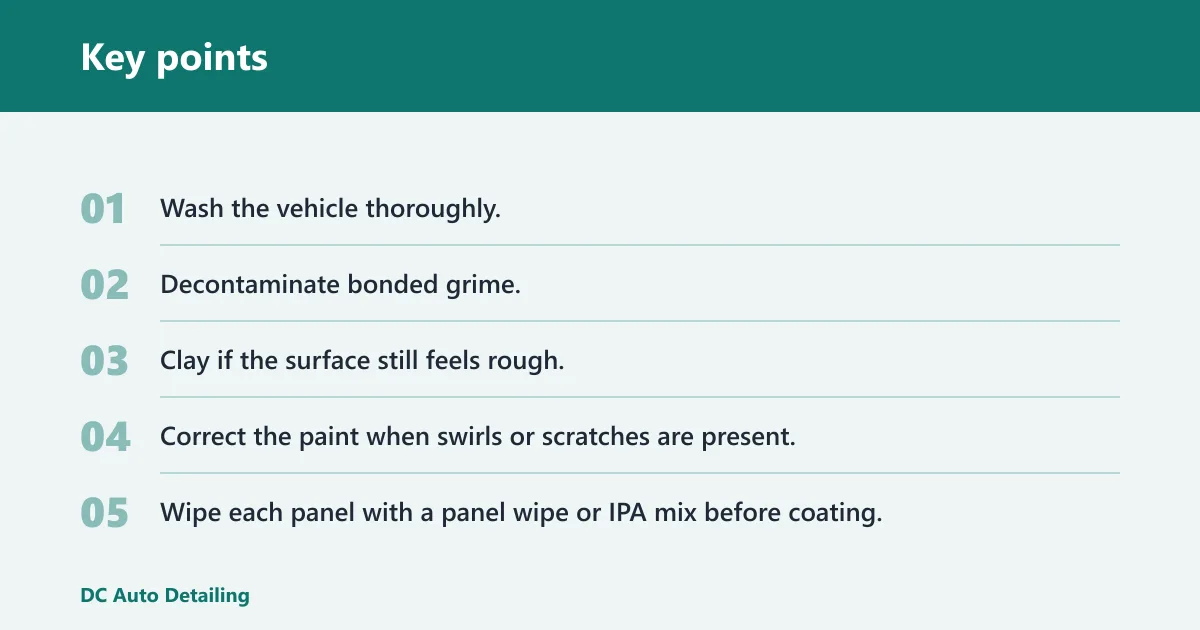
Start with a thorough wash to remove loose dirt, then decontaminate the paint so bonded grime does not sit under the coating. Clay is useful when the surface still has embedded contamination after washing and chemical decon.
When paint correction is mandatory
Paint correction means multi-stage polishing used to remove swirls and scratches before coating. Skip it, and you lock those defects under the film, where they remain visible for the life of the coating.
Panel wipe / IPA wipe-down before application
A panel wipe or IPA wipe-down removes polishing oils and residue that can interfere with adhesion. This step matters for both product types, and it matters more if the panel was heavily polished or compounded. Many manufacturers specify a dedicated panel wipe or a compatible alcohol-based prep solution rather than a strong, wet IPA bath. Koch-Chemie Panel Prep is an example of a manufacturer-made surface cleaner intended for this stage.
- Wash the vehicle thoroughly.
- Decontaminate bonded grime.
- Clay if the surface still feels rough.
- Correct the paint when swirls or scratches are present.
- Wipe each panel with a panel wipe or IPA mix before coating.
Say your black sedan is parked outside and the hood has visible swirl marks under sun. If you coat it without correction, those marks stay under the film and still catch light; the coating cannot hide them.
Why flash time and curing control change the outcome
Flash time is the brief window after application when the coating needs to be leveled before it starts to grab. Professional coatings may require flash-time leveling in one to three minutes, which leaves less room for error and raises the chance of visible high spots.
Flash time and leveling window
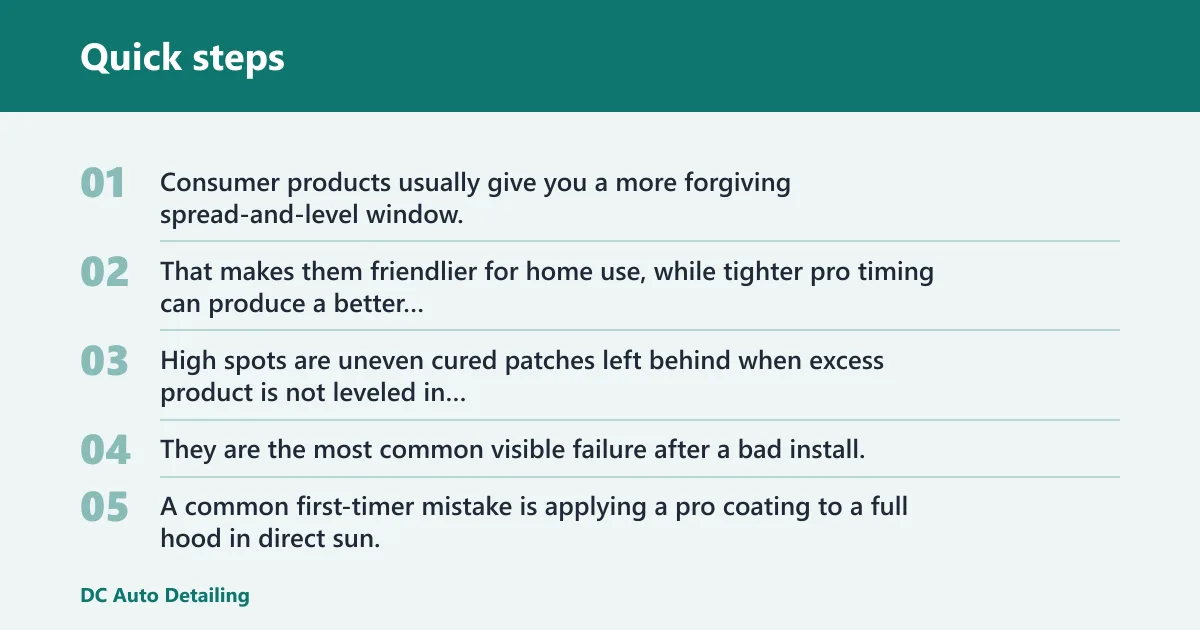
Consumer products usually give you a more forgiving spread-and-level window. That makes them friendlier for home use, while tighter pro timing can produce a better cured film in skilled hands.
High spots and other install failures
High spots are uneven cured patches left behind when excess product is not leveled in time. They are the most common visible failure after a bad install, and removing them often means polishing the panel back down.
A common first-timer mistake is applying a pro coating to a full hood in direct sun, then walking away to prep the next panel. By the time the installer returns, the coating has flashed, and the hood shows dark, smeared patches that need polishing to fix.
Temperature, humidity, and dust control
Warm panels, high humidity, and airborne dust all make curing less predictable. Professional systems are less forgiving in uncontrolled spaces, so a garage with stable conditions is far safer than a driveway with wind and changing sun.
How long does each type usually last?
Professional coatings can last several years, with many brands marketing terms in the 2- to 10-year range depending on system and care, while consumer-grade coatings usually last between 6 months and 3 years. That gap matters, but yearly cost matters even more, because a cheap bottle that needs frequent reapplication can cost more over the life of the car.
Lifespan versus maintenance burden
Professional coatings reduce how often you need to redo the job, but they still need proper washing to keep water behavior and appearance strong. Consumer products often ask for more frequent renewal, especially spray versions that can break down within 3 to 6 months in intense heat.
Why yearly cost matters more than bottle price
Real ownership cost includes prep time, possible correction work, and how often you have to reapply. A lower-cost product that lasts one season can be more expensive per year than a professional coating that stays in place for several seasons.
When reapplication becomes part of ownership cost
If the coating is expected to fail after a short summer cycle, reapplication is not an exception; it is part of the cost model. That is why comparisons based only on bottle price miss the real difference.
Is professional ceramic coating really worth it?
Professional coating is worth it when you value longer service life, stronger warranty terms, and less frequent reapplication more than lower entry cost. It is less attractive if the car is low risk, the paint is already tired, or the vehicle will change hands soon.
Cost per year versus upfront price
Professional coatings can look expensive on day one, but the annual cost can drop if the coating holds up for years. Consumer products often win the upfront price comparison, yet the shorter lifespan can erase that advantage for owners who keep a car a long time.
Warranty coverage and installer requirements
Professional systems often include warranty coverage, but the fine print matters. Some require certified installers, specific maintenance products, and proof that prep was done correctly; consumer products usually do not offer the same level of coverage.
Professional coating examples include Gtechniq Crystal Serum Ultra with a 9-year warranty and XPEL Fusion Plus with up to an 8-year warranty. Those terms are only useful if the installer follows the system rules and the owner follows the maintenance rules, and warranty language is commonly conditional on approved prep, wash methods, and excluded misuse.
Which vehicles benefit most from professional installation?
High-value vehicles, outdoor daily drivers, and owners who want long protection intervals usually benefit most. Lease cars and garage-kept weekend cars can make more sense with consumer products if the goal is decent appearance at a lower annual cost.
Choose Professional if… / Choose consumer ceramic coating if…
Choose Professional if you want the longest practical service life, you keep the vehicle outside, you are willing to pay for paint correction and careful application, or you want warranty coverage with installer rules. Choose consumer ceramic coating if you want a home-friendly install, lower upfront cost, or a coating that you are comfortable refreshing sooner.
Choose Professional if…
- Your car is a high-value daily driver.
- You want 3 to 10 years of service life.
- You can pay for correction, controlled curing, and installer labor.
- You want warranty terms and can meet the maintenance requirements.
Choose consumer ceramic coating if…
- You are coating a lease car or a garage-kept weekend car.
- You want a lower-risk DIY path.
- You prefer easier leveling and less flash-time pressure.
- You are fine reapplying every 6 months to 3 years.
If your car sits outside every day, the pro option usually wins on cost per year and durability. If the car is a short-term hold or a low-stakes project, a consumer product often makes more sense.
Frequently asked questions
What is the difference between professional and consumer ceramic coating?
Professional coating usually uses a tighter formula, a shorter flash window, and a longer expected lifespan. Consumer coating is usually easier to apply at home and carries less install risk, but it typically lasts for a shorter period and may not offer the same warranty terms.
Is professional ceramic coating really more durable than DIY ceramic coating?
Usually, yes, but only if the install is done correctly and the vehicle is maintained properly. Professional coatings are commonly described as lasting several years, while consumer-grade coatings usually last between 6 months and 3 years. Manufacturer claims vary, so the best comparison is the specific product system rather than the category alone.
Why do professional ceramic coatings cost so much more?
You are paying for labor, paint correction, controlled application, and often warranty-backed installation. The product itself may also be more demanding to install, which raises the labor cost and the risk of correction work if something flashes too soon.
Can I apply a professional ceramic coating at home?
Yes, but only if you can prep the paint correctly, control the environment, and level the coating fast enough. If you cannot correct paint, do a proper panel wipe, and work panel by panel, a pro install is the safer choice.
What does 9H hardness actually mean on a ceramic coating label?
It refers to the pencil hardness scale, not to Mohs hardness or rock-chip resistance. It is a label for cured film behavior against pencil marks, so it should not be treated as proof that the coating will stop scratches or impacts. ASTM D3363 is the standard test method behind that claim type.
What causes high spots when applying ceramic coating?
High spots happen when excess coating is not leveled before the flash window closes. Too much product, too much heat, too much humidity, or moving too slowly across the panel can all leave uneven cured areas that often need polishing to remove.