Is wheel cleaner necessary, or is car soap enough?
Car soap is usually enough for light, routine wheel cleaning. Wheel cleaner is commonly used for heavier brake dust, bonded contamination, or sensitive finishes that call for a product matched to the job. Pick the wrong cleaner and you can leave metallic dust behind, waste time scrubbing, or stain delicate finishes. This guide explains when soap is fine, when wheel cleaner is worth buying, and how wheel finish changes the choice.
When soap is enough and when cleaner helps
The core trade-off is simple: car soap is milder and better for maintenance-level grime, while wheel cleaner is built to loosen wheel-specific contamination such as brake dust, road film, and metallic particles. The safer choice depends less on the label and more on what is stuck to the wheel and what the wheel finish can tolerate.
| Criterion | Car soap | Wheel cleaner |
|---|---|---|
| Main use | General wash maintenance on painted surfaces | Wheel grime, brake dust, road film, metallic contamination |
| Cleaning strength | Best on light dust and fresh film | Stronger on baked-on or bonded contamination |
| Finish risk | Lower, but still needs rinsing and a soft tool | Depends on chemistry and finish; acid, alkaline, gel, and pH-neutral options vary |
| Best use case | Weekly or frequent maintenance on lightly soiled wheels | Dirty wheels, winter buildup, performance brakes, neglected wheels |
| Agitation needed | Often light agitation is enough | Often needs a wheel brush or mitt to fully reach barrels and spokes |
What each product is designed to do
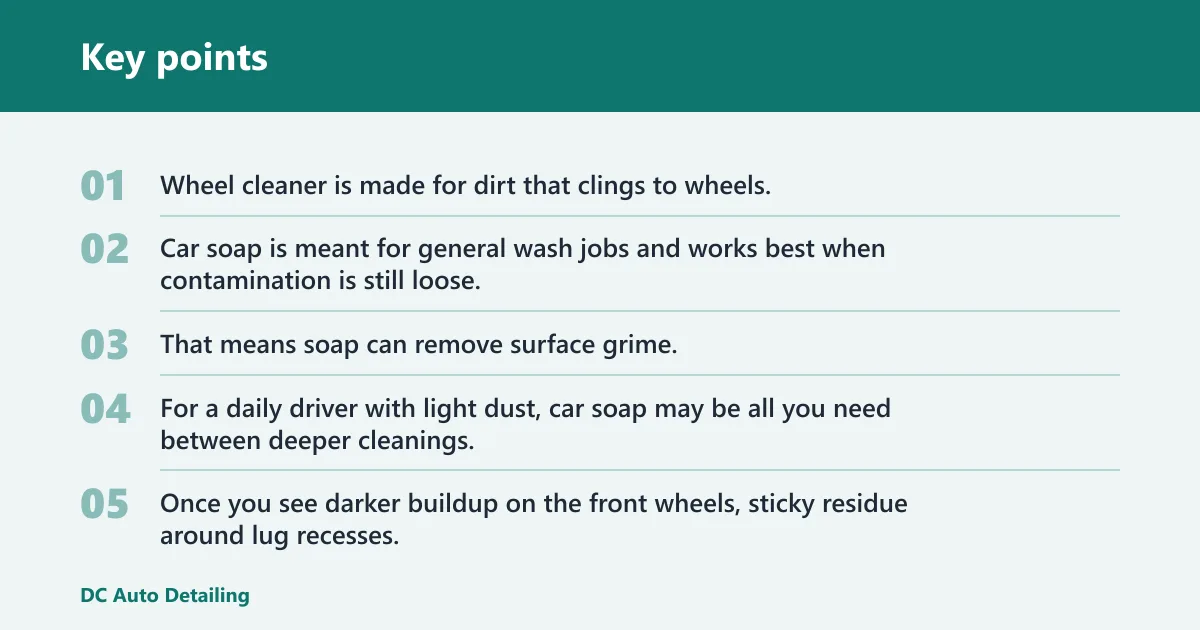
Wheel cleaner is made for dirt that clings to wheels, especially brake dust and embedded metal. Car soap is meant for general wash jobs and works best when contamination is still loose. That means soap can remove surface grime, but it usually has less dwell time and less targeted chemistry than a purpose-built wheel product.
Where the trade-off changes for daily drivers
For a daily driver with light dust, car soap may be all you need between deeper cleanings. Once you see darker buildup on the front wheels, sticky residue around lug recesses, or a brown-gray film that returns quickly, wheel cleaner becomes the better tool. The more the car is driven in rain, winter slush, or stop-and-go traffic, the faster that line is crossed.
Can car soap handle brake dust?
Car soap can handle light brake dust if it has not been baked on or packed into the finish. Once brake dust bonds to the wheel, soap alone often leaves behind a gray haze, especially on front wheels where brake wear is usually higher. Agitation helps, but it cannot turn mild wash chemistry into a dedicated brake-dust remover.
Why baked-on brake dust resists soap
Brake dust comes from pad and rotor wear particles. It is often metallic and highly adherent, which is why it sticks so well to spokes, barrels, and lug pockets. Fresh dust may lift with soap and a wheel brush. Older dust usually needs a cleaner that is made to loosen wheel grime before scrubbing starts.
What agitation can and cannot fix
A soft-bristle or wool-style wheel brush can reach tight areas that a wash mitt misses, and that alone improves results. But agitation only removes what the cleaner has already loosened. If the dust is bonded, the brush may just move grime around or force you to scrub harder than the finish should have to take.
Say your front wheels pick up a light gray film after a one-week commute and the spokes still feel smooth. A bucket of car soap, a soft wheel brush, and a careful rinse may be enough. If the wheel still shows brown specks after drying, that is usually a sign that soap left embedded material behind.
What wheel cleaner does better
Wheel cleaner is built to loosen the kinds of soil that ordinary car soap struggles with. Its chemistry is aimed at brake dust, road film, and metallic contamination, so it often breaks the bond faster and reduces the amount of scrubbing needed. That matters on dirty wheels and on finishes that should not be scrubbed aggressively.
Dwell time and chemistry made for wheel grime
Most wheel cleaners need a short dwell time so the product can sit on the contamination before agitation or rinsing. Leave it on too long and the risk rises, especially on sensitive finishes. Neutral cleaners are commonly marketed around pH 7, while acid and alkaline products sit at different points on the pH scale and can behave very differently on the same wheel.
Why dedicated cleaners often need less scrubbing
Because the chemistry does more of the work, a wheel cleaner can cut the amount of force you need on the brush. That is useful on barrels, around lug holes, and between spokes where grime builds fast. It is also useful when the wheel has a finish that does not like repeated hard scrubbing.
How to use it safely
- Rinse the wheel first to remove loose grit.
- Spray the cleaner evenly and follow the label for dwell time.
- Use a wheel brush or mitt to reach the barrel, spokes, and lug area.
- Do not let the product dry on the wheel.
- Rinse with plenty of clean water until no cleaner remains.
- Check a small hidden spot on older, polished, or delicate wheels before full use.
Suppose a set of front wheels has dark dust in the barrel after a few highway trips and a brake-heavy commute. Soap may lighten the surface, but a wheel cleaner can loosen the embedded film before the brush touches it, which shortens the job and reduces the need for forceful scrubbing.
Which wheel finishes need extra caution?
Wheel finish changes the risk level. Painted and clear-coated wheels usually tolerate more common cleaners than polished aluminum, chrome, or some bare-metal finishes, but none of them should be treated as universal. Ceramic-coated wheels still need product checks, because coating does not erase compatibility concerns or product dwell time.
Painted and clear-coated wheels
These are common on many modern cars and are usually the easiest place to start. A pH-neutral wheel cleaner is often the safer first choice, especially if you are unsure how the wheel was finished or maintained. Still, the label matters, and a hidden test spot is smart if the wheel is older or damaged.
Polished aluminum, chrome, and powder coat
Polished aluminum can react poorly to strong chemistry and overworking. Chrome often needs careful product choice and quick rinsing. Powder-coated wheels may tolerate more than polished metal, but they still deserve a product that matches the contamination level rather than the strongest option on the shelf.
Ceramic-coated wheels and label checks
Ceramic-coated wheels can make maintenance easier, but they are not a free pass for any cleaner. Check the wheel-cleaner label for compatibility with coated surfaces, then keep dwell time short and rinse promptly. If the wheel is only lightly dusty, soap may be the gentler first step.
When is wheel cleaner worth buying?
Wheel cleaner is worth buying when the contamination level moves past routine dust and the wheel finish needs more than plain wash chemistry. If your wheels stay clean between washes, soap may cover most jobs. If brake dust returns fast, feels bonded, or survives normal washing, a dedicated wheel cleaner earns its place.
Driving severity and front-wheel buildup
Front wheels often collect more brake dust because they do more braking work. Winter driving adds salt, slush, and road film. Performance cars with aggressive pads can build dust quickly even after short trips. In all three cases, the wheel grime often becomes too stubborn for soap-only washing.
Signs soap is no longer enough
- The wheel still looks gray after washing and rinsing.
- Brown or black specks remain in the barrel or around the lug area.
- Dust returns quickly, especially on the front wheels.
- The surface feels gritty or bonded instead of smooth.
- You need more scrubbing than the finish should reasonably take.
Cost per wash, in practical terms
| Routine | Typical product use | What it covers | Relative cost per wash |
|---|---|---|---|
| Soap only | One diluted wash solution | Light maintenance dust and fresh film | Lowest |
| Wheel cleaner only | Dedicated wheel product on dirty wheels | Brake dust and bonded grime | Moderate |
| Hybrid maintenance | Soap for routine washes, wheel cleaner only when needed | Low cost over time with stronger cleaning when buildup appears | Usually the best balance |
The hybrid routine often makes the most sense for DIY owners. You use car soap for quick maintenance washes, then switch to wheel cleaner only when the contamination level rises. That keeps product cost down without forcing soap to do a job it was not made to handle.
Wheel cleaner decision matrix
This matrix ties together wheel condition, finish type, and driving severity. The safest method is the one that matches all three, not just the dirtiest spot you see.
| Wheel condition | Finish type | Driving severity | Safest method |
|---|---|---|---|
| Light dust, smooth surface | Painted or clear-coated | Low | Car soap, soft wheel brush, rinse well |
| Light dust, smooth surface | Powder-coated or ceramic-coated | Low to moderate | Car soap first; wheel cleaner only if residue remains |
| Heavy brake dust, visible buildup | Painted or clear-coated | Moderate to high | Dedicated wheel cleaner, short dwell time, soft brush |
| Heavy brake dust, embedded specks | Chrome or polished aluminum | Moderate to high | Finish-safe wheel cleaner only if the label allows it; check a hidden spot first |
| Road film plus metallic contamination | Any finish with known sensitivity | Winter or performance use | Start with the mildest compatible wheel cleaner; do not let it dry |
| Repeated stubborn buildup | Clear-coated or coated wheel | High | Wheel cleaner plus a wheel brush; consider iron remover for ferrous contamination |
Best routine for daily, winter, and performance use
- Daily drivers: Soap often works between deeper cleanings if dust stays light.
- Winter driving: Use wheel cleaner more often because salt and road film stick with brake dust.
- Performance cars: Expect more front-wheel buildup and choose a cleaner matched to the finish.
Choose car soap if… / Choose wheel cleaner if…
Choose car soap if the wheels only have light maintenance dust, the finish is in good shape, and you are washing often enough that grime has not bonded. Choose wheel cleaner if brake dust is heavy, contamination is embedded, or the wheel needs chemistry that can do more work before you scrub.
Choose car soap if…
- The wheels were cleaned recently and only have fresh dust.
- The finish is painted, clear-coated, or coated and the grime is mild.
- You are doing a quick maintenance wash between deeper cleanings.
- The wheel surface still looks smooth after rinsing.
Choose wheel cleaner if…
- Brake dust is dark, sticky, or visibly bonded.
- The wheel has front-axle buildup that returns fast.
- You need less scrubbing because the finish should not be worked hard.
- The label says the product is compatible with your wheel finish and contamination level.
Choose iron remover or APC only when the job calls for it
An iron remover is more targeted than general soap for ferrous contamination, and many products show it by color change or odor as they react. An APC can help with mixed grime, but it must be diluted correctly and it can be too aggressive for some wheel finishes. Neither product is a universal substitute for the right wheel cleaner.
Frequently asked questions
Is wheel cleaner necessary or can I just use car soap?
Car soap is enough for light, routine wheel cleaning. Wheel cleaner becomes the better choice when brake dust is heavier, contamination is bonded, or the finish needs a product made for wheel grime. The decision depends on what is stuck to the wheel, not just how dirty it looks.
Can car wash soap clean brake dust off wheels?
It can remove light, fresh brake dust, especially with a soft wheel brush. It usually struggles with baked-on or metallic dust that has bonded to the surface. If the wheel still looks gray or gritty after washing, soap has likely hit its limit.
When do I need a dedicated wheel cleaner?
You need one when the grime is no longer just surface dust. Heavy brake dust, winter road film, stubborn front-wheel buildup, and neglected wheels are all common signs. A dedicated cleaner is also helpful when you want less scrubbing on a finish that should not be worked hard.
Will wheel cleaner damage painted or clear-coated wheels?
It can if the product is too strong, left on too long, or used outside the label instructions. Painted and clear-coated wheels often tolerate many finish-safe cleaners, but you still need to check compatibility, keep dwell time short, and rinse thoroughly. Check a hidden spot on older wheels before full use.
How often should I clean my wheels with wheel cleaner?
Use wheel cleaner as often as the contamination level calls for it, not on a fixed schedule. Many owners use soap for routine washes and wheel cleaner every few washes, after winter driving, or whenever brake dust stops responding to soap alone. Heavy brake dust may require it more often.
Can I use APC instead of wheel cleaner on wheels?
Sometimes, but only with the right dilution and only when the finish can handle it. APC is for mixed grime, not a dedicated wheel formula, and it can be too aggressive for some finishes. If you choose APC, treat it as a carefully diluted cleaner, not a default replacement.