Dual action polisher vs orbital sander: What’s different?
A dual action polisher uses a pad that spins and orbits to correct paint with less heat, while an orbital sander usually orbits for sanding and flattening, not paint correction. Using the wrong one can haze paint, remove too much clear coat, or leave sanding marks. This guide compares motion, pad and abrasive choices, and the narrow overlap where one can mimic the other.
| Decision factor | Dual action polisher | orbital sander | Winner |
|---|---|---|---|
| Primary job | Paint-safe correction and finishing on car paint and clear coat | Sanding, flattening, and surface prep on wood, metal, filler, or paint | Dual action polisher |
| Motion | Random orbital motion with spinning and circular movement | Standard orbital motion or random orbital motion for sanding | Dual action polisher |
| Risk on clear coat | Lower risk of swirls and holograms when matched with the right pad and polish | Higher risk of marring, heat, and edge damage if used like a correction tool | Dual action polisher |
| Material removal | Light correction only | Designed to remove material | orbital sander |
| Best overlap use | Soft finishing pad with controlled speed | Soft polishing pad for very light finishing only | Dual action polisher |
Motion difference and primary job
The difference is simple. One tool corrects paint. The other removes and levels material. A dual action polisher is a random orbital machine with a dual motion path, while an orbital sander is built for sanding work first and finish work second.
Dual action polisher
A dual action polisher combines spinning and circular motion, and that dual motion helps reduce visible swirls and holograms compared with more aggressive rotary action. Typical paint-correction setups use a backing plate around 5-inch or 6-inch, and orbit throw is often listed in a single-digit millimeter range on some machines.
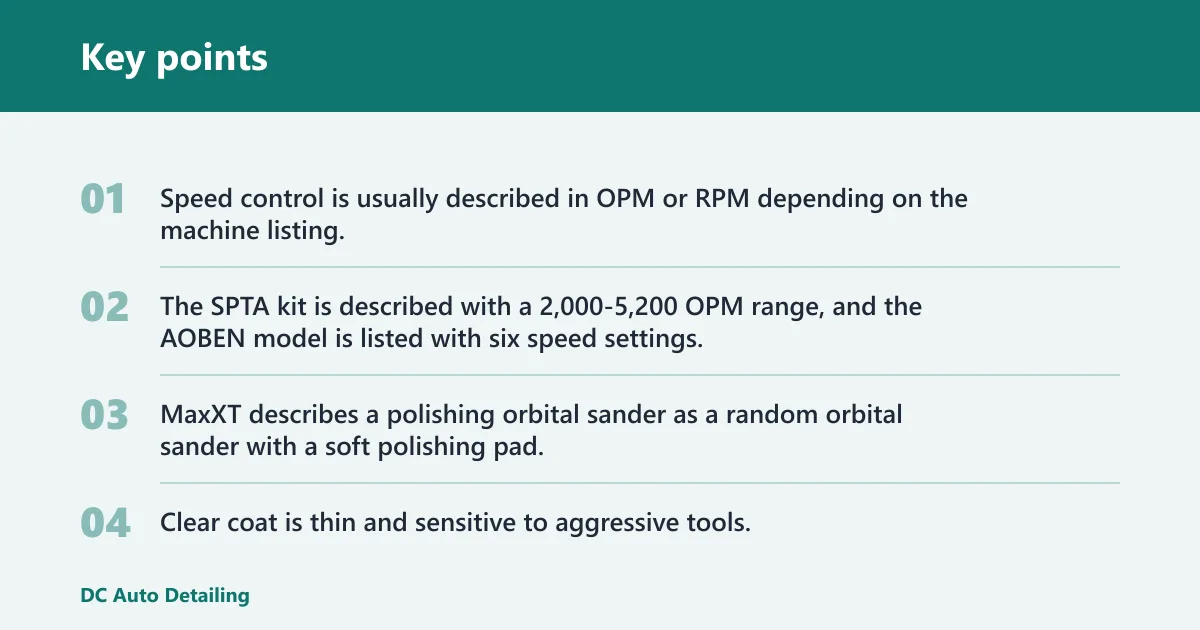
Speed control is usually described in OPM or RPM depending on the machine listing. The SPTA kit is described with a 2,000-5,200 OPM range, and the AOBEN model is listed with six speed settings. Those numbers by themselves do not define safe paint correction; pad choice, polish, pressure, panel temperature, and how the machine behaves on the paint matter just as much.
Orbital sander
An orbital sander is made for sanding. Standard orbital sanders move in fixed circles, while random orbital sanders combine circular motion with spinning movement, and some descriptions also note back-and-forth motion. That movement helps during sanding, but it does not make the tool a paint-correction machine by default.
MaxXT describes a polishing orbital sander as a random orbital sander with a soft polishing pad. That shows the narrow overlap between the two categories. Even there, the tool is still a sander adapted for very light finishing, not a dedicated polisher taking on full correction.
Why motion matters on clear coat
Clear coat is thin and sensitive to aggressive tools. A tool that levels material faster can also create heat, leave sanding marks, or cut through at edges and body lines if the pad, abrasive, or pressure is wrong.
Random orbital motion can help reduce heat buildup and swirls, but pad choice, compound, pressure, stall behavior, and panel temperature matter just as much. That is why a dual action polisher is the safer correction tool on finished paint, while an orbital sander belongs to prep and refinement work.
Can you use an orbital sander to polish car paint?
An orbital sander with a soft polishing pad can sometimes handle very light finishing on already-corrected paint, but it is not a substitute for a dual action polisher when you need swirl removal, oxidation removal, or broader clear coat correction.
Where the overlap is real
The overlap appears when the task is light and the pad is soft. A polishing pad on a random orbital sander can help remove faint haze, clean up light residue, or refresh gloss on a forgiving panel.
That overlap ends quickly if the finish has deeper defects. Once you need consistent correction across a hood, door, or roof, the sanding machine’s pad and motion are less predictable than a polisher built for paint.
Where it falls short
An orbital sander is limited by pad behavior, dust extraction demands, and the way it loads abrasives. A pad that clogs or a tool that runs too hot can leave visible marring, especially on soft clear coat.
Curved panels, sharp edges, and trim lines are the biggest trouble spots. The same pad that feels controllable on a flat panel can dig in at a crease or burn through thin clear coat at the edge.
Common failure cases
- Start with the least aggressive pad. Use a soft polishing pad only, and keep the abrasive light. If the finish still needs real correction, switch to a dual action polisher rather than pushing the sander harder.
- Keep pressure low. Heavy hand pressure raises heat and makes marring more likely. Let the pad skim the surface instead of forcing cut.
- Watch panel shape. Avoid edges, body lines, and thin spots unless the goal is only a quick finish pass. Flat panels tolerate this overlap better than curved sections.
If a fender already has clean paint but a soft haze after washing, a soft polishing pad on a random orbital sander may improve gloss. If the same fender has etched swirls and oxidation, that is the point where a dual action polisher is the correct tool.
Can this tool do the job?
| Task type | Tool | Pad type | Risk level | Appropriate? | Notes |
|---|---|---|---|---|---|
| Light polish | Dual action polisher | Soft polishing pad | Low | Yes | Best for gloss cleanup and light finishing on clear coat. |
| Swirl removal | Dual action polisher | Polishing pad, then finish pad if needed | Low to medium | Yes | Random orbital motion helps reduce new swirls while correcting. |
| Oxidation | Dual action polisher | Light cutting pad or polishing pad | Medium | Yes | Use the mildest pad that clears the haze; inspect often. |
| Sanding prep | orbital sander | Abrasive sanding disc | Medium to high | Yes | That is its main job for wood, filler, metal, and refinish prep. |
| Edge work | Dual action polisher | Small soft pad | Medium | Sometimes | Use caution. A sander is easier to miscue on body lines and corners. |
| Fresh paint | orbital sander | Very fine abrasive or soft finishing pad | Medium | Sometimes | Only for controlled prep or very light finishing, not final correction. |
| Clear coat correction | Dual action polisher | Polishing pad | Low to medium | Yes | Safer for paint-safe correction and less likely to leave visible defects. |
How do pad, plate, and speed numbers change the result?
Pad and plate size, plus speed numbers, decide whether a tool finishes gently or cuts too hard. A 5-inch backing plate usually gives more edge control, while a 6-inch plate can cover more area per pass but may be less nimble on curved panels.
Backing plate size
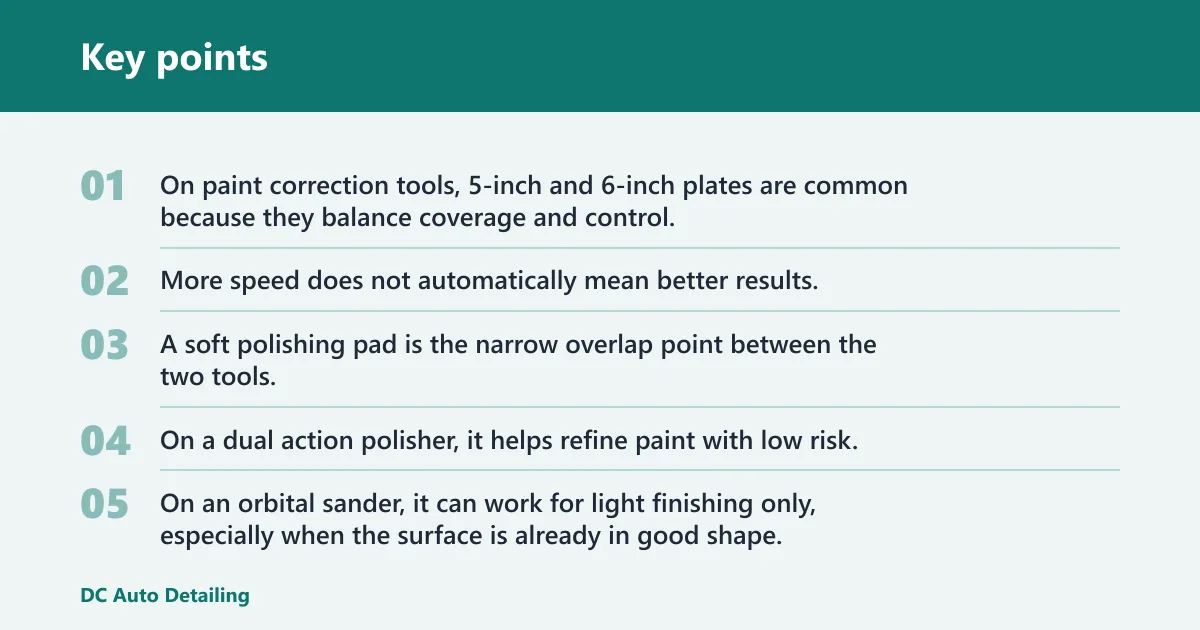
Backing plates support the pad. On paint correction tools, 5-inch and 6-inch plates are common because they balance coverage and control. Smaller setups track body lines better; larger setups cover more panel area and can feel smoother on broad flat surfaces.
That trade-off matters on bumpers, mirrors, and fenders. A larger plate can bridge curves and make edge work harder, while a smaller plate usually gives better control around trim and tighter sections.
OPM, RPM, and orbit throw
OPM means oscillations per minute. RPM means revolutions per minute. Orbit throw is the distance the pad travels in its orbit, and a larger throw can increase correction potential and cutting action if the pad and polish are matched correctly.
That is why a machine listed with about 2,000-5,200 OPM can still be gentle or aggressive depending on pad choice and pressure. More speed does not automatically mean better results. It can also mean more heat and more risk on clear coat.
Soft pad choices for light finishing
A soft polishing pad is the narrow overlap point between the two tools. On a dual action polisher, it helps refine paint with low risk. On an orbital sander, it can work for light finishing only, especially when the surface is already in good shape.
A common first-timer mistake is pairing a coarse abrasive with a soft pad and expecting a finish result. That combination can leave marring or pad loading instead of gloss.
Where each tool fits besides car paint
Both tools can work on other materials, but for different reasons. The orbital sander belongs in sanding prep, surface leveling, and material removal, while the dual action polisher is mainly a finishing tool for surfaces that need controlled correction rather than flattening.
Wood and metal tasks
orbital sander is the stronger choice for wood sanding, primer prep, and metal cleanup because it is designed to remove material. Its motion pattern is suited to flattening and refining a surface before the next finish stage.
Dual action polisher can be used on some coated surfaces or gloss work, but it is not the first choice for shaping raw wood or leveling metal. That job belongs to the sanding tool.
Fresh paint and body prep
Fresh paint is a special case. If the finish is still being leveled or prepped, a sanding tool can be correct. If the goal is final gloss and defect cleanup on cured clear coat, a dual action polisher is the better fit.
Do not treat fresh paint and cured clear coat the same way. The wrong abrasive step can leave sanding trails that are visible under light for a long time.
Curved panels, edges, and trim
Curved panels need more control than broad flat panels. The dual action polisher generally handles this better because its motion reduces the chance of a hard-cut edge catching and leaving a visible mark.
orbital sander can become unsafe or ineffective on these areas if the pad loads up, the user leans on the tool, or the pad rides the edge. The risk rises fast on thin clear coat and sharp body lines.
Is a dual action polisher safer on clear coat?
Yes. A dual action polisher is generally safer on clear coat because its random orbital motion can reduce the chance of swirls, holograms, and concentrated heat. That does not make it risk-free, but it is built for paint-safe correction in a way an orbital sander is not.
Swirl and hologram reduction
The dual motion path matters. Spinning plus orbiting spreads work across the pad face, which helps reduce visible trail marks and keeps the correction pattern more even. That is the main reason these tools are used on automotive clear coat.
Random orbital motion can make finishing behavior more forgiving, but pad choice, compound, pressure, stall behavior, and panel temperature still determine how safe the process is. The motion alone does not guarantee a good finish.
Burn-through risk on thin clear coat
Burn-through is still possible. Thin clear coat, sharp edges, and too much pressure are the main problems, and a faster or more aggressive setup makes those problems show sooner.
Using a sander for correction increases that risk because the tool is built to remove material. If the goal is visible correction on a painted panel, the safer route is the dual action polisher with a mild pad first.
How abrasive choice changes risk
The pad and abrasive matter as much as the machine. A soft polishing pad with a finishing polish can clean up light defects with low risk. A harder pad or coarse abrasive raises cut, heat, and the chance of haze.
That is why product descriptions matter. A kit like the Chemical Guys TORQX 13-piece bundle or a machine with six speed settings is still only as safe as the pad and process you put on it.
Choose Dual action polisher if… / Choose orbital sander if…
Choose Dual action polisher if you need swirl removal, oxidation cleanup, light to moderate clear coat correction, or final finishing on paint. It is the better fit for curved body panels, edges that need caution, and any job where the goal is to improve gloss without making the surface flatter.
Choose orbital sander if the task is sanding prep, material removal, or flattening a surface before paint or filler work. It only overlaps with polishing when you use a soft polishing pad for very light finishing on already-safe paint.
- Match the job first. If the panel needs correction, start with the polisher. If the surface needs leveling, start with the sander.
- Match the motion second. Random orbital motion is the safer paint-finishing path. Fixed-circle sanding motion is for prep, not correction.
- Match the pad last. Use a soft pad for light finishing and a more aggressive setup only when the defect actually requires it.
Frequently asked questions
What is the difference between a dual action polisher and an orbital sander?
A dual action polisher is built for paint-safe correction with random orbital motion, so it can reduce swirls and improve gloss on clear coat. An orbital sander is built for sanding and flattening. It can overlap with polishing only when fitted with a soft pad for very light finishing.
Is a dual action polisher safer than a sander on clear coat?
Yes. A dual action polisher is generally safer because its spinning-and-orbiting motion reduces the chance of visible swirls, holograms, and excessive heat. A sander can be safe only when used very lightly and with the right pad, but it is easier to misuse on thin clear coat.
What motion does a dual action polisher use?
It uses a dual motion path: the pad spins while also orbiting. That random orbital motion spreads the work across the pad face and helps keep the finish more even. Some product listings describe this as spinning and circular motion, which is the same basic idea.
When would you use a random orbital sander instead of a polisher?
Use the sander for sanding prep, surface flattening, and material removal on wood, metal, filler, or other non-paint tasks. It can also handle light finishing with a soft pad, but only when the surface is already close to ready and the goal is mild cleanup rather than correction.
Can a polishing pad on an orbital sander work for light correction?
Yes, but only for very light finishing, not full correction. A soft polishing pad can clean up faint haze or improve gloss, yet it will not replace a dual action polisher for swirl removal, oxidation removal, or reliable clear coat correction across an entire panel.
What surfaces can each tool be used on besides car paint?
An orbital sander is the better choice for wood, metal, filler, and other prep surfaces where material removal matters. A dual action polisher fits coated or finished surfaces that need controlled gloss work. Their overlap is small, and the task should decide the tool.
How do you avoid swirl marks or scratches when choosing between them?
Choose the dual action polisher for paint correction, use the softest effective pad, and keep speed and pressure moderate. Avoid aggressive abrasives on thin clear coat, stay off edges when possible, and use the sander only for sanding tasks or very light finishing where its motion will not cut too hard.