What to ask your installer about ceramic coating maintenance
Ask for the coating’s cure window, approved wash products, warranty terms, and written proof before you leave; if the shop cannot give those details in writing, treat the handoff as incomplete. Skipping those questions can lead to early washing damage, warranty disputes, and staining that could have been avoided. This checklist tells you exactly what to ask, what proof to collect, and what to document on pickup day.
Ceramic coating checklist table
| Question | Installer answer | Surface it applies to | Required proof to collect | Warranty-critical? |
|---|---|---|---|---|
| What is the exact cure window for this coating? | Paint, glass, wheels, trim | Written handover sheet with product name and cure notes | Yes | |
| When can I wash the car for the first time? | Paint and all coated exterior surfaces | First-wash restriction in writing | Yes | |
| Which shampoo is approved for this coating? | Paint, glass, wheels, trim | Product name and dilution guidance, if any | Yes | |
| Which drying towels are approved? | Paint and glass first, then trim and wheels | Approved towel type or brand list | Usually | |
| Can I use a topper or maintenance spray, and which one? | Paint, glass, trim if listed | Compatibility note for the exact coating system | Often | |
| What should I use for bird droppings or road film? | Paint and glass | Approved spot remover name and method | Yes | |
| How often should I wash the car? | Whole vehicle | Maintenance interval in writing | Yes | |
| How often should I inspect the coating? | Whole vehicle | Inspection interval and who performs it | Yes | |
| Do I need an annual inspection or service visit? | Whole vehicle | Annual check requirement and deadline | Yes | |
| Is the warranty registered to my VIN? | Warranty record, not a surface | Registration confirmation with VIN | Yes | |
| Is the warranty manufacturer-backed or shop-only? | Warranty record | Copy of the warranty terms | Yes | |
| Can the warranty transfer to a later owner? | Warranty record | Transfer rules in writing | Yes |
Print this checklist before pickup and use it as a proof sheet, not just a reminder. Leave with the install date, the exact products used on each surface, the first-wash limit, the cure notes for weather-sensitive products, and any follow-up inspection date. CeramicCoating.com’s guidance on cure timing, surface-specific care, and warranty paperwork is useful here: https://ceramiccoating.com/ceramic-coating-aftercare/
What should you get in writing before you leave?
Get a written handover sheet that names the coating, the install date, the cure window, the first wash rule, and the exact products approved for each coated surface. Also get warranty proof tied to your VIN, plus any transfer rule and maintenance record requirement. Oral instructions are easy to forget, and hard to prove later.
Aftercare sheet details to verify
Ask for a sheet that lists the coating product on paint, glass, wheels, and trim separately if different products were used. CeramicCoating.com’s aftercare guidance says cure time and approved care can vary by product, so the sheet should not rely on one blanket number if the installer used multiple systems. The document should also state what counts as contamination during the cure window: https://ceramiccoating.com/ceramic-coating-aftercare/
Confirm whether the install was completed in a climate-controlled bay. Aristocrat’s install guidance says a serious ceramic install should happen in a climate-controlled bay, and that the installer should discuss maintenance recommendations and follow-up inspections: https://aristocratdetailing.com/ceramic-coating-installation/ That does not tell you how to maintain the car, but it does tell you what a serious handoff should include.
Warranty registration and transfer proof
Ask whether the warranty is manufacturer-backed or shop-only. Ask for a registration confirmation that shows the VIN, the coverage term, and whether the warranty transfers to a later owner. Envy Executive says warranties may require maintenance records as proof, so collect the registration number, the stated recordkeeping rule, and the exact maintenance interval that keeps coverage active: https://www.envyexecutive.com/ceramic-coating-warranty/
Surface-by-surface product list
Do not assume the same coating system was used everywhere. CeramicCoating.com says each surface can have its own cure time, cleaners and warranty rules, which matters if the installer used one product on paint and another on wheels or trim. Ask for the exact product names for each surface and the approved cleaner for each one: https://ceramiccoating.com/ceramic-coating-aftercare/
Confirm the install date. Write it down exactly as it appears on the invoice and handover sheet. That date anchors the cure window, the first wash limit, and any warranty clock tied to registration.
Collect the product list. Ask for each coating name, each approved shampoo, any topper or maintenance spray, and the approved spot remover. If the shop used more than one coating system, label each one by surface.
Save the warranty proof. Get the VIN registration confirmation, the warranty type, and the transfer rule. Keep a photo or PDF before you leave the parking lot.
How long should you wait before the first wash?
There is no universal waiting period. The safe answer depends on the coating product, the weather, and the surface being coated, so you need the installer’s written cure rule before you touch the car with wash mitts or chemicals. Ask what to do if contamination lands on the coating during the cure window, not after it becomes a problem.
Cure window cautions
Cure time changes with product and weather, and CeramicCoating.com says different surfaces can have different cure rules. That means paint may have one instruction, while glass or wheels may have another. If the shop gives only a broad phrase like “wait a few days,” ask for the exact rule by surface and ask whether humidity, rain, or cold weather changes it: https://ceramiccoating.com/ceramic-coating-aftercare/
Suppose a bird dropping lands on the hood the day after pickup. If the coating is still within its cure window, you need the installer’s approved cleanup method, not a generic detail spray guess. The wrong wipe or chemical can leave a mark that was avoidable.
When to schedule the first inspection
Ask whether the installer wants to inspect the coating after the first wash. That inspection can reveal spotting, roughness, or a missed high spot before those issues become harder to correct. Auto Film Guys lists a free maintenance wash two weeks after installation in its Gold package, which is a useful example of how some shops build follow-up into the handoff: https://autofilmguy.com/ceramic-coating-care/
Which products are approved for your car?
Ask for exact product names, not just product categories. A coating-safe shampoo is not enough if the shop also wants a specific topper, a specific spot remover, or a towel type that matches the coating system. If the car has multiple coating types, confirm compatibility for each one before buying anything.
Shampoo and wash media
Use the shampoo the installer approves, even if it is simply a coating-safe or pH-neutral formula. The point is verification, not guesswork. Ask whether the shampoo is approved for paint only or for paint, glass, wheels, and trim, because different surfaces can have different cleaner rules.
Drying towels and drying aids
Ask which microfiber towels are approved for the finish. You also need to know whether a drying aid is allowed, because some installers want towels only while others approve a compatible spray. Dry the car promptly to avoid water spots, but do it with the towel type the shop names.
Topper or maintenance spray
Do you need a maintenance spray for your ceramic coating? Sometimes yes, sometimes no. Ask whether the installer wants one and whether it is required for warranty maintenance or only optional for extra slickness. The answer should name the exact product and say which surfaces it can touch.
Spot remover for bird droppings and road film
Ask which spot remover is safe for bird droppings, bug residue, and road film. Also ask how soon to use it, since contamination during the cure window may need a different response than contamination after full cure. Keep the product name on the aftercare sheet, not just in a sales pitch.
List every approved product. Shampoo, towels, topper, spot remover, and drying aid all belong on one sheet. If the installer cannot name a product, treat that item as unapproved until you get clarification.
Match products to surfaces. Confirm whether each product is safe on paint, glass, wheels, and trim. Surface-specific rules matter because one coating system may allow a spray on paint but not on matte trim.
Mark the restrictions. Write down what to avoid, including harsh cleaners, abrasive towels, and any product the warranty excludes. Keep the list with the invoice.
How do warranty rules usually work?
Warranty terms usually split into two buckets: manufacturer-backed coverage and shop-only promises. You need to know which one you have, what maintenance records the warranty expects, whether the VIN is registered, and which exclusions can void coverage. Some programs say improper maintenance can void ceramic coating warranties, and automatic car washes can affect coverage in some cases.
Manufacturer-backed vs shop-only coverage
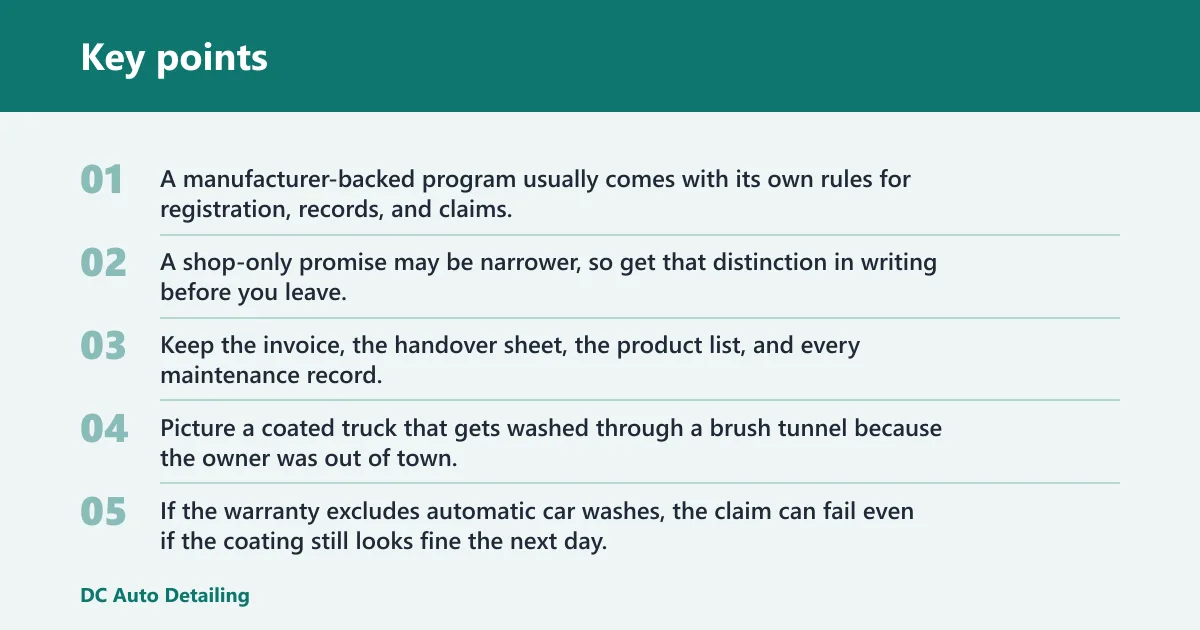
Ask who actually stands behind the warranty. A manufacturer-backed program usually comes with its own rules for registration, records, and claims. A shop-only promise may be narrower, so get that distinction in writing before you leave.
What records the warranty may require
Keep the invoice, the handover sheet, the product list, and every maintenance record. The same source says warranties may require maintenance records as proof, so photograph the documents and store digital copies. If the warranty requires annual inspection, note the due date on your calendar now: https://www.envyexecutive.com/ceramic-coating-warranty/
Common exclusions to confirm
Ask directly about automatic car washes, harsh chemicals, physical damage, improper maintenance, and environmental staining. Those are common exclusion areas, and some programs treat brush washes as coverage killers. Ask what evidence the shop wants if a claim comes up later, since a missing record can be as damaging as the wrong wash cycle.
Picture a coated truck that gets washed through a brush tunnel because the owner was out of town. If the warranty excludes automatic car washes, the claim can fail even if the coating still looks fine the next day. That is why the exclusion list belongs on paper before pickup, not in memory.
What maintenance schedule should you follow?
Follow the installer’s schedule for wash timing, inspection cadence, and annual checks. The point is not to guess a “normal” routine; the point is to match the product and warranty terms you were given. If the warranty expects records, every service interval should be easy to prove later.
Wash interval
Ask how often the car should be washed, and whether that timing changes with local weather, road salt, or parking conditions. The shop may want a fixed schedule or a condition-based one. Either way, write down the interval and the approved shampoo together.
Inspection interval
Ask when the coating should be checked for spotting, roughness, or weaker beading. A scheduled inspection can catch contamination or wear before it turns into a warranty question. If the installer recommends a first inspection after the first wash, put that date on the handover sheet.
Annual check and recordkeeping
Many programs commonly want some form of annual inspection or service record. Ask whether that check must be done by the original installer or by any approved shop. Keep a folder with wash dates, inspection notes, product receipts, and any warranty communication.
- Track wash dates. Record each wash on the same day it happens. This helps prove the car was maintained on schedule.
- Save inspection notes. Keep any note that mentions beading, spotting, roughness, or correction work.
- Retain product receipts. Store proof for shampoo, topper, and spot remover purchases if the warranty asks for it.
Which signs should you watch after pickup?
Watch for water spots, roughness, weaker beading, high spots, and lifting film. Those signs can mean the coating was contaminated during cure, maintained with the wrong product, or applied unevenly on one surface. If the behavior changes after a wash, ask for a follow-up inspection while the issue is still small.
Water spots and roughness
Water spots often point to slow drying, hard water, or contamination during cure. Roughness under a clean hand or microfiber can mean bonded residue on the coating. Ask the installer which spot remover is approved before you rub at the surface with a random chemical.
Weaker beading
Weaker beading does not automatically mean failure, but it is a reason to inspect the surface. It can come from film buildup, poor maintenance, or environmental contamination. If beading changes after the first wash, document the date, the shampoo used, and the panels affected.
High spots or lifting film
High spots can show up as dark patches, streaks, or uneven gloss. Lifting film is more serious and needs prompt attention from the installer. If you notice either one, stop using random toppers or cleaners on that area until the shop gives a repair plan.
Frequently asked questions
What should I ask my ceramic coating installer before I leave?
Ask for the cure window, the first wash limit, approved products, warranty registration, and the exact maintenance schedule. Also ask for a written aftercare sheet that lists the install date, the coated surfaces, and any follow-up inspection date. If those details are missing, the handoff is incomplete.
What maintenance instructions should I get in writing for ceramic coating?
You should get the install date, cure guidance by surface, first-wash restrictions, approved shampoo, approved towels, topper rules, spot remover guidance, and inspection timing. CeramicCoating.com says each surface can have its own cure time, cleaners and warranty rules, so the sheet should not be vague: https://ceramiccoating.com/ceramic-coating-aftercare/
How long should I wait before washing a newly coated car?
Ask the installer, because cure time varies by product and weather. There is no universal waiting period that fits every coating. The correct answer should be written on the handover sheet and should also explain what to do if contamination lands on the car during cure.
What products are safe to use on a ceramic coated car?
Use the exact shampoo, towel type, topper, and spot remover the installer approves. A coating-safe or pH-neutral product is a starting point, not the finish line. Ask for product names and surface compatibility so you do not assume one item works everywhere.
What maintenance steps can void a ceramic coating warranty?
Common warranty problems include automatic car washes, harsh chemicals, physical damage, and poor maintenance records. The same source says improper maintenance can void ceramic coating warranties and that automatic car washes can eliminate coverage in some programs. Ask the shop to name every exclusion before you sign: https://www.envyexecutive.com/ceramic-coating-warranty/
Should my installer inspect the coating after the first wash?
Yes, if the shop offers or requires it. A first-wash inspection can catch water spots, roughness, or missed high spots while the issue is still manageable. Ask for the inspection date in writing and keep the result with your warranty records.
What should I do if bird droppings land on the coating while it cures?
Ask the installer for the approved emergency cleanup method before you leave. During the cure window, the wrong wipe or cleaner can cause staining or disturb the coating, especially if the product is still sensitive to weather. Do not improvise with an unknown chemical.
How often should I maintain a ceramic coated car to keep the warranty valid?
Follow the installer’s schedule for washing, inspection, and annual checks. The exact interval depends on the coating and the warranty program, and Envy Executive notes that maintenance records may be required as proof. Keep every service date and product receipt in one file: https://www.envyexecutive.com/ceramic-coating-warranty/